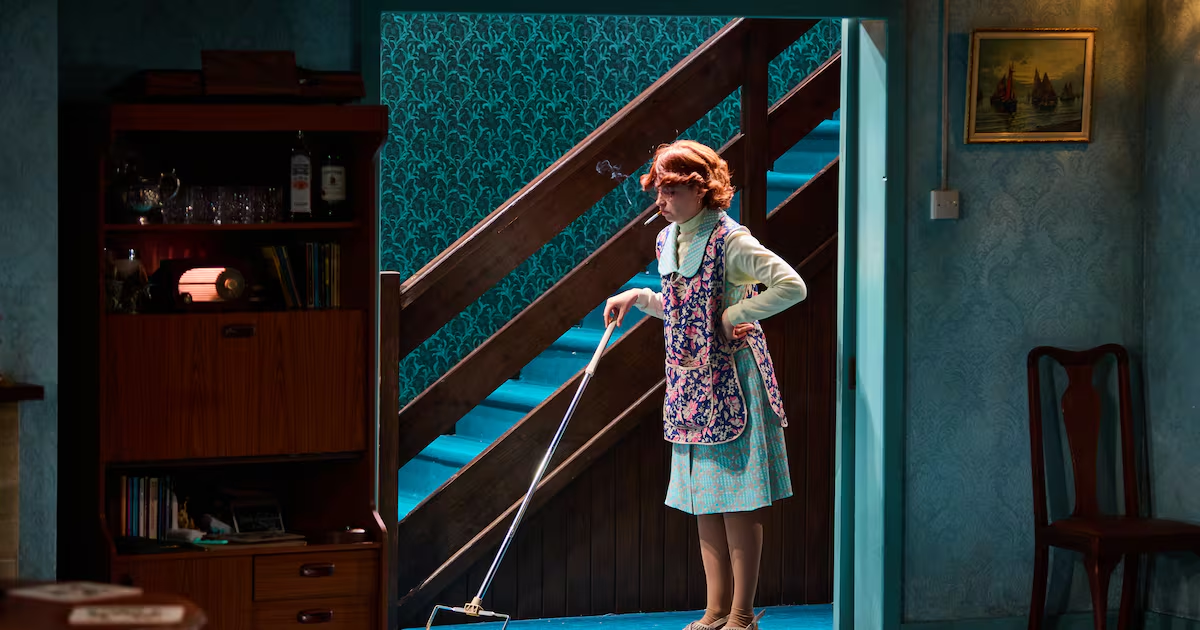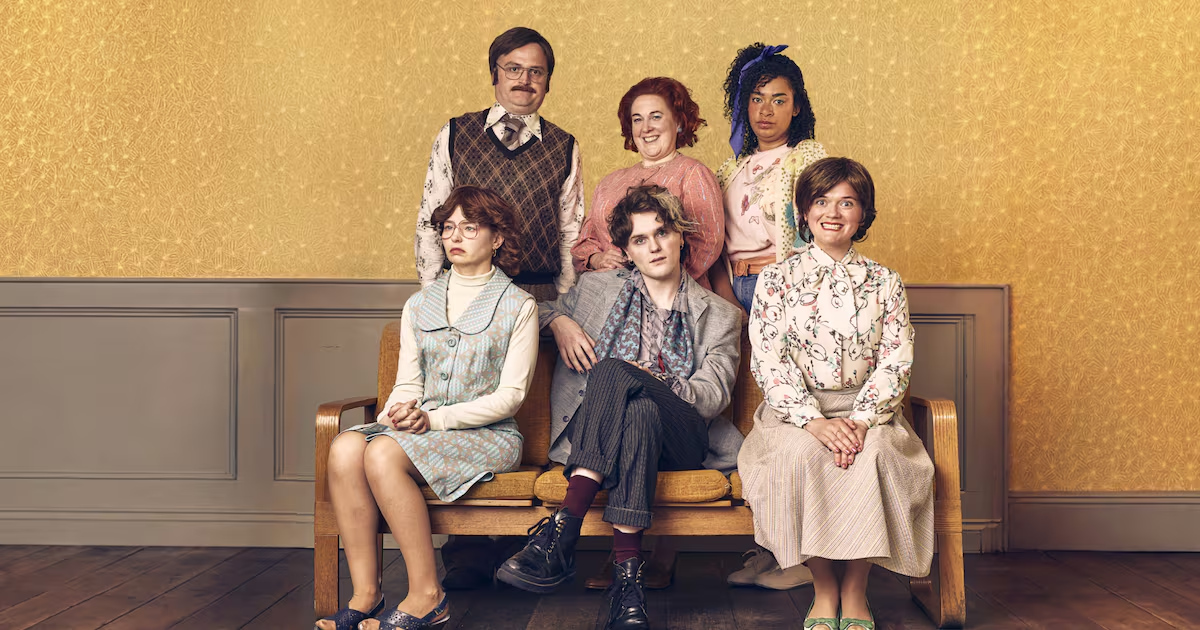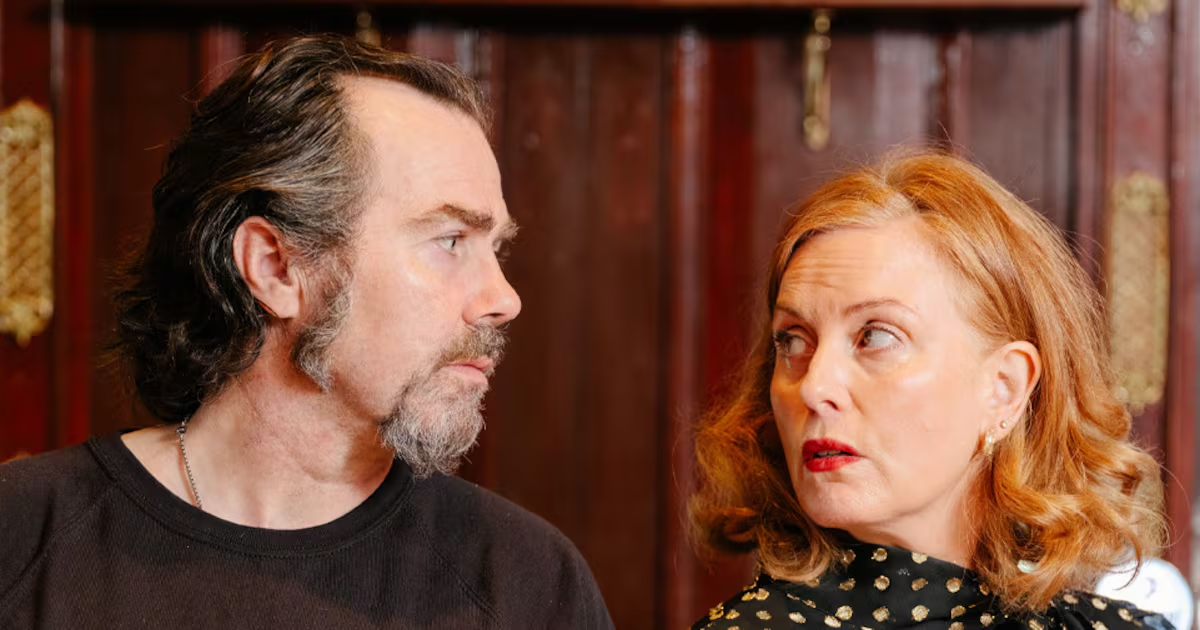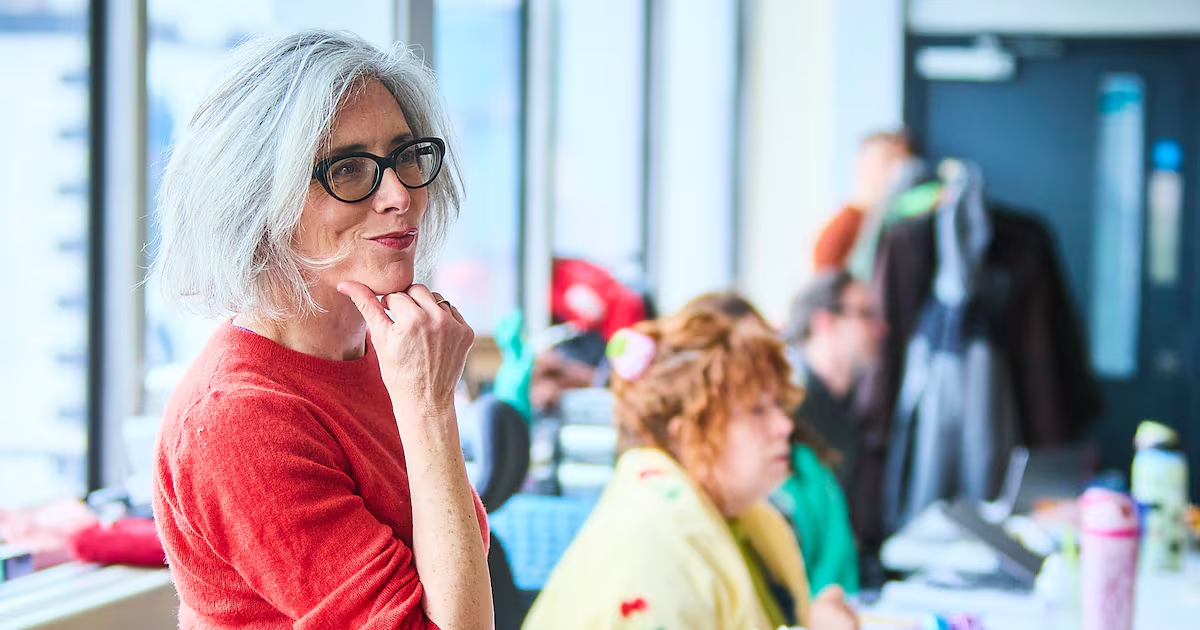
“One of the first problems I had with the play,” Annie Ryan says, “was that it ends so badly for the girls.” She’s talking about The Whiteheaded Boy, by Lennox Robinson, which was first performed at the Abbey in 1916, and which she is directing as the national theatre’s big summer production.It’s a comedy about a family who pin all their hopes on the mother’s favourite son, the charming but useless Denis. They spend all their savings sending him to study medicine at Trinity College Dublin, where he gambles, drifts and fritters his opportunities away while his more deserving siblings are left to live increasingly narrow lives. The play opens with news that Denis has once again failed his exams, setting in motion an intricate web of schemes.The Whiteheaded Boy may be brilliant, but it’s also incredibly dated. The sisters are trapped: they can’t leave home unless they find husbands; they have no work or independence; and the eldest daughter, Kate, has effectively been ignored because the family can’t afford to marry her off. Ryan, who is warm and funny – and brushing leaves from a nearby park out of her hair – when we sit down to talk on a breezy Dublin day, wanted to make the play more familiar. So she decided to set it at the start of the 1980s – “not actually that long ago” – which makes the play’s misogyny feel recognisable rather than historical. The director, who rose to prominence as founder of Corn Exchange, the admired Irish theatre company, points out that women had very few choices until recently: the country was impoverished, emigration was rampant and the Catholic Church was at the height of its power. If you even looked at a boy the wrong way, she says, you could be sent to the Magdalene laundries forever. “We’re still wrenching ourselves out of that patriarchal mould.”Growing up in the United States, she believed feminism had already solved most of these problems. “I thought the battle was fought in the 1970s, and now we’re all equal, grand.” It wasn’t until much later, she says, that she realised how often she had been dismissed as she navigated Irish theatre as a young female director.“I just didn’t look like a leader to the men in charge,” she says. “I came all guns blazing. This bolshie little Yank going, ‘Let’s do it like this.’ I didn’t know Ireland, so I didn’t know that that was the least cool thing you could do.”Now, she says, she is trying not to be cool at all.[ 2026 on stage: Twenty headline playsOpens in new window ]She gestures towards the set, with its furniture, props and cluttered domestic realism. “There’s probably a version somebody could do with no set and poured concrete,” she says. “Something that looks like it’s set in Berlin. But I wanted to lean into the comedy. I kind of wanted it to be ugly.”The play is full of boiled eggs, empty whiskey bottles and slapstick comedy.The Whitehead Boy by Lennox Robinson, directed by Annie Ryan, at the Abbey Theatre from dates in June to July 2026 “It’s basically like a sitcom,” Ryan says. “Like Succession, weirdly. Everybody wants money and power, but there’s no money, so all they have is what the neighbours think. The play wants to be staccato. Fast. Percussive.”For many, The Whiteheaded Boy carries another shadow. In 1997, Barabbas, the theatre company founded by Veronica Coburn, Raymond Keane and Mikel Murfi, staged a landmark production that became almost mythic within Irish theatre circles. Ryan remembers it vividly.“I thought, I can’t do it, Caitríona, because Barabbas has done it already,” she says, referring to the Abbey’s artistic director, Caitríona McLaughlin, who invited her to direct the revival. “And Barabbas did such an important, iconic production of this piece.”McLaughlin’s response was simple: “Yeah, but it was 30 years ago.”Annie Ryan in rehearsals at the Abbey Theatre for The Whiteheaded Boy by Lennox Robinson. Image credit: Pato Cassinoni “So I said, ‘Okay, great’.”To understand Ryan’s approach to theatre is to begin in Chicago, where she grew up immersed in the famous Piven Theatre Workshop, an influential youth theatre founded by Byrne and Joyce Piven. The training was rigorous.“We were in the empty space,” she says. “We could be in a car or we could be anywhere we want as long as everyone agrees to go there. It was very different to the New York schools or method-acting schools,” she says. “It was all about transformation.”By the late 1980s, Chicago’s theatre scene had begun spilling into film and television. Ryan became involved with New Crime, a furious, politically charged company rooted loosely in commedia dell’arte and driven by anti-establishment energy.“It was all about ‘F**k the president,’ who was [George HW] Bush at the time,” she says. “We were all really privileged white kids. It was incredibly male, really full-on, very yang energy.”In 1989, she came to Trinity for a year abroad and encountered a generation of young Irish artists who would later become noted cultural figures: the writer Michael West, whom she later married; the director Lenny Abrahamson; the actor Dominic West; and Gemma Bodinetz, who is now the head of the Lir, the national academy of dramatic art.Back in the day, it felt like you could see a play where no one moved their arms for the whole time— Annie Ryan“It was a very exciting time,” Ryan says. “The job of 20-year-olds is to kick down the door and say ‘F**k you’ to the old ones and start again.”What struck her immediately was the appetite among young Irish performers for physical theatre. “I noticed this was a very literary tradition,” she says. “Back in the day, it felt like you could see a play where no one moved their arms for the whole time.”Corn Exchange emerged from that climate: a company dedicated to ensemble-based creation and physical storytelling.Her rehearsals always begin with yoga. “What I try to do is create an atmosphere of safety and nurture,” she says. “Bring people really deep inside themselves and into the body. Because our material is the body.”Ryan recently trained as an intimacy co-ordinator, partly, she says, as “a side hustle” because of how difficult it has become to survive financially in theatre. But the training unexpectedly aligned with her approach to directing.“It’s all about safety and agreement,” she says. “It’s about relaxing and stepping into something collective. I almost wonder if the creative impulse that we cherish and feel is ‘my creative impulse’, or maybe it’s just ‘the creative impulse’. Like a river everybody has access to.”There are lots of nerves among actors. But one thing I like to remind everyone of is that we’re here because we love it— Annie RyanSo how do rehearsals work? “I generally lie them all on the ground. Very gentle practice. Bring them into their breath. Their real connection with what’s true right now. Bring them back into their bodies. “There are lots of nerves among actors. But one thing I like to remind everyone of is that we’re here because we love it. We want to be here. And we’re glad we don’t have to be doing something we don’t want to do for a job, driving a bus, or in an office.”Michael Tient and Andrew Bennett in rehearsals for The Whiteheaded Boy. Photo: Pato Cassinoni In the rehearsal room, Ryan’s philosophy is visible in practice. The cast drift in and out. The atmosphere is loose, noisy and jokey, more like a crowded family kitchen than a work environment. When it comes to practising, there are still glitches in scenes, moments when actors fumble their lines or come in too soon, when certain gestures don’t land. The response is relaxed and good natured. One actor lightly ribs another for their misuse of an imaginary object. “In our line of work, we become adept at handling imaginary objects,” Ryan says to me as an aside.At another point, she stops a scene to say: “That’s good, but try to put it into your feet.” Fionnuala Gygax and Genevieve Hulme-Beaman in rehearsals at the Abbey Theatre for The Whiteheaded Boy. Photo: Pato Cassinoni I’m not really sure what that means, but Peter McGann, who plays Denis’s older brother, George, seems to understand immediately. “I’m trying, but my feet won’t listen!”“We’ve been very lucky,” McGann tells me later. “It became familial very quickly.” He describes The Whiteheaded Boy as “Frasier with Tipperary farmers. There’s so much shenanigans going on. People running in doors, hiding things, lying to each other. But it’s all rooted in real family stuff.”That sense of recognisable dysfunction comes up repeatedly in conversation with the cast. Teddy Moore, who plays the titular “whiteheaded boy”, Denis, says they were surprised by how contemporary the play felt despite being 110 years old. “You understand those family dynamics immediately,” they say. “You see them everywhere.”Teddy Moore and Clare Barrett in rehearsals for The Whiteheaded Boy. Photo: Pato Cassinoni For Genevieve Hulme-Beaman, who plays the eldest sister, Kate, one of the points of their production is to take the characters on the margins of the original play and place them at the emotional centre. Kate, unmarried at 36, has effectively been written off by her family and absorbed into the household as unpaid labour. Ryan’s staging reframes her role, allowing Kate to act as a chorus or commentator.“She’s sort of become the housekeeper,” Hulme-Beaman says. “And Annie is really turning the lens on to how mad that situation actually was.”Clare Barrett, who plays the matriarch, Mrs Geoghegan, believes the play works because it doesn’t flatten its characters too much. “The mother could just be this woman saying awful things all the time,” she says. “But nobody is all bad or all good. There’s truth underneath all the madness.”McGann compares watching the play unravel to playing Kerplunk. “Every character pulls one of the sticks,” he says, “and eventually all the marbles start falling.”It’s a point similar to something that comes up again and again in conversation with Ryan: the importance of making space for playfulness, for the childlike, anarchic spirit. After all, The Whiteheaded Boy debuted onstage at a time of extreme political upheaval and social anxiety, yet the script makes no mention of its context.Ryan suggests that in times of difficulty and stress, when the future looks uncertain, it’s important to have moments of respite. “It’s a summer play, and we want it to be fun. We’re having fun making it, as you can see, and we just hope that the audience will have as much fun watching.”The Whiteheaded Boy previews at the Abbey Theatre, Dublin, on Wednesday, June 3rd; it then runs from Tuesday, June 9th, until Saturday, July 25th
‘I came to Ireland all guns blazing ... I didn’t know that was the least cool thing’
For The Whiteheaded Boy, at the Abbey, theatre director Ryan is drawing on the anarchic spirit of her Chicago past
1,784 words~8 min read