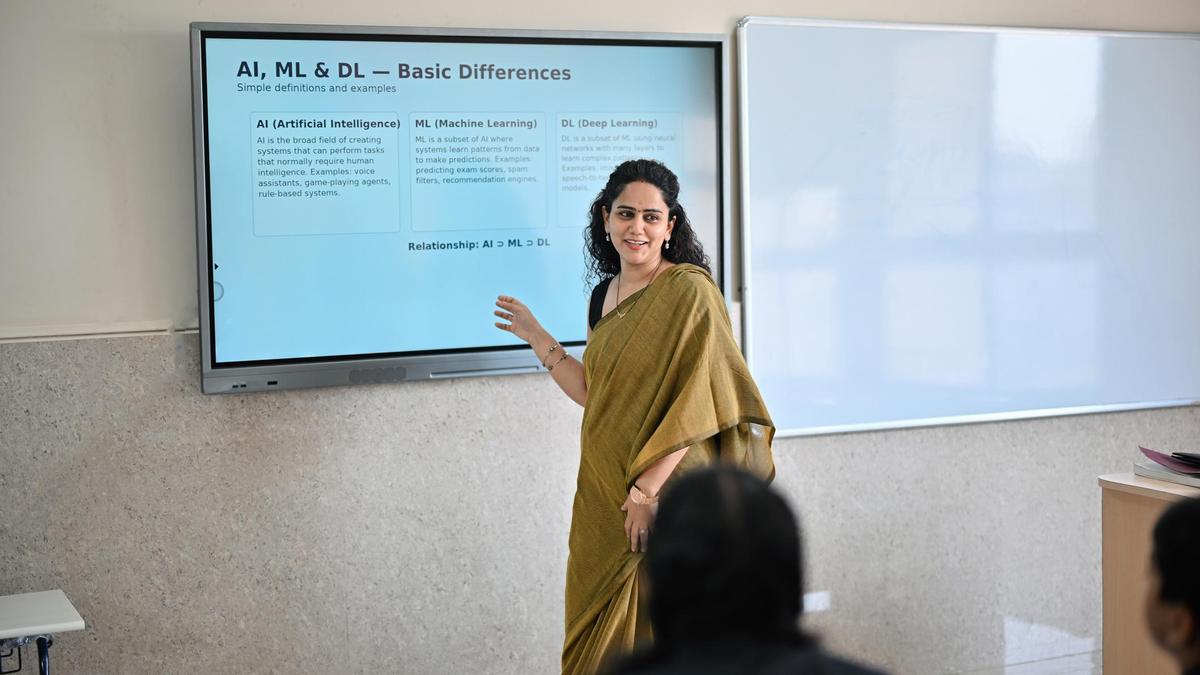
Image used for representational purposes
| Photo Credit: Getty Images
While educational institutions across Chennai are hosting AI literacy and futuristic tech workshops, many young people say what they need actual guidance with is understanding their own health, managing their money, everyday decision-making, and other practical aspects of adulthood.Malini, a 19-year-old college student, says she has never undergone any workshops on health or finance while in school or college. “We were just told to eat healthy and not to waste money,” she says. Currently in college, she feels that a degree of importance is given to health, though it is nowhere close to the attention that AI receives.“A lot of students take drastic measures, such as skipping meals, to stay thin,” she says, adding that students are mostly unaware of the concept of health literacy unless they are studying medicine. “Students need to know what nutrients and diet they require, according to the climate here,” she says.Shanmuga Priya V., an instructional designer from Chennai, says when it comes to health, self-finance, and behavioural sciences, workshops addressing these have been few and far between when she was growing up. “I had attended health-related workshops and exhibitions, but they were mostly limited to menstruation and were girls-only,” says Ms. Priya.Ms. Malini concurs, and says: “We are slowly moving out of menstruation being seen as a taboo, though boys were not allowed to participate in those workshops and they were kept a ‘secret’ from them.” She adds that boys should also know what menstruation is, and that is a huge contributor to breaking stereotypes and will help girls become more outspoken about their bodily concerns.Vaishnavi Jaikumar, a project technical assistant, meanwhile, says that educational institutions must conduct more seminars on deep tech. “Students are mostly encouraged to develop technical and professional skills, but practical knowledge related to physical well-being, mental health, financial planning, savings, and responsible spending are less in comparison,” she adds.The experience of Bhagavathi Thiruselvan, a 17-year-old who completed his Class XII this year, however, has been quite different. Through his school’s Rotaract Club, he has participated in several health rallies and attended monthly sessions with eminent professionals, besides career guidance programmes at his school. “Parents are also mostly focused on academics. We can’t expect everything to come from the school,” he says.Overlooked skillsMs. Priya, meanwhile, says it was only after graduating from school and college that she realised how many life skills had been overlooked. “I earn my own money now, but sometimes, I don’t even know where it goes. As much as we talk about savings, there should also be seminars on investments and personal finance at the college level, at least to give us an idea,” she adds.There are also conversations in online spaces about how educational institutions can also introduce ‘repair workshops’, where students can learn how to mend their own clothes or electronics by themselves, so as to imbibe a culture of repair rather than replacement. Published - June 01, 2026 03:05 pm IST