This story was supported by the Pulitzer Center.
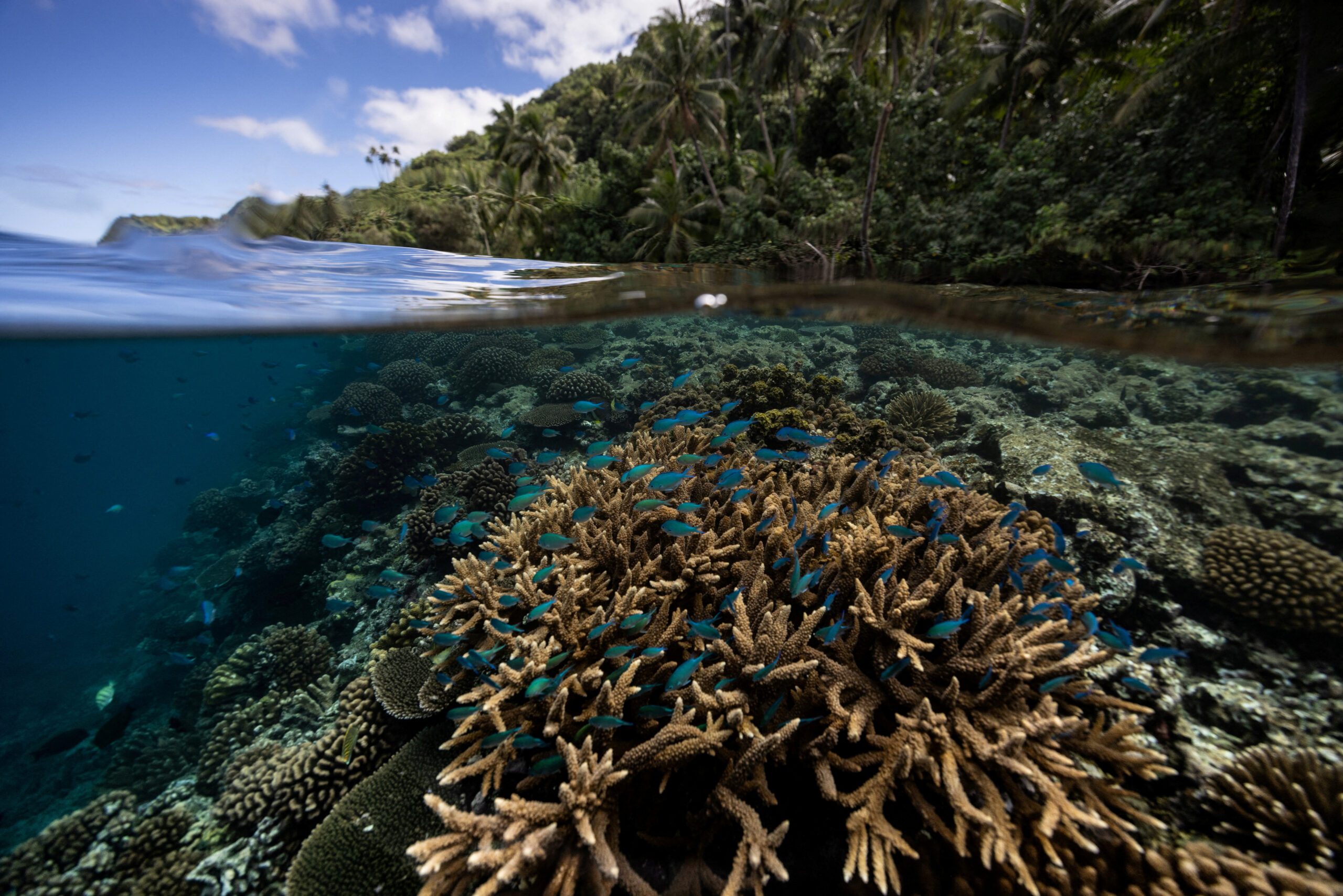
On the island of Moorea, in French Polynesia, deep green volcanic mountains slope from high peaks down towards the sea. But they don’t stop at the shore. The ridgelines of ancient lava flows stretch underwater, providing the perfect rocky substrate for a coral reef.
Between the ancient rock formations, blacktip reef sharks swish their tails over a sandy seabed. And on these underwater mountains, the reef once thrived.
In the middle of the South Pacific, 2,700 miles south of Hawaii, Moorea is known within the coral science community as an incredibly resilient place. But a new study has uncovered a peculiar phenomenon never before seen in scientific literature: hollowed-out dead corals are being structurally maintained by an encrusting algae.
When corals die, a cycle begins. Usually, storms pass through that remove dead coral “rubble” from the seabed, creating a clean slate on which new corals can seed and grow. But in Moorea, these dead corals are held in place by a host of microscopic organisms, so even as storms pass through, the skeletons remain. Since they aren’t breaking down, no new space is being created for coral to grow.