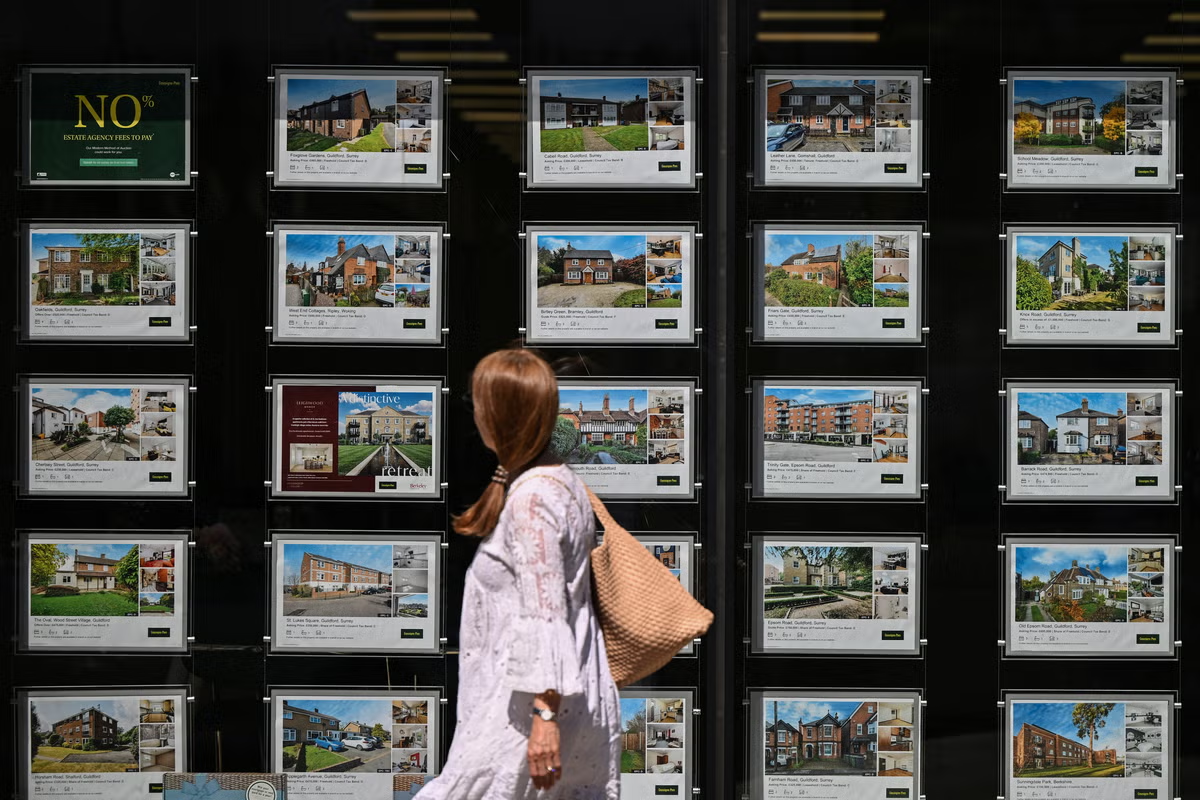
The building society has given its latest take09:20, 01 Jun 2026Updated 09:36, 01 Jun 2026Nationwide issued a new update on Monday morning.It revealed that house prices fell by 0.6% month on month in May as the "impact of the Middle East conflict feeds through" into the property market – though experts say it's the ideal moment for first-time buyers to secure a bargain. The building society's House Price Index revealed that UK annual house price growth dropped to 1.7% in May, down from 3% in April, marking the first monthly decline of 2026.Nationwide attributed the housing market's loss of momentum to the Iran conflict finally filtering through into the data. The lender highlighted that the Royal Institution of Chartered Surveyors recorded a sharp drop in new buyer enquiries in March, pushing the index to its weakest reading since 2023, with figures remaining firmly in negative territory throughout April.Despite this, the UK economy entered this turbulent period in a somewhat stronger position than anticipated. The economy posted a robust 0.6% growth quarter on quarter in the first three months of the year, while inflation eased more than predicted in April, dropping to 2.8%.Robert Gardner, Nationwide's chief economist, said: "Given the uncertainty caused by developments in the Middle East and the subsequent rise in energy prices and market interest rates, some loss of momentum was to be expected. Indeed, consumer confidence has weakened noticeably since the start of the conflict, with GfK's headline index falling to its lowest level since late‐2023 in April, with only a marginal increase in May."He continued: "Economic growth is likely to be somewhat weaker and inflation higher than previously expected this year as a result of developments in the Middle East, although the impact will ultimately depend on the duration of the shock and the policy response. The UK economy and housing market have proved remarkably resilient in recent years. Household finances are solid, with total household debt at its lowest level relative to income for around two decades, and sizeable savings buffers have been built up, though these are not evenly distributed across households."Moreover, housing affordability had been improving steadily in recent years due to a combination of income growth outpacing house price growth by a wide margin and a modest decline in borrowing costs. While market interest rates have risen in recent months, the impact on affordability has so far been modest. Indeed, swap rates, which underpin fixed‐rate mortgage pricing, remain well below the highs reached in 2023 and are broadly in line with levels prevailing in 2024, implying only a partial reversal of earlier gains. This provides some confidence that, if the latest shock passes relatively quickly, and energy prices normalise in the quarters ahead, any near-term softening in the housing market will also prove short-lived."Shaun Sturgess, director of Swansea-based Sturgess Mortgage Solutions, described it as the ideal moment for prospective buyers to secure a property at a knockdown price.He continued: "The impact of the Middle East conflict, and specifically the higher mortgage rates it triggered, is now starting to feed through. While first-time buyers will be elated by this news, those already on the property ladder will be feeling anything but. Current conditions in the property market are perfect for anyone who wants to snap up a property at a bargain price as buyers hold all the cards."Riz Malik, Independent Financial Adviser at Southend-on-Sea-based R3 Wealth, noted that numerous landlords had exited the market.He continued: "The war on Iran has impacted a housing market that could have been assisted by lower rates at the beginning of the year. On top of that many accidental landlords have realised that enough is enough and the maths isn't maths-ing when it comes to their properties and want out. Only a significant drop in interest rates or stamp duty concessions can provide the adrenaline shot that is needed."Babek Ismayil, CEO at homebuying platform OneDome, observed that confidence was fragile across the market.He continued: "This latest data from the Nationwide reinforces the buyers' market we are now in. With mortgage rates still noticeably higher than they were at the end of February before the war began, and sentiment as a whole understandably weak, first-time buyers are in a position to negotiate very hard on price."Chris Barry, director of London-based Thomas Legal, remarked that the market was decelerating.He continued: "2026 started unseasonably strong as interest rates were predicted to decline along with pent-up demand carried over from the tail end of 2025. The result of this early spike in activity has meant that spring activity, which is typically buoyant, has started to slow earlier."Justin Moy, managing director of Chelmsford-based EHF Mortgages, explained there were numerous factors behind people's reluctance to move house currently.Article continues belowHe said: "The property market is arguably the most accurate barometer of the UK economy, and how confident the public feels generally. When you combine higher taxation, Middle East woes and the inevitable inflationary pressures on the horizon, the vast majority of home movers will sit on their hands."
New Nationwide update as 'impact feeds through'
The building society has given its latest take
834 words~4 min read