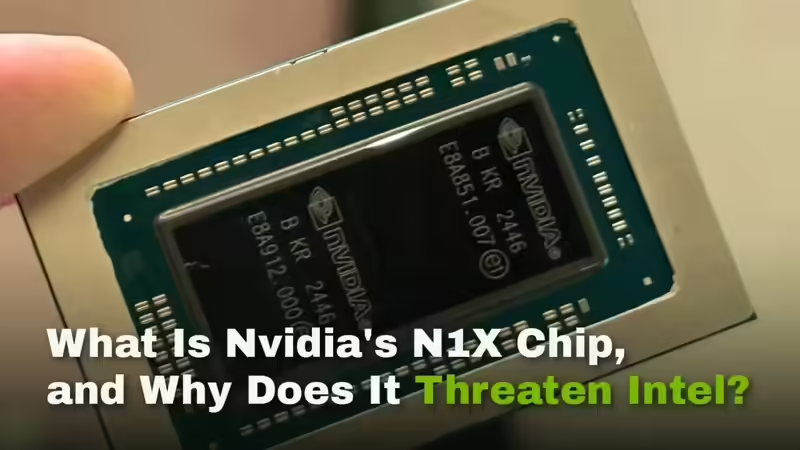
Nvidia's N1 and N1X mark its first real move into the Windows PC processor since 2012, pairing 20 Arm cores with RTX 5070-class Blackwell graphics and the full CUDA stack. The specs, the devices from Dell to Lenovo, the pricing question and the execution risk — everything that matters before the GTC Taipei keynote begins.For two decades Nvidia has been the engine supplier of the PC world — the part you bolted into someone else's chassis. Intel built the car. AMD built the car. Qualcomm spent three years insisting Arm could build a better one. Nvidia supplied the GeForce that made the thing worth buying and let the others own the bit that mattered most: the processor socket. That arrangement ends at the Taipei Music Center this morning. When Jensen Huang takes the GTC Taipei stage at 11am local time, he is expected to announce the N1 and N1X — Nvidia's first laptop processors, and the company's first serious move into the chip that sits at the heart of a Windows PC since the Tegra-powered Surface RT misadventure of 2012. The pre-show choreography has been loud, coordinated and impossible to misread. Here is everything that matters before the lights go down.A Teaser, Three Logos and a Set of CoordinatesOn Friday, Nvidia, Microsoft and Arm posted the identical line to X — "a new era of PC" — beneath GPS coordinates pointing at the Taipei Music Center, the exact spot where Huang keynotes today. Three of the four companies that decide what a Windows-on-Arm machine becomes, singing from the same sheet on the same morning. Windows chief Pavan Davuluri followed with his own tease — something coming for developers, and pointedly not a new operating-system version. ASUS joined with a winking ProArt teaser the same day.The scheduling tells its own story. GTC Taipei runs June 1, with Huang's keynote a full day before the Computex show floor opens on June 2. Any silicon revealed today gets hands-on demos at OEM booths from tomorrow. One detail betrays how central this reveal is: MediaTek's own Computex keynote slot was reportedly cancelled and handed to Nvidia. Partners are also lining up separate laptop unveilings in the hours after Huang leaves the stage. The formation lap is over. The grid is set.What Is the Nvidia N1X, in One Paragraph?The N1X is Nvidia's flagship laptop system-on-chip: an Arm-based processor that fuses a 20-core CPU with a Blackwell-architecture GPU and the full CUDA software stack into a single package. It is built with MediaTek on TSMC's 3-nanometre process, with a unified LPDDR5X memory pool, and it is Nvidia's first chip designed to live inside a Windows laptop rather than a data-centre rack. The shorthand that captures it best: a desktop RTX 5070's worth of graphics muscle, plus a 20-core CPU, in something thin enough to carry. The N1 is its smaller, cheaper sibling for mainstream machines. Everything below the leak line is still leak — Nvidia confirms it on stage today — but the specifications have been so thoroughly reported that the keynote is more confirmation than revelation.Two Chips, Four ConfigurationsThe lineup splits into a performance tier and a mainstream tier. According to specifications reported by VideoCardz and corroborated across Tom's Hardware, Neowin and others — sourced from internal Nvidia documents, so treat the fine print as directional until Huang reads it out — the split looks like this.ChipCPU configCUDA coresGPU (SM)PowerNotesN1X (flagship)20-core (10+10)6,14448 SM Blackwell45–80WRTX 5070-class; Cortex-X925 performance plus Cortex-A725 efficiency coresN1X (lower tier)18-core (9+9)5,12040 SM45–80WA step down for thinner chassisN1 (upper)12-core (8+4)2,560—18–45WMainstream ultrabook targetN1 (base)10-core (7+3)2,048—18–45WEntry tierOn memory, the leaks point to serious headroom. The N1X starts at 16GB LPDDR5X and scales to 128GB across 16 channels, with a previous leak suggesting 8,533 MT/s — which would put it ahead of AMD's Strix Halo on memory bandwidth. It also carries 12 PCIe 5.0 lanes plus five PCIe 4.0 lanes and supports up to three M.2 SSDs; the base N1 drops to eight PCIe 5.0 lanes and two M.2 slots. The numbers describe a platform that wants to be taken seriously by people who currently buy workstations.The DGX Spark in Your BagThe reason this chip exists tells you who it is for. The N1X is closely related to the GB10 Grace Blackwell Superchip that powers Nvidia's DGX Spark, the company's $3,999 desktop AI machine. The N1X is essentially that GB10 class of silicon adapted for laptops — the key difference being Windows support, which the DGX Spark never officially received. There is one technical wrinkle worth holding onto: the DGX Spark uses Nvidia's custom Grace CPU cores, while the laptop N1X reportedly leans on standard Arm Cortex-X925 and Cortex-A725 designs, and runs a 45–80W envelope against the Spark's 140W. Same family, lighter build.What that buys a buyer is the part Qualcomm has never been able to offer. CUDA on a laptop means AI and machine-learning work written for Nvidia's software — the PyTorch CUDA backend, TensorRT, llama.cpp CUDA builds — runs natively on an N1X machine with zero code changes. For the researcher who currently rents cloud GPUs to run serious local inference, or the developer who has had to choose between a Mac and a hot, heavy gaming laptop, that is the whole pitch in one line. The data-centre company is bringing a scaled-down slice of its own philosophy down to the thing in your bag.Who Is Actually Shipping These?Plenty of names, and the speed of the OEM pile-on is itself a signal. Before Nvidia has said a single official word, at least four major laptop makers are confirmed or strongly indicated.OEMDevice(s)StatusDellXPS (N1X); a 16 Premium also leaked earlierLaunch confirmed via Computex media materials, set for May 31LenovoLegion 7, Yoga Pro 7, Yoga 9 2-in-1, IdeaPad Slim 5Multiple N1X models confirmed internallyASUSProArt laptopTeased publiclyMSIAt least one N1X systemIn preparationMicrosoft SurfaceSurface variantReported via supply chain; the Windows account's teaser is the strongest signal so farOne charger listing is doing a lot of talking: Lenovo's Legion 7 with the N1X appears tied to a 245W power adapter, which points squarely at a high-performance gaming machine rather than a thin-and-light. As for when anyone can buy one, temper the excitement. First devices from Dell, Lenovo, ASUS and MSI are expected before the 2026 holiday season, with broader availability spilling into early 2027. This is a reveal, not a release.The Grid Is Already CrowdedNvidia is pulling onto a track the incumbents have raced for years, and the socket it wants has long belonged to someone else. Intel held it by default. AMD fought its way back into it. Qualcomm has spent since 2024 trying to convince Windows buyers that Arm was more than a battery-life curiosity. And every one of those rivals brought hardware to Taipei this week too.Qualcomm used Computex to announce its Snapdragon C platform, aimed at $300 Windows laptops from Acer, HP and Lenovo — though it lacks Copilot+ support, which still requires the pricier Snapdragon X with Oryon cores. Intel launched the Arc G3 and Arc G3 Extreme, its first chips purpose-built for gaming handhelds, alongside an XPS 13 with Wildcat Lake starting at $599. AMD, meanwhile, confirmed its EPYC Venice server chip as the first high-performance product to enter mass production on TSMC's 2nm process. Nvidia arrives with a different weapon entirely. Arm-based PCs are projected to reach 30 per cent of the global market by 2026, and the N1X's GPU heritage gives it a lever Qualcomm never had at the same scale: creators and gamers, two audiences Snapdragon X struggled to win. Nobody else on this grid can put RTX-class graphics and CUDA inside a fanless-adjacent Arm laptop. That is the gap Nvidia drove straight through.Microsoft's Half of the StoryThe silicon is only half of what gets announced this week, and the quieter half may matter more. Microsoft is expected to debut software that lets AI agents do work locally on a Windows machine — the on-device counterpart to everything it has built in the cloud. Build 2026 opens June 2 in San Francisco with Satya Nadella's keynote, a dedicated Windows local-AI track, and confirmed sessions on agentic workflows, GitHub Copilot and Azure AI Foundry — which already routes across models from OpenAI, Anthropic, Mistral and DeepSeek. Microsoft has also confirmed there is no Windows 12 on the Build agenda.The strategic read here belongs to Microsoft as much as Nvidia. Windows 11 version 26H1 appears tied to new silicon enablement, which makes this more than a routine OEM refresh. Microsoft's first AI PC swing — the Copilot+ push — landed soft. A second swing with the world's most valuable chipmaker bolted to it is a better story to tell developers, and a better reason for them to build local-first AI features that need exactly the kind of GPU the N1X carries. The chip gives the software somewhere to run. The software gives the chip a reason to exist.The Pit Wall Says WaitStrip away the teaser coordinates and a sober counter-case remains. Analyst Ming-Chi Kuo's read is that the N1X could ship roughly 10 million devices over two years, creates a niche market rather than a mass one, and that the success of AI PCs depends more on Microsoft's Windows than on Nvidia's hardware. Ten million units over two years is a respectable debut and a rounding error against the hundreds of millions of PCs shipped annually. This is a beachhead, not an invasion.The execution risk is the real story. Nvidia has shipped zero PC processors at scale, and driver support, power management and application compatibility are precisely where Intel and AMD hold decades of institutional knowledge. Then there is gaming, the lever that should be Nvidia's strength and could become its embarrassment. Anti-cheat systems and x86-to-Arm translation remain the soft spots; if major titles stumble, the Nvidia logo on the lid will carry the blame, and buyers will ask what they can actually play. History supplies the cautionary note: Nvidia powered Windows RT Surface tablets back in 2012, and that platform died young. A faster chip solves the benchmark. It solves none of the software maturity that decides whether a Windows-on-Arm machine is a daily driver or a second laptop you stop charging by March.What Will It Cost — and What Does That Mean in India?Pricing stays the largest blank on the page. Nvidia has held official numbers back, but the arithmetic points one way. Given Nvidia's record with premium hardware, analysts expect N1X laptops to land above $1,400 at launch — well clear of budget territory. The cost physics support that: LPDDR5X memory and TSMC 3nm manufacturing are both expensive, though laptop designs drop the DGX Spark's specialised ConnectX-7 networking card, which takes meaningful cost out versus the $3,999 desktop.For the Indian buyer, the timing is unkind. Gartner projects a 17 per cent rise in PC prices this year as DRAM and SSD costs surge — a memory-led squeeze that hits hardest exactly where the N1X already sits, the high-LPDDR5X premium tier. Layer customs duty and GST on a sub-$1,400 import and the first N1X machines plausibly open near or above Rs 1.5 lakh in India, before the inevitable early-adopter mark-up. The OEM names work in India's favour — Dell, Lenovo and ASUS all run deep retail and service networks here — so local availability should trail the global launch rather than skip it. The catch worth flagging for any Indian reader weighing a 2026 purchase: every current source carries global pricing and global dates. India pricing, India availability and India warranty terms remain entirely unstated. That is the gap to watch once the OEM booths open tomorrow.What to Watch When the Lights Go OutThe keynote will be judged on the answers the leaks could not supply. Watch for four things. First, performance you can trust — independent benchmarks rather than Nvidia's own slides, because a leaked CUDA-core count tells you the engine size and nothing about how it drives. Second, the CUDA compatibility list: which AI frameworks and tools work on day one versus which sit on a roadmap, because that single distinction separates a developer machine from a marketing claim. Third, battery life and thermals on a 45–80W Arm chip carrying RTX 5070-class graphics — the spec that decides whether this is a laptop or a luggable. Fourth, pricing and a firm shipping date, the two numbers that turn a Computex slide into a purchase.Nvidia has spent a decade making other companies' PCs faster while owning none of the socket that matters. Today it stops being the engine supplier and tries, for the first time at scale, to build the whole car. The grid has never been more crowded, the incumbents have never been more entrenched, and the software has never been more ready. The lights are about to go out. Watch what Nvidia does on the run to turn one.Frequently Asked Questions —What is the Nvidia N1X?The N1X is Nvidia's first flagship laptop processor: a 20-core Arm CPU fused with a Blackwell GPU carrying 6,144 CUDA cores, built with MediaTek on TSMC's 3nm process. It targets Windows-on-Arm laptops with desktop RTX 5070-class graphics and the full CUDA stack.When will Nvidia N1X laptops launch?Nvidia reveals the N1X at GTC Taipei on 1 June 2026. First devices from Dell, Lenovo, ASUS and MSI are expected before the 2026 holiday season, with broader availability arriving in early 2027.How much will the Nvidia N1X cost?Pricing stays officially unconfirmed ahead of the keynote. Analysts expect N1X laptops above $1,400 at launch, placing them in premium territory. In India, customs duty and GST plus a 2026 memory-price surge could push early machines near Rs 1.5 lakh.Which laptops will use the Nvidia N1X?Confirmed or strongly indicated models include the Dell XPS, Lenovo Legion 7, Yoga Pro 7, Yoga 9 2-in-1 and IdeaPad Slim 5, an ASUS ProArt laptop, and at least one MSI system. A Microsoft Surface variant is reported via supply-chain sources.Is the Nvidia N1X better than Qualcomm's Snapdragon X?On graphics, the N1X holds a clear lead — its Blackwell GPU and CUDA stack give it muscle Snapdragon X lacks for creators and gamers. Qualcomm keeps the edge on maturity, efficiency and Copilot+ certification. Independent benchmarks will settle the rest.Can the Nvidia N1X run games?Yes, with caveats. The RTX 5070-class GPU has the raw power, and Windows-on-Arm gaming has improved sharply. The open questions are anti-cheat support and x86-to-Arm translation, where some titles may stumble until compatibility matures.What is the difference between the N1 and N1X?The N1X is the performance tier — up to 20 cores and 6,144 CUDA cores at 45–80W. The N1 is the mainstream tier — 10 to 12 cores and 2,048 to 2,560 CUDA cores at 18–45W, aimed at lighter, cheaper ultrabooks.Does the Nvidia N1X support CUDA?Yes. The N1X runs the full CUDA software stack, so tools such as the PyTorch CUDA backend, TensorRT and llama.cpp CUDA builds work natively on the laptop with zero code changes — the capability no rival Windows-on-Arm chip offers.end of article
Nvidia N1X and the Jensen Huang GTC Keynote: Everything to Know Before Computex 2026
Nvidia's N1 and N1X mark its first real move into the Windows PC processor since 2012, pairing 20 Arm cores with RTX 5070-class Blackwell graphics and the full CUDA stack. The specs, the devices from Dell to Lenovo, the pricing question and the execution risk — everything that matters before the GTC Taipei keynote begins.
2,486 words~11 min read