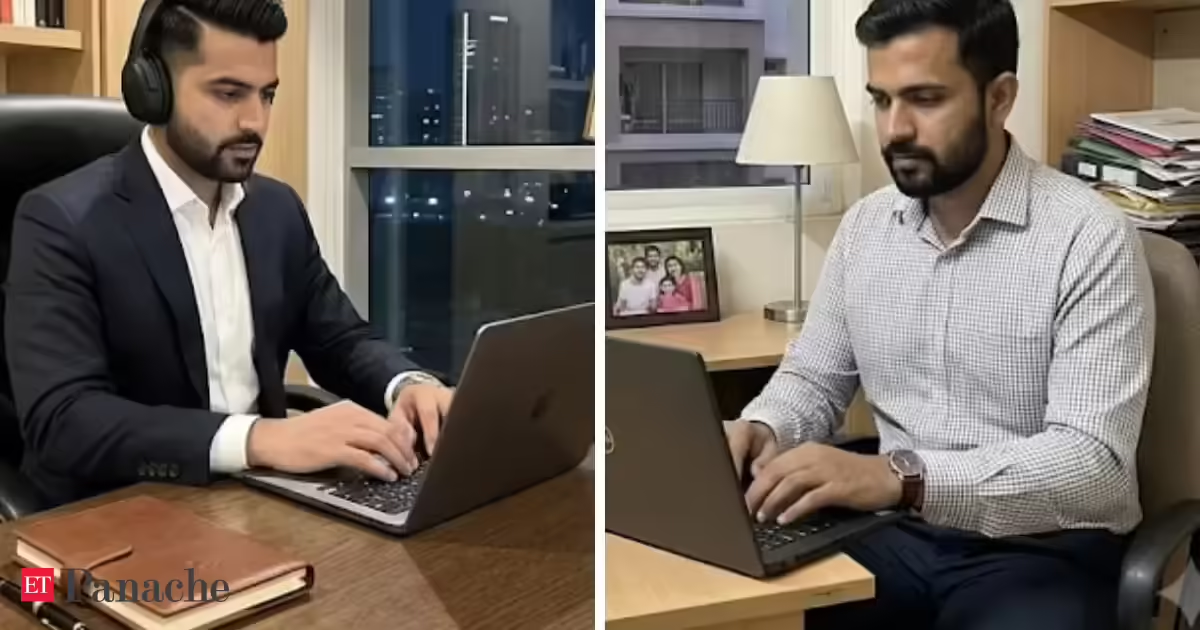
For many professionals, a high-paying job is considered the ultimate sign of financial success. A larger salary often brings a better lifestyle, premium purchases and the confidence that money worries are firmly in the rear-view mirror. But what if that sense of security is more fragile than it appears? According to Chartered Accountant Nitin Kaushik, one of the biggest financial mistakes people make is confusing a high income with genuine wealth. His recent post on X has sparked discussion about what true financial independence actually looks like.Taking to X, CA Nitin Kaushik argued that a high salary can become a "comfortable trap" if people fail to look beyond their monthly paycheck.According to him, many corporate professionals mistake a large salary for long-term financial strength while overlooking how dependent they are on a single source of income. He pointed out that if a person's cash flow relies entirely on showing up to work every Monday morning, they are not necessarily wealthy. Instead, they may simply be highly compensated.Salary is temporary cash flowKaushik challenged one of the most common assumptions in corporate life: that a salary represents stable income. In his view, a salary is not permanent income but "temporary cash flow". It exists only as long as employment continues and a person's ability to work remains intact. The moment a job ends or health issues affect productivity, that stream of money can disappear.You Might Also Like:This, he explained, creates a level of risk that many professionals fail to recognise. Kaushik compared relying solely on a salary to running a business with a single client. In such a scenario, one client controls the entire revenue stream and can effectively eliminate it overnight. He described this as one of the highest concentrations of financial risk a person can take.— Finance_Bareek (@Finance_Bareek) Financial securityWhile a large paycheck may create the appearance of stability, he argued that genuine financial security comes from diversification rather than compensation alone. According to Kaushik, true stability is not determined by the size of a monthly salary but by the number of income streams supporting an individual. Real wealth, he suggested, is built when money continues to flow regardless of whether someone is actively working, travelling or sleeping.He emphasised that genuine income is detached from time. Unlike a salary, which requires ongoing effort and presence, alternative income streams can continue generating value independently. This is where financial independence begins.You Might Also Like:Salary earnings into assetsKaushik noted that building lasting wealth requires converting salary earnings into assets that can produce income on their own. These may include investments, equity ownership and other forms of capital that exist outside the traditional corporate ecosystem.Rather than depending entirely on one employer, individuals should gradually create multiple sources of financial support. He also warned that a high salary can sometimes encourage bad habits. As income rises, many people increase their spending and become accustomed to a lifestyle that requires continuous high earnings to maintain. This creates what Kaushik described as a "high-burn lifestyle" accompanied by deep structural dependency on a single paycheck.The result is that even individuals earning substantial sums may feel trapped. Their expenses, commitments and expectations rise alongside their income, making it difficult to step away from work or take financial risks. CA's message ultimately centres on ownership and control.
'High salary is a comfortable trap’: CA explains why a big paycheck may not make you financially secure
A high salary does not equate to true wealth. Chartered Accountant Nitin Kaushik highlights that relying solely on a paycheck creates a 'comfortable trap'. Genuine financial security stems from multiple income sources, not just compensation. Wealth is built when money flows independently of active work. Professionals should convert earnings into income-generating assets for lasting financial independence.
547 words~2 min read