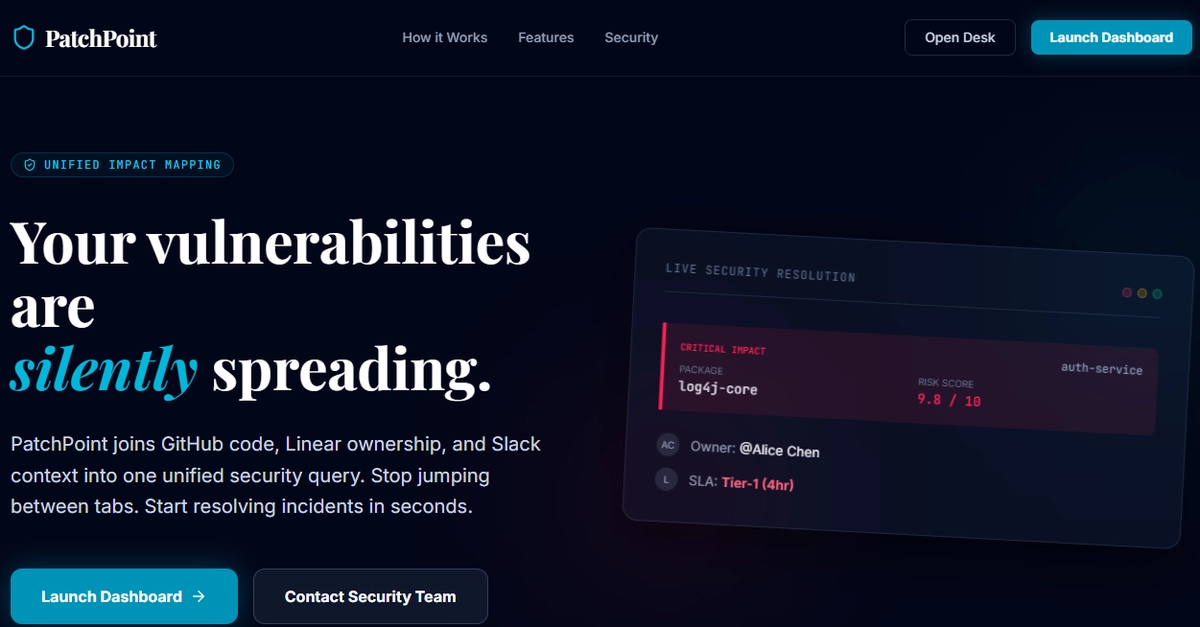
In modern software engineering, security data is fragmented. Your code lives in GitHub, your ticket ownership in Linear (or Jira), and your incident context in Slack. When a critical CVE like Log4j drops, engineers don’t just need to know what is broken; they need to know who owns it, how critical it is, and where to ping the on-call engineer.
Traditionally, connecting these dots requires writing brittle API glue code, handling pagination, managing auth tokens, and dealing with rate limits. It’s slow, expensive, and prone to errors.
I built PatchPoint to solve this. It’s an enterprise-grade Vulnerability Impact Mapper that unifies these silos into a single, SQL-queryable intelligence layer using Coral SQL.
Imagine you are a Security Engineer. A vulnerability scanner flags log4j-core in your auth-service repo.
You go to GitHub to find the file path.