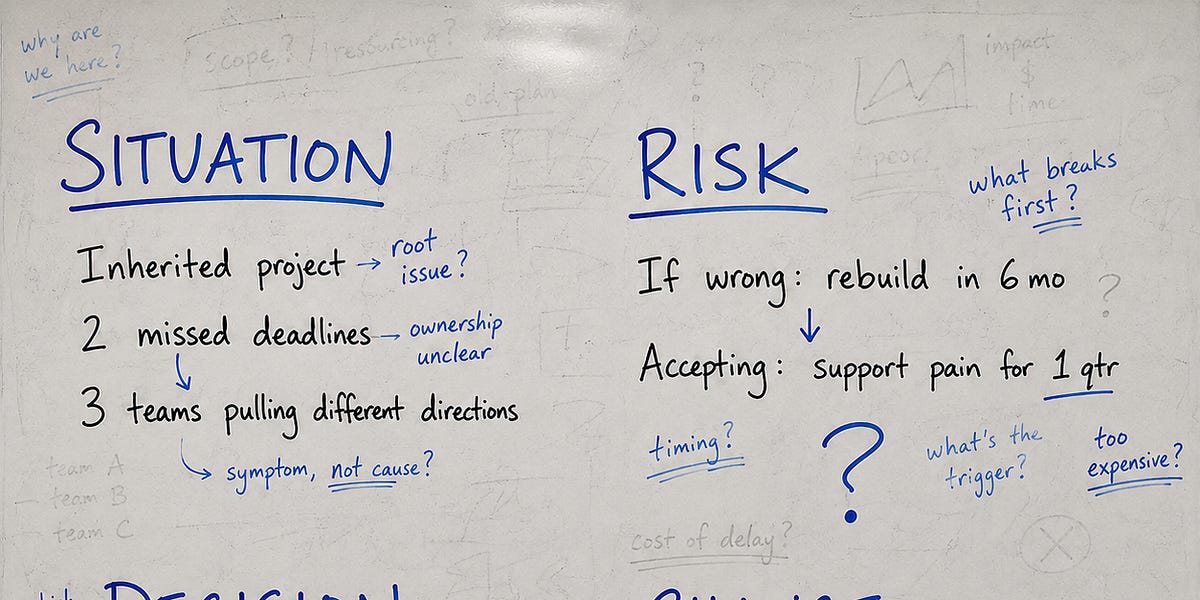
A reader wrote in with a job search problem that has been sitting with me. They had been laid off, and the work they were proudest of was the work they could not show.They had made decisions with limited information and kept a team moving through a quarter that could have gone sideways. They had understood a messy system better than anyone else in the room. In interviews, they had to tell those stories over and over to people who were skeptical by default.I’ve been thinking about why that problem keeps getting worse.AI did not break human judgment. It broke the signal that judgment used to leave behind. A polished memo no longer proves you understood the business. A clean prototype no longer proves you understood the user. Everyone can look productive now. The hard part is seeing who actually understood the work.And this runs in both directions. If you run an organization, your evaluation systems are losing signal. If you are the talent — especially if you sit far from the execution layer — the evidence problem is worse. You did not write the code. You did not design the screen. You made the call that kept the company from spending millions on the wrong bet, and there is no artifact for that.The thinking layer has to travel with the work.The evidence problem I am describing hits hardest at the executive level, because the work is almost entirely judgment — portfolio bets, org design, market timing, decisions that shaped the company for years. None of that ships as a work sample. So this briefing talks to you as someone who evaluates others, but also as someone who may be facing the same problem from the other side.This briefing covers:Build portable judgment evidence. Four questions (situation, decision, risk, change) applied from IC to division lead, with a sanitized case showing how to share reasoning without leaking confidential work.Change how you evaluate and get evaluated. What to ask in interviews, what to look for in promotion packets, and why AI makes the old evidence unreliable on both sides of the table.Use the prompts that do the hard extraction. A diagnostic that flags where your career evidence is thin, a builder that interviews you through one real decision, and a question set for when you’re on the hiring side.Put the evidence somewhere it travels. Why judgment artifacts need a home you own — a TalentBoard profile, a personal site, a packet you bring to interviews — before your badge stops working.
Executive Briefing: 86% of AI users treat output as a starting point. Your career evidence hasn't caught up.
Watch now | The work you're proudest of is the work you can't show. A discipline for making it travel.
419 words~2 min read