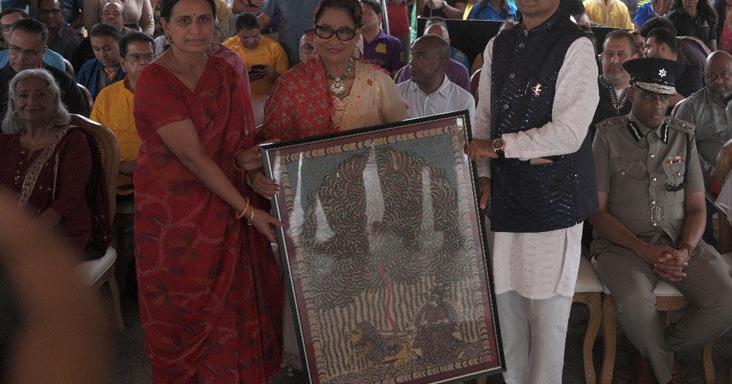
Prime Minister Kamla Persad-Bissessar said descendants of Indian indentured labourers today represent the fulfilment of the dreams carried across the kala pani by generations of jahajis who endured poverty, discrimination and hardship in pursuit of a better life.The Prime Minister yesterday arrived aboard a replica of the Fatel Razack at the Heritage Dam in Clarke Road, Penal, as part of a re-enactment symbolising the arrival of the first East Indian indentured labourers to Trinidad 181 years ago.Following that, she led a procession to the Petrotrin grounds where hundreds came out in the rain to celebrate Indian Arrival Day.The ceremony recreated the historic landing of the immigrants who arrived aboard the Fatel Razack on May 30, 1845, marking the beginning of Indian indentureship in Trinidad and Tobago.Addressing the gathering, which included members of the Diplomatic Corps and Police Commissioner Allister Guevarro, the Prime Minister intertwined the national story of Indian indentureship with her own family history, recalling her childhood in Penal and the struggles of her great-grandmother Sumaria Seepersad, who journeyed from Madras to colonial Trinidad in the early 1880s.“Indian Arrival Day is not distant history. It is living memory, the story of our grandparents and great-grandparents whose journeys began in poor villages across India, yet whose struggles, prayers, and traditions still resonate through our communities today,” she said.Persad-Bissessar described the procession as far more than a ceremonial observance, saying it symbolically retraced the painful journey undertaken by thousands of Indian immigrants who arrived between 1845 and 1917.“When we re-enact the long walk to Calcutta, the boarding of the ships, and the crossing of the kala pani, we are doing far more than celebrating Indian Arrival Day. We are symbolically retracing the footsteps of our foreparents from another time, a journey once filled with fear, uncertainty, heartbreak, and sacrifice.”Exploitative arrangementsPersad-Bissessar, who has represented Siparia for the past 31 years, said the occasion held special significance because she had grown up among the descendants of indentured labourers whose sacrifices helped build communities across south Trinidad.She recalled hearing Bhojpuri spoken by elders throughout villages and communities and remembered accompanying her grandmother to the Penal market as a child.“I can still hear the echoes of their voices rising through the stalls. Voices carrying memories, prayers, hardship, humour, and tradition,” she said.The Prime Minister noted that many descendants of indentured immigrants knew their ancestors only through faded photographs, family stories and fragments of history passed down through generations.“Many of us never even knew what our great-grandparents looked like. Their faces faded with time, and their voices disappeared into history.”Persad-Bissessar painted a stark picture of the conditions faced by Indian indentured labourers, describing the recruitment system as exploitative and akin to modern-day human trafficking.“Our ancestors who boarded the Fatel Razack and other ships between 1845 and 1917 were poor villagers from regions such as Bihar, Uttar Pradesh, and Madras. Many were deceptively drawn into exploitative arrangements that effectively amounted to human trafficking,” she said.She said many left behind families, villages and entire worlds they would never see again before embarking on dangerous sea voyages to Trinidad.“They survived the treacherous kala pani only to face hardship, discrimination, and conditions little better than slavery. Still, they endured,” she added.Embodiment of resilienceThe Prime Minister also paid tribute to her great-grandmother Sumaria Seepersad, whose life story, she said, embodied the resilience of the indentured generation.Persad-Bissessar said Sumaria left Madras at age 16 carrying only a small jahaji bundle and arrived in colonial Trinidad unable to speak English.She described how her great-grandmother, who spoke only Bhojpuri, lived in a small cutya (house) and struggled to survive after being widowed.“After her husband died, she raised her children alone, walking barefoot for long miles to and from the canefields and cocoa lands in the hot sun,” she said.Yet despite the hardships, she persevered.“Every morning, before sunrise, she got up and kept going, never realising that she and thousands like her were not merely enduring hardship. Instead, they were laying the foundation for generations they would never live to see.”Persad-Bissessar reflected on how far the descendants of indentured immigrants had come since the arrival of the Fatel Razack.She questioned whether her great-grandmother could ever have imagined that her own great-granddaughter would one day become Prime Minister of Trinidad and Tobago.“Could Sumaria ever have imagined that the same roads and mud tracks she once walked in such poverty and hardship would one day be retraced by her own great-granddaughter? Not as an outcast, but as Prime Minister of the very nation in which she once struggled to survive and find acceptance?” she asked.The Prime Minister said the rise of descendants of jahajis to positions of leadership represented a collective triumph for the indentured community.“Could she ever have imagined that the descendants of jahajis, once mocked and marginalised, would one day help lead this country and stand proudly among the builders of modern, independent Trinidad and Tobago? That is their triumph, their victory, and the greatness of the jahaji legacy.”While celebrating the contributions of Indian immigrants, Persad-Bissessar stressed that the story of indentureship formed part of a broader national narrative that includes all ethnic groups that contributed to the development of Trinidad and Tobago.She said the descendants of Indian immigrants joined those of Africa, Europe, China and the Middle East in shaping the country’s culture, identity and development.
Kamla: We are the fulfilment of the jahajis’ dream
Prime Minister Kamla Persad-Bissessar said descendants of Indian indentured labourers today represent the fulfilment of the dreams carried across the kala pani by generations of jahajis who endured poverty, discrimination
882 words~4 min read