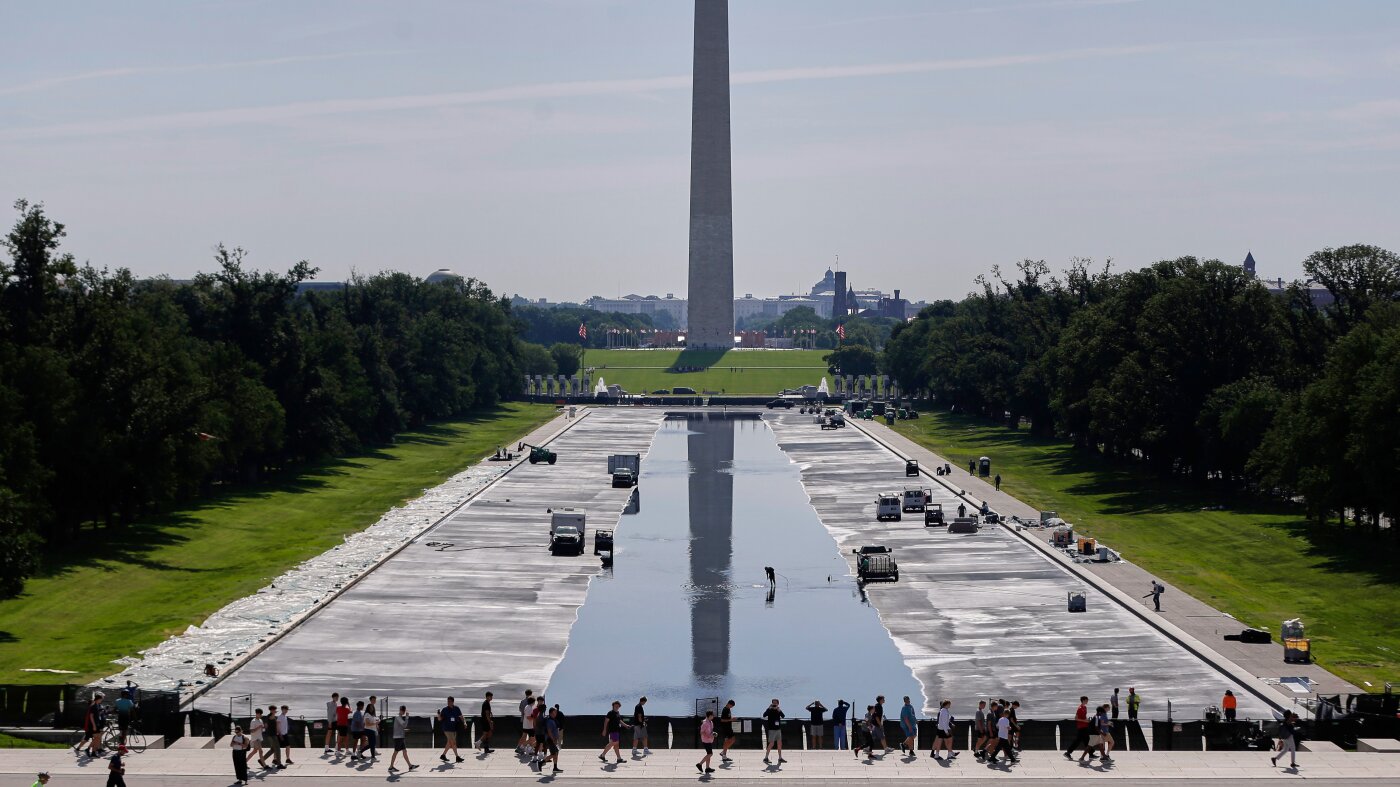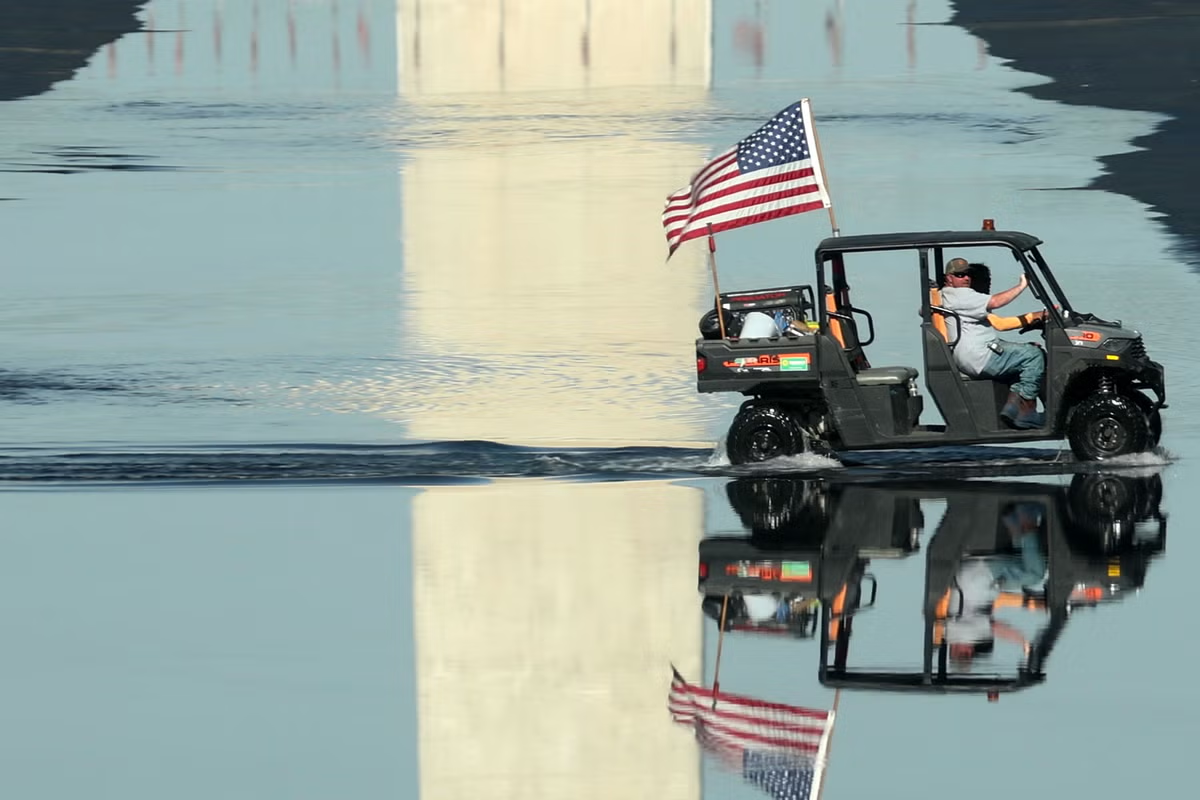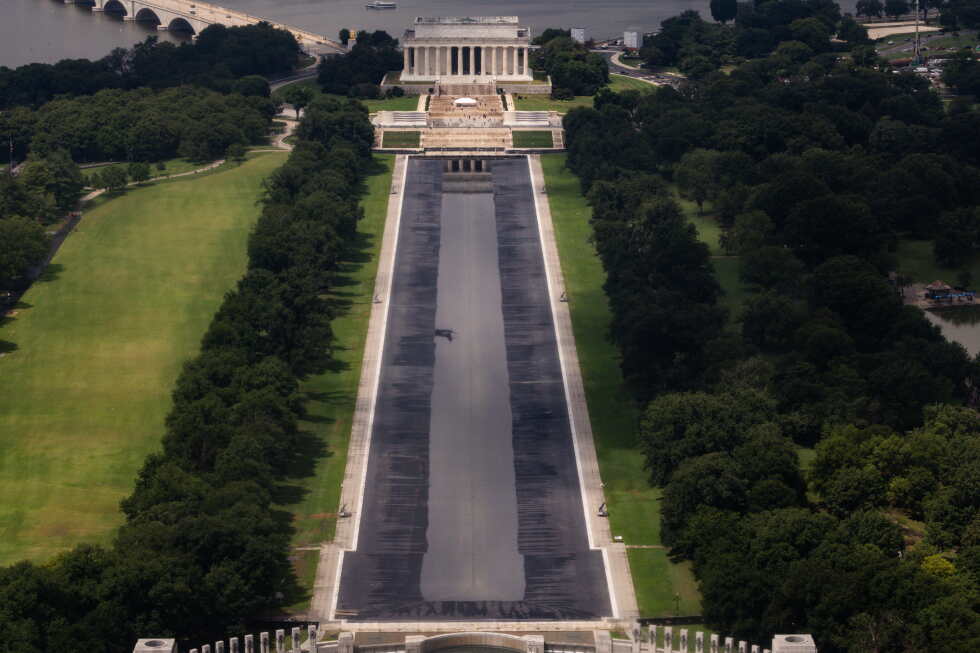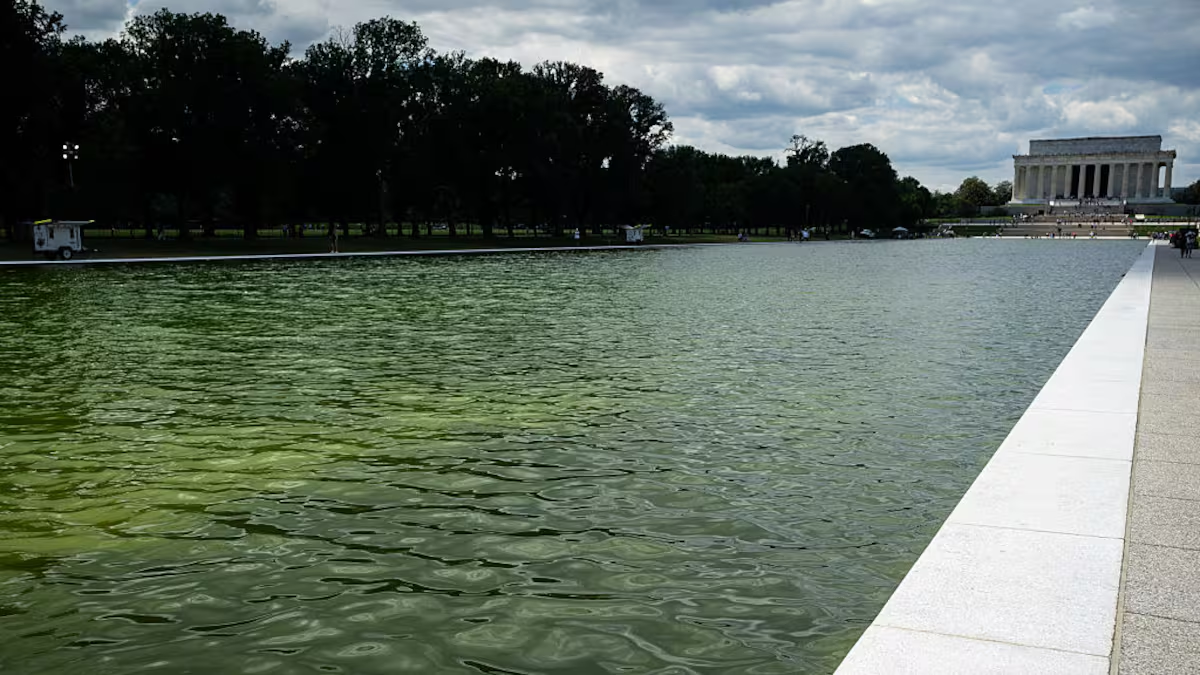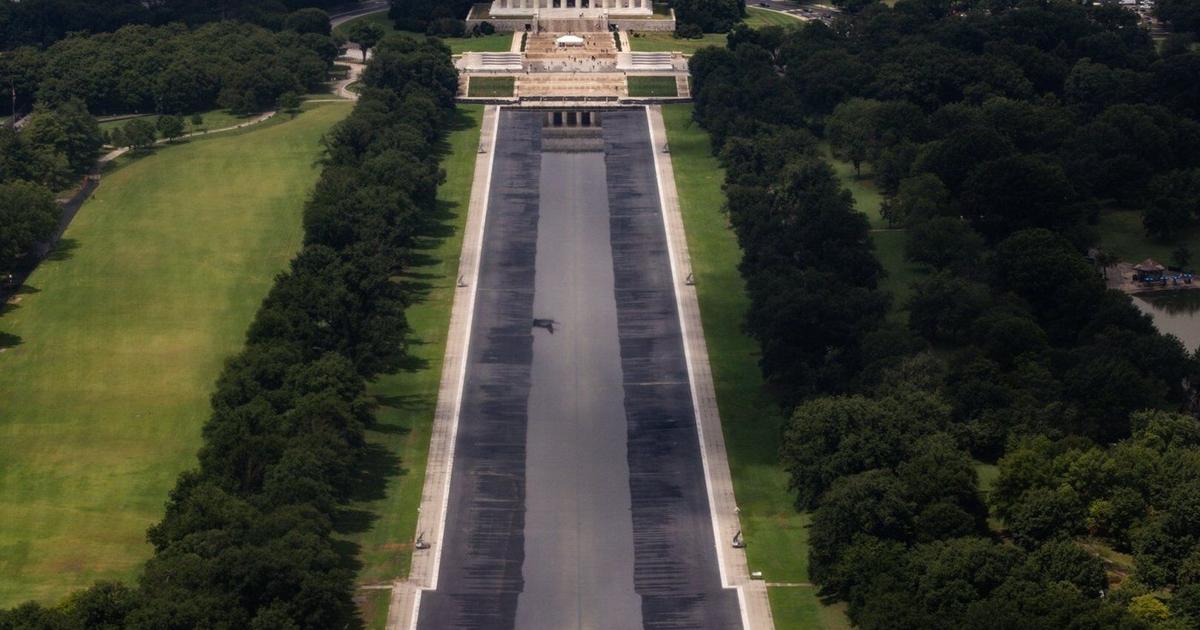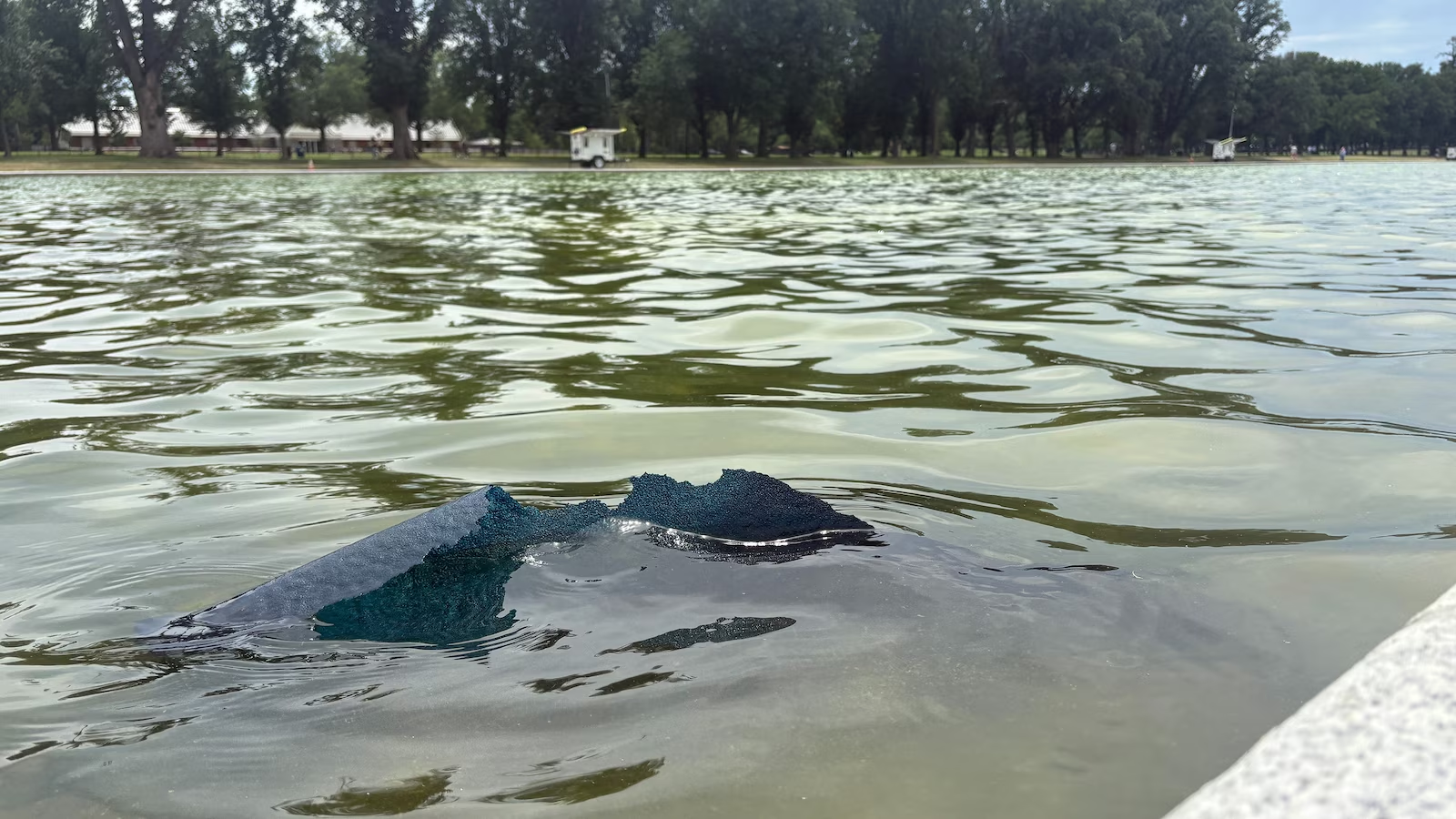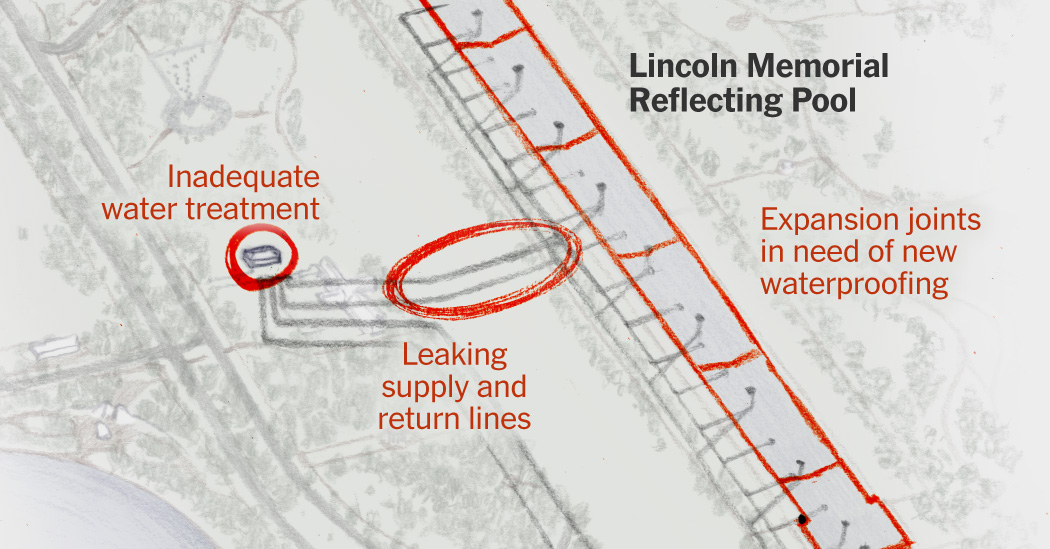
In April, President Trump announced his plans to reseal and add blue-tinted coating to the Lincoln Memorial Reflecting Pool. A bird’s eye view illustration of the Lincoln Memorial Reflecting Pool and the surrounding area.It is his latest project to reshape the nation’s capital. An illustration showing how much of the Lincoln Memorial Reflecting Pool had been resurfaced as of May 15.But the work may not be a long-term solution. An illustration showing how much of the Lincoln Memorial Reflecting Pool had been resurfaced as of May 26.Multiple problems plague the landmark. One issue is its leaky pipes, which are not currently being addressed by the renovations. An illustration summarizing the long-standing problems affecting the Lincoln Memorial Reflecting Pool: inadequate water treatment, leaking supply and return lines and expansion joints in need of new waterproofing.When the architect Henry Bacon designed the Reflecting Pool, he envisioned it as a quiet, mirror-like surface that would reflect the Lincoln Memorial, the Washington Monument and the surrounding sky.But beneath the smooth surface, major engineering problems have lurked since it was constructed in the 1920s. The pool was built on unstable mudflats that have shifted over the decades, cracking the pool’s concrete and causing massive leaks. And the stagnant, shallow water has become a petri dish for algae.It has posed a headache for other presidential administrations, and the first Trump administration formed a plan to fix some of the pool’s problems, but it was never carried out. Then, around Thanksgiving last year, the second Trump administration suddenly took interest again.Two days before the holiday, the National Park Service cleaned goose poop and fallen leaves out of the Reflecting Pool using specialized equipment called a “super scrubber.” Frank Lands, the deputy director of the Park Service, was scheduled to personally supervise this work, according to a copy of his calendar obtained by The New York Times.The next day, Mr. Trump suggested on social media that the Park Service would pursue a larger renovation project immediately after it had finished cleaning the pool. “Study it hard because you won’t be seeing this Biden filth and incompetence much longer,” the president wrote in a post on social media.But the Park Service waited four months to award the contracts for a broader renovation project. And that project did not tackle one of the pool’s biggest problems: its pipes. The Reflecting Pool is supported by a complex plumbing system that centers on a water treatment plant.That plant was built during the most recent renovation in the 2010s, when the Obama administration spent $35 million to renovate the pool. Afterward, the algae and leaks returned. An illustration showing the network of plumbing that supports the Lincoln Memorial Reflecting Pool. There is a network of pipes that cycle water between the pool and a water treatment plant. Additionally, there are pipes connecting the treatment plant to the Tidal Basin and the city’s sewer system. A drain line connects the pool to the Tidal Basin, and a municipal water line also connects to the pool.Water is pumped from the Tidal Basin, an inlet of the Potomac River, to the treatment plant. There it is filtered and purified before being fed into the Reflecting Pool. An illustration showing how water is pumped in from the Tidal Basin into the water treatment plant, where it is then moved into the Lincoln Memorial Reflecting Pool.But when the water from the Tidal Basin is too murky or filled with algae — which is often — the pool is filled with city drinking water instead. This happens especially in the hot summer months, when algae blooms are prevalent. An illustration showing the municipal water supply connecting to the Lincoln Memorial Reflecting Pool, which is the primary source of water for the pool when water from the Tidal Basin cannot be used.No matter where the water comes from — the Tidal Basin or the city — it does not stay clean for long. In warm weather, the shallow pool bakes in the sun.The treatment plant is supposed to combat this problem, using screens and sand to filter the water and a system that infuses the water with ozone gas, which kills algae and bacteria. The first Trump administration had called for an upgraded ozone system to make the treatment more effective. This year, the Trump administration is spending $1.7 million to buy one. Then there is the matter of the pipes. Water is fed into the Reflecting Pool from the treatment plant and continuously cycled back to be treated and reused. An illustration showing the pipes used to move water from the Lincoln Memorial Reflecting Pool back to the water treatment plant.Twelve-inch pipes under the surrounding parkland are responsible for moving large volumes of water from the pool to the treatment plant and back again.When it works, that system is supposed to filter all of the pool’s four million gallons every three days or so. An illustration highlighting the large-diameter pipes that move large volumes of water between the treatment plant and the Lincoln Memorial Reflecting Pool.But these pipes often break and leak. The Park Service has said their plastic walls fail under pressure from the surrounding soil. An illustration highlighting roughly where pipes leak in relation to the pool’s broader plumbing system.“It’s almost impossible to maintain the water level that is required to make the pool reflective,” said Kym Hall, a former National Capital Area director for the National Park Service. “It’s like pouring water into a colander.”When the pipes break, they have to be shut off, and the pool is disconnected from its filtration system. It is left stagnant, sometimes for weeks.In Mr. Trump’s first term, the Park Service said the only solution was to replace thousands of feet of pipe. But it has still not done so. The Trump administration has said it plans to have that work begin in the fall, but has declined to give details. Finally, there is the system of expansion joints around the pool’s concrete slabs. The slabs grow and shrink with temperature fluctuations, so the seals need to stretch while remaining watertight. An illustration showing the approximate location of the expansion joints in and around the Lincoln Memorial Reflecting Pool.But those seals have repeatedly failed. The Interior Department has said that 16 million gallons leak out every year, enough to fill the pool four times over. An illustration showing that all of the expansion joints in and around the Lincoln Memorial Reflecting Pool need new waterproofing.It is this issue the Trump administration is spending millions to fix. It gave out a no-bid contract to a Virginia company, Atlantic Industrial Coatings, to repair those expansion joints. Its solution has involved stuffing pieces of solid foam into the gaps and then adding a sealant compound on top.But the blue-tinted sealant that the company is spreading on the pool’s concrete slabs is not something that had been previously listed in Park Service documents as a possible solution to the leakage and algae problems. The slabs are eight inches thick, and previous analyses of the pool indicated that water mainly leaked out between the slabs, not through them.The waterproofing of the slabs now appears nearly done, but sealing the gaps has proven more difficult. Documents obtained by The Times show that the firm’s efforts failed two tests in mid-May. But on Thursday — six days after the project’s original deadline of May 22 — Interior Secretary Doug Burgum wrote in a social media post that the company had successfully tested a solution.Mr. Burgum said the solution had been developed in consultation with the Army Corps of Engineers. The joints would be sealed within days, he said.Yet if the pipes connecting the pool to the treatment plant are not fixed, experts on the pool say, the algae could come back. If that happens, the pool’s newly waterproofed blue floor could again be invisible under a layer of green murk.
See the Reflecting Pool's Problems That Trump's Renovations May Not Fix
See the problems that have plagued the Lincoln Memorial pool for decades and why President Trump’s repairs might not fix them.
TL;DRAI
Trump's $1.7M Reflecting Pool renovation covers new coating and ozone treatment, but excludes the leaking 12-inch supply pipes causing chronic water loss. A $35M Obama-era overhaul failed for the same reason; pipe replacement — the only lasting fix — remains deferred.
1,313 words~6 min read