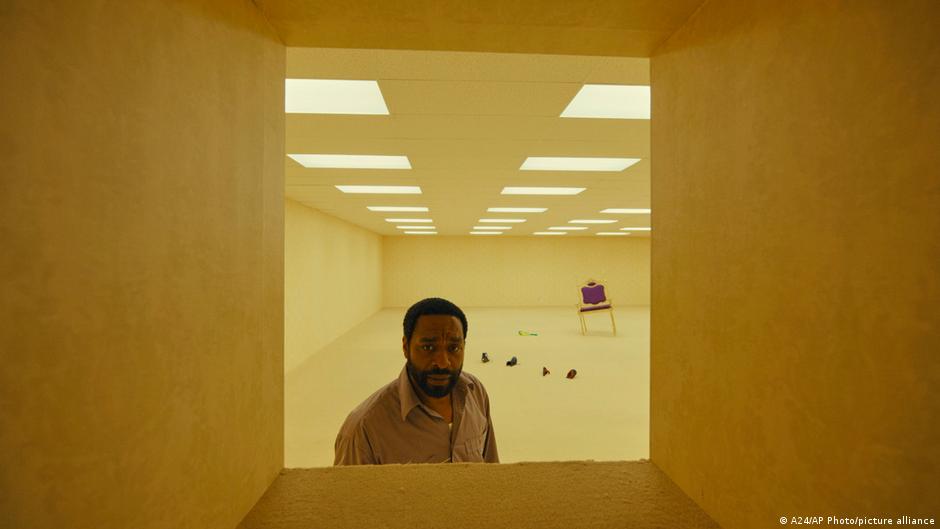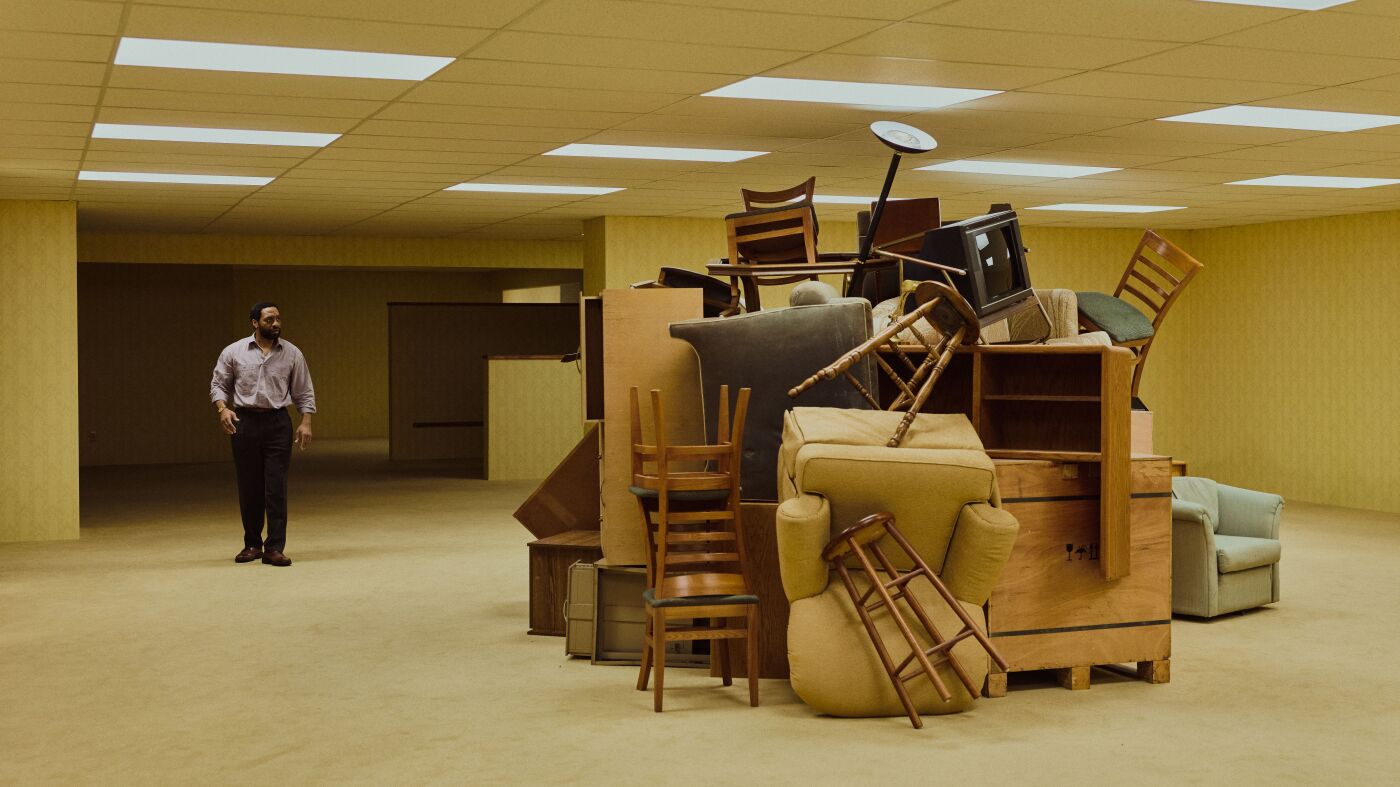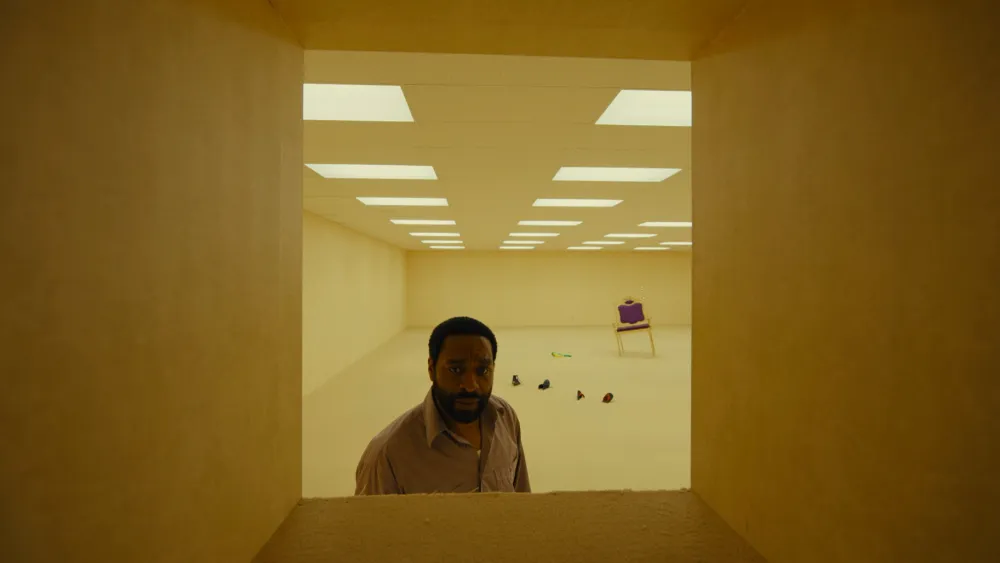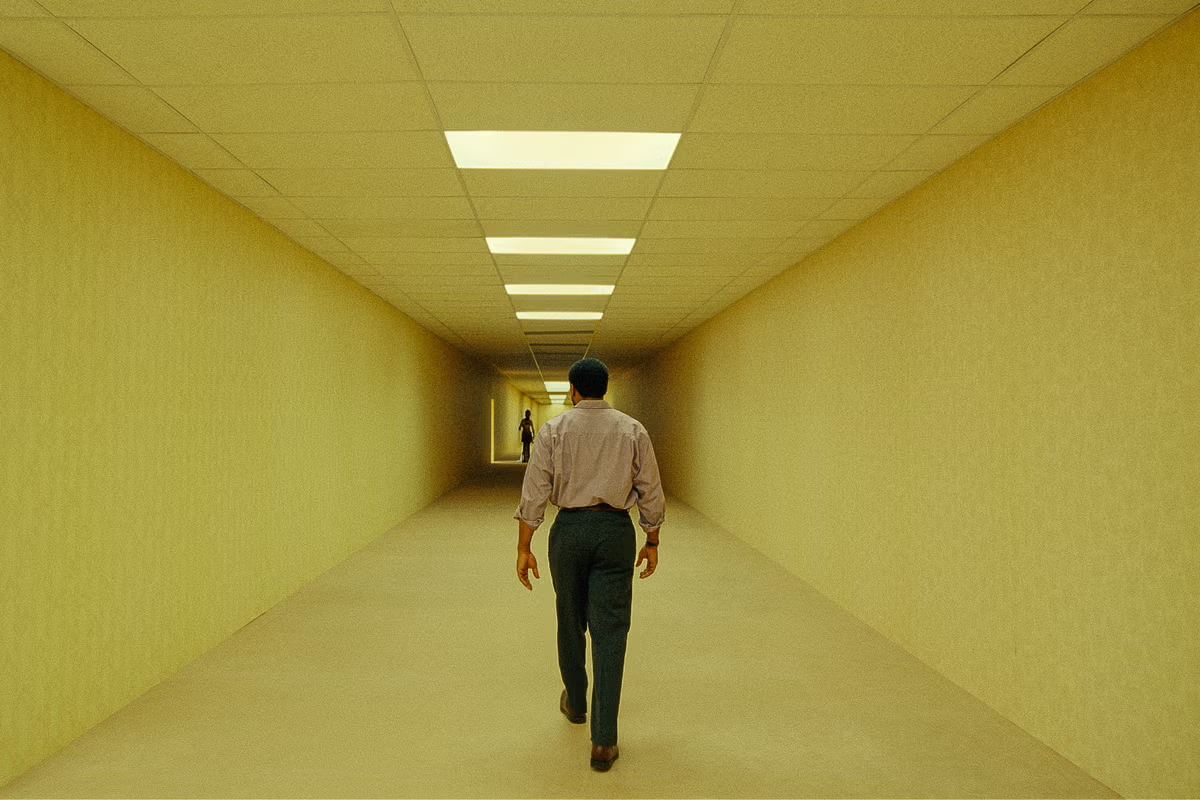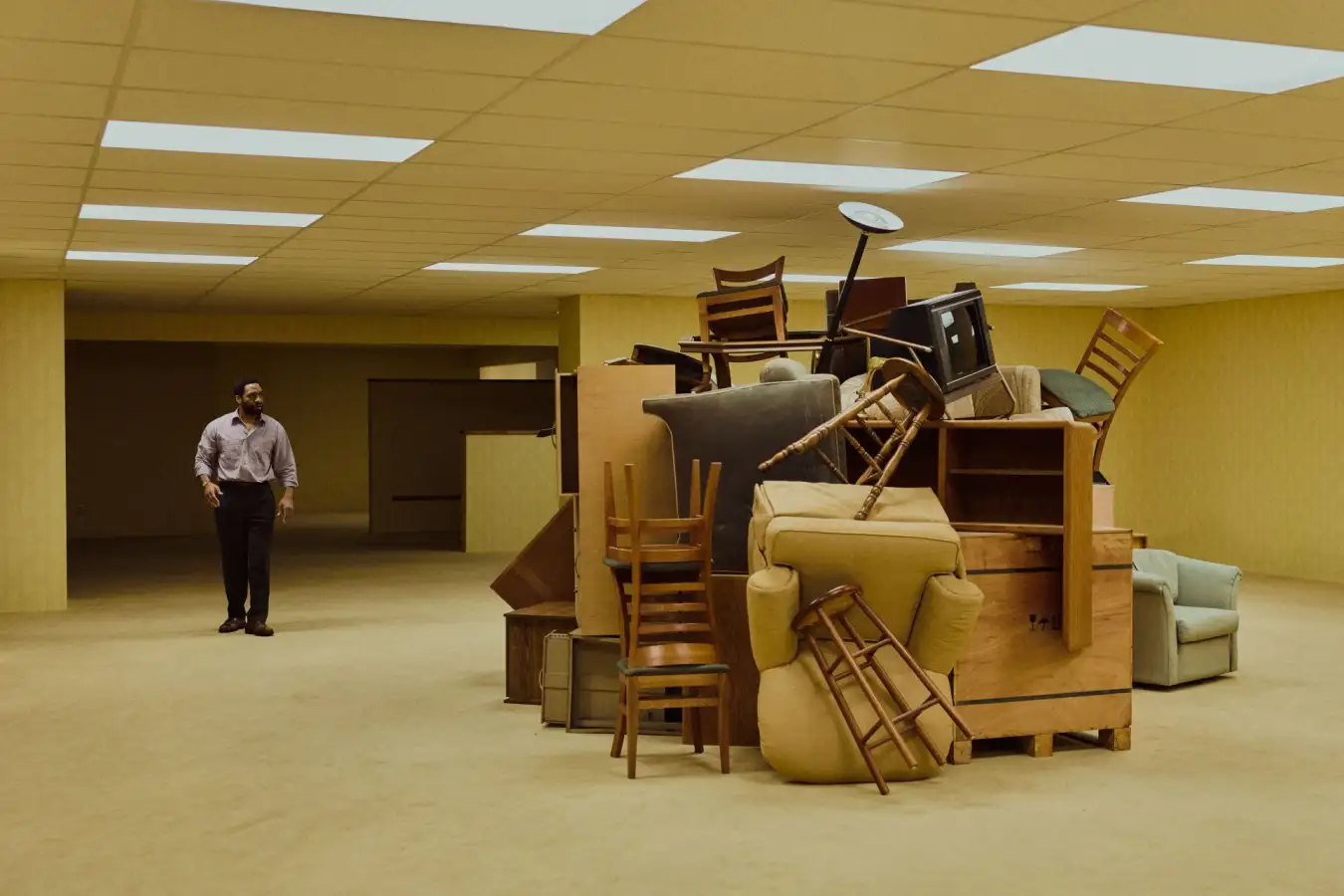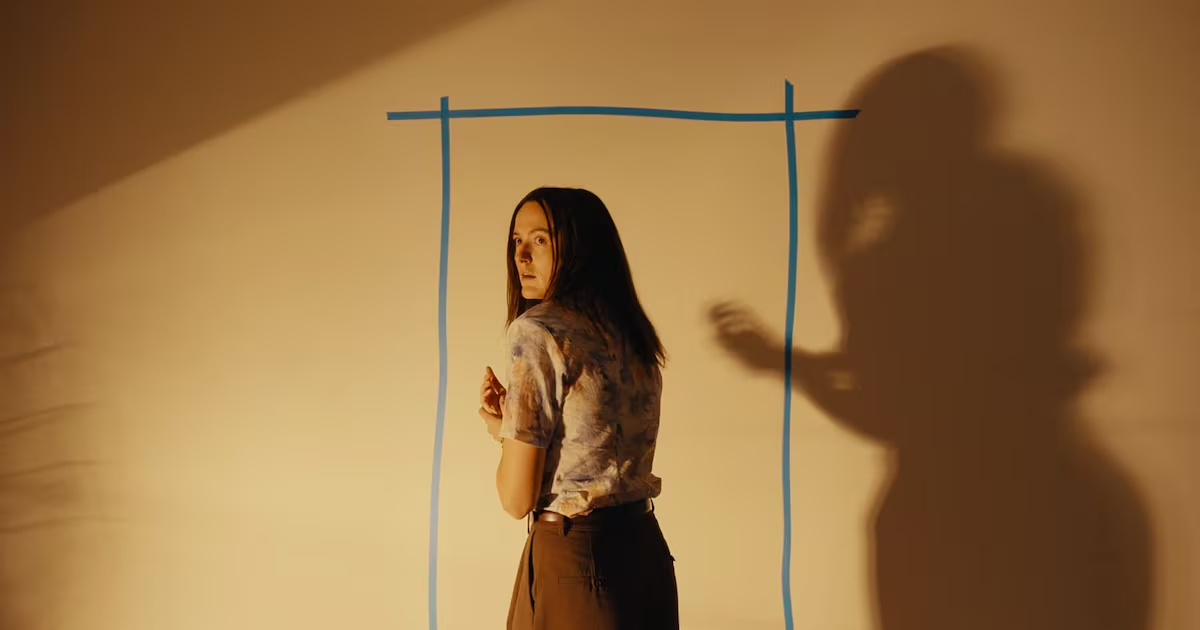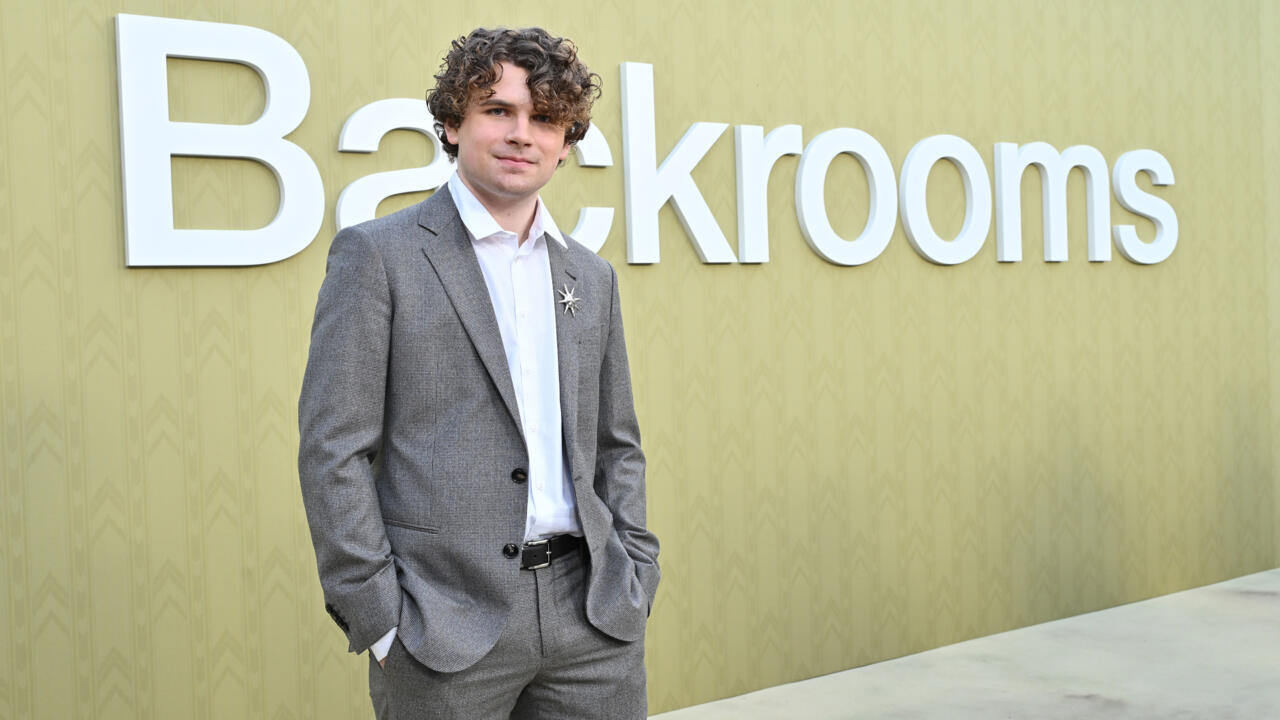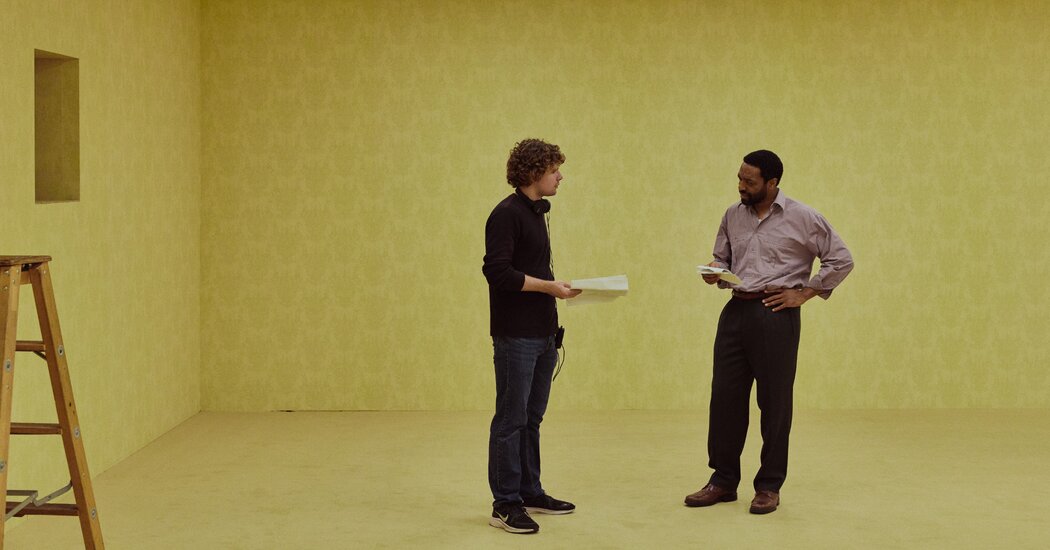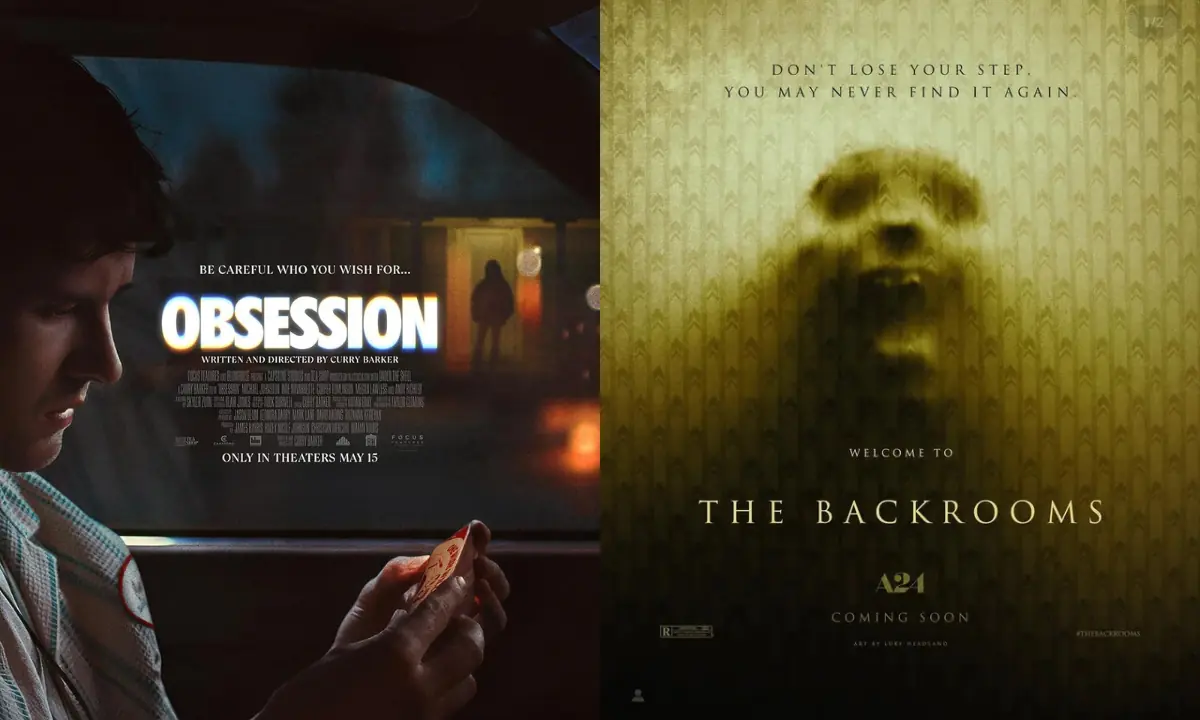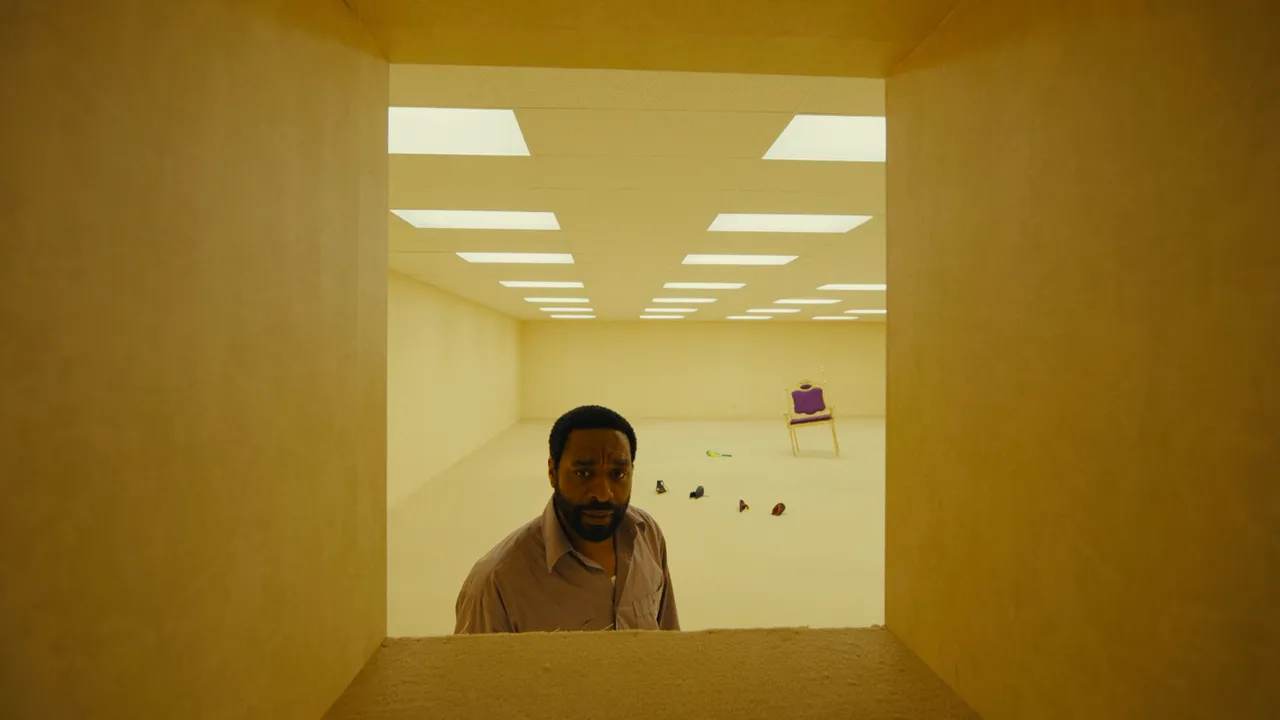
Alice tumbled down a rabbit hole; Lucy wandered through a wardrobe. For Clark (Chiwetel Ejiofor), the middle-aged man-child protagonist of the new thriller “Backrooms,” the portal to another dimension lies in a strip-mall furniture outlet in California’s Santa Clara Valley. Clark owns the store, a depressingly pirate-themed affair called Cap’n Clark’s Ottoman Empire, and it’s about as successful as his recently ended marriage. He needs an escape from this reality, and he finds it, one sleepless night, in the store’s basement-level showroom. Slipping through a wall like a ghost, he enters a maze of the disquietingly mundane—a wasteland of beige carpets, moldering yellow wallpaper, and buzzing fluorescent-light fixtures. Does Clark do the sensible thing, turn around, and flee this nine-to-five Narnia? He does not. A former architect, he wanders, fascinated, around corners and through crawl spaces, taking particular note of the furniture, much of which is drably interchangeable with his store’s wares. In one cavernous room, chairs, barstools, halogen lamps, and storage units have been stacked atop one another, as if someone had been trying to erect a barricade—but who, or what, is being kept at bay?The twenty-year-old director Kane Parsons envisions the Backrooms as a way station of the inexplicably familiar, where our terror arises less from jump scares (though there are a few) than from a droning, dread-soaked ambience. Like the recent Japanese video-game adaptation “Exit 8,” which transformed a subway station into a nightmarish, white-tiled infinity loop, “Backrooms” is an ingeniously contoured exercise in liminal horror. It is also—despite, or perhaps owing to, some self-consciously analog touches—a slick and sophisticated piece of cinematic refurbishment. The concept of the Backrooms originated in 2019, in a 4chan post featuring a low-grade photograph of a yellowing office space and a vivid text description of “approximately six hundred million square miles of randomly segmented empty rooms to be trapped in.” Thus was born a creepypasta—a term that does not mean a plate of squid-ink farfalle but, rather, a freaky urban legend, built for online dissemination. In 2022, Parsons, then a teen-ager, made a short film, “The Backrooms (Found Footage),” and uploaded it to his YouTube channel. It became a viral sensation, spawning a more than twenty-episode web series and eventually this movie, with Parsons in the director’s chair.The feature-length “Backrooms,” which was written by Will Soodik, is essentially a more ambitious, bigger-budget extension of the series. It’s 1990, and the production design, by Danny Vermette, evokes the period with a marvellously ugly specificity: floppy disks and fax machines, chunky gray computers and TV sets, and lumpy floral-patterned sofas straight out of a Bob Barker-era “The Price Is Right” display. It’s a sad backdrop for a sad story: Clark, recently kicked out of his house, has taken to sleeping in his own showroom. His attitude is at once desperate, indignant, and entitled. Meeting with his shrink, Mary (Renate Reinsve), he opens up about his drinking problem, but also rages against his ex-wife, claiming that he was their sole provider for years. Parsons films the therapy session with a detachment that mimics Mary’s calm and mocks Clark’s anger; here, we can tell, is a man who demands respect, especially from women.After stumbling upon the Backrooms that first night, Clark returns to them again and again, like a man obsessed. He becomes bent on mapping them out and uncovering their secrets, and Ejiofor lends him a fanatic’s wide-eyed conviction, as if this great mystery might give his life new meaning. In an underdeveloped twist, Clark persuades his skeptical assistant, Kat (Lukita Maxwell), and her more gullible boyfriend, Bobby (Finn Bennett), to enter the Backrooms with him, armed with Bobby’s camcorder. It’s here that “Backrooms” briefly becomes a found-footage movie, and one that notably takes place before found-footage movies were a thing. (When Bobby descends to a much darker, scarier lower level of the Backrooms, you’re reminded of the shaky-cam suspense of “The Blair Witch Project,” which, in 1990, is still almost a decade away.) It soon becomes clear that something large, hulking, and dangerous is stalking them through the maze—and, eventually, it will bear down on Mary, who also gets sucked into the Backrooms and even supplants Clark as the story’s protagonist.If a more readily watchable screen actor than Reinsve has emerged in recent years, they aren’t coming to mind. In a drama, she can hold you rapt with a hushed line reading; here, she also gets your pulse racing, whether she’s dodging an assailant or racing up a staircase suspended over a seemingly bottomless chasm. We cling to Mary even when the script saddles her with flashbacks to a formatively miserable childhood, or when we hear drearily revealing excerpts from a self-help book she’s written: “We all have our loops, our habits, behaviors that keep us walking in circles.” We scarcely need such subtextual nudging to grasp that the Backrooms are, like the circular maze of “Exit 8,” a metaphor for a life of fearful, self-protective routine. They are also, it seems, a storehouse of the subconscious, filled with the demons and detritus of old memories, some of which—a woman with many shard-like faces, an overgrown, sentient pirate statue—appear distorted to the point of abstraction.The eerie conceptual power of the Backrooms hinges on these ideas and associations remaining just beneath the surface; it’s the unyielding opacity of the environment that sustains its mystery. The film is at its best early on, as Clark wanders through a physical environment that, to his mind and ours, has no obvious origin and no clear reason to exist. Ironically, it’s when the script begins to roll out the explanations that the entire edifice threatens to collapse. The deeper we plunge, and the more we get to know the phantasms of Clark’s anguished psyche, the more “Backrooms” seems to shrink, conceptually, into a hard, unsatisfying nubbin of a movie—less an exploration of a strange world than a tidy evisceration of male toxicity. The movie’s closing scenes smack, dispiritingly, of franchise consolidation: a scientist type (Mark Duplass) who has been monitoring the proceedings from afar suddenly takes center frame, tying the events of the film into the web series’ larger mythology. Parsons is an undeniable talent, with a potent gift for atmosphere, but a sharper resolution to “Backrooms” might have increased my excitement at the promise of more to come.As of this writing, “Backrooms,” buoyed by strong word of mouth and a shrewd marketing campaign by its distributor, A24, is projected to earn an astonishing seventy million dollars in its opening weekend. Remarkably, it isn’t the first time this month that a horror-themed big-screen début from an enviably young YouTuber has surpassed box-office expectations. Or crushed them, in the case of “Obsession,” the shoestring-budgeted first feature from the twenty-six-year-old director and writer Curry Barker, who got his start directing horror and comedy shorts and posting them online. “Obsession,” which was acquired by Focus Features after premièring at the Toronto International Film Festival, opened in theatres on May 15th, and has since grossed more than a hundred million dollars worldwide—well over one hundred times its production costs. Might a generation raised on social media, a force often credited with hastening the death of theatrical moviegoing, instead prove to be its salvation?In any event, the success of “Obsession” is an independent filmmaker’s dream-come-true scenario, which is amusing considering the movie’s attitude toward wish fulfillment: it’s “The Monkey’s Paw” by way of “Fatal Attraction.” In lieu of a paw, the story turns on a novelty item called a One Wish Willow, which, when snapped in two, grants the snapper any one thing their heart desires. Bear (Michael Johnston), a nice, somewhat withdrawn music-store employee in his twenties, wishes that his beautiful friend, crush, and co-worker Nikki (Inde Navarrette) would love him “more than anyone in the fucking world.”What’s striking about Bear’s wish—which he makes, impulsively, after giving Nikki a ride home—is what does and doesn’t happen next. Nikki doesn’t suddenly hurl herself at Bear and shower him with kisses. She walks over to him slowly, as if propelled by forces beyond her control, looking more confused than smitten. “Nikki, are you O.K.?” Bear asks, uncertain whether his wish has come true. Before long, there’s no doubt that it has—and Bear, whatever his initial concern, and despite his superficial nice-guy pose, is all too happy to reap the benefits. He falls into Nikki’s arms, at which point Barker unleashes a falling-in-love montage so aggressively cute, and yet also so deliberately perfunctory, that you can just about hear him cackling over the saccharine soundtrack.From the beginning, and with rigorous narrative concentration, “Obsession” complicates and defamiliarizes an age-old fantasy premise. What if, rather than merely taking the granting of a wish for granted, as fairy tales have long primed us to do, we witnessed the phenomenon as a series of mounting emotional and psychological ruptures—a supernaturally supreme violation? Nikki’s every loving gesture toward Bear is, tellingly, accompanied by a hateful counter-reaction: the spectacular by-product of a losing battle with not only the unseen entity that has seized control of her but also with the man who made it happen. Nikki will not go quietly. In an early moment of intimacy, she recoils from Bear with a sudden scream of fear—then just as quickly snaps out of it, pretending that everything is fine. A later public act of self-harm is, more than terrified onlookers realize, a brutal cry for help. Puncturing her captor’s fantasies of romantic bliss with blood-curdling rictus grins and banshee howls, Navarrette dramatizes the loss of bodily and spiritual autonomy with as totalizing a sense of internal conflict as any actor since Betty Gabriel, in “Get Out” (2017).Here, as in “Backrooms,” the villain of the piece turns out to be a male protagonist, one whose unexamined selfishness turns out to have horrific consequences for others. (Crucial to the plot are two other co-workers, played by Cooper Tomlinson and Megan Lawless, which gives “Obsession” a hilarious secondary moral: be careful how many horny twentysomethings you employ at your not terribly busy music store.) But not all social-media-savvy horror wunderkinds are created equal, and the differences between Parsons’s and Barker’s films are instructive. “Backrooms,” outwardly the more visually striking and self-consciously elevated of the two, gets tangled in its own ambitions, and ends on a disappointingly conventional note. “Obsession,” by contrast, opens in the realm of the straightforward and ultimately reveals itself to be something far more thoughtful and subversive. The finale is blackly comic perfection—a meticulously timed series of misunderstandings, complete with a rogue bottle of poison, that reminded me of nothing so much as “Romeo and Juliet.” As for the tragedy of Nikki’s displacement from her own body, it raises the ghost of another Shakespearean end: exit, pursued by a Bear. ♦
With “Backrooms” and “Obsession,” Hollywood Is Having a Zoomer-Horror Renaissance.
“Backrooms” and “Obsession,” both directed by precocious YouTube-trained talents, breathe shivery cinematic life into urban legends and cautionary tales.
1,789 words~8 min read