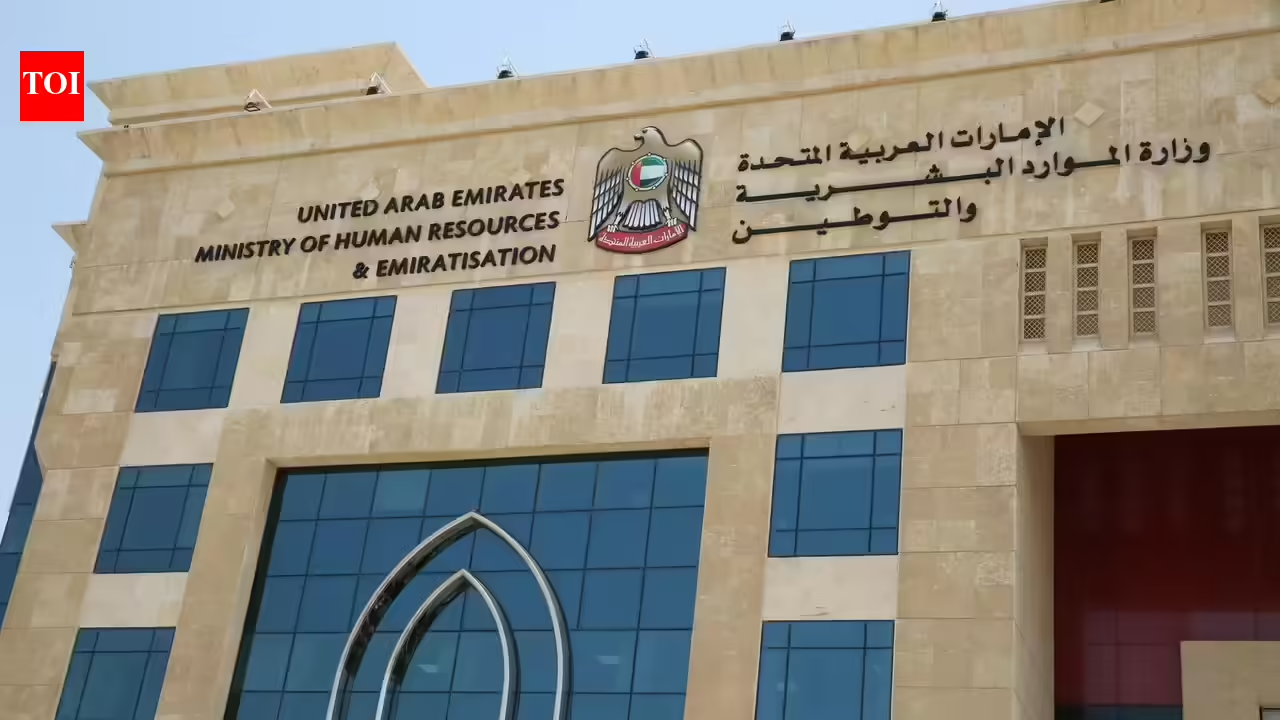
Private sector establishments must pay employee wages by the first day of each monthLast updated: May 31, 2026 | 11:495 MIN READSuppliedThe Ministry of Human Resources and Emiratisation (MoHRE) has begun implementing the new Wage Protection System (WPS) tomorrow, Monday, 1 June 2026, under which the first day of every calendar month will serve as the unified salary due date for workers in private sector establishments for the preceding month. Any payment made after this date will be considered delayed.The new system, introduced under Ministerial Resolution No. 340 of 2026, requires all establishments registered with MoHRE to pay employee wages on the designated due date through the Ministry-approved Wage Protection System or any other payment systems approved by the Ministry for this purpose.Get updated faster and for FREE: Download the Gulf News app now - simply click here.All establishments are also required to submit the documents and data necessary to verify wage payments in accordance with the regulations and procedures established by the Ministry.Wage compliance calculation method
The new Wage Protection System establishes regulatory thresholds and procedures for assessing employers’ compliance, without affecting workers’ entitlement to their full wages and while taking into account legally permissible deductions under Article 25 of Federal Decree-Law No. 33 of 2021 on the Regulation of Labour Relations.Under these provisions, an establishment will be deemed compliant if it transfers at least 85% of the total wages due to its workforce by the salary due date. Similarly, an employee will not be considered unpaid if he or she has received at least 85% of the wage due, without prejudice to the employee’s right to claim any outstanding amounts.Six measures for delayed wage paymentsThe new system outlines a graduated enforcement mechanism for establishments that fail to pay wages on time, while respecting the powers of judicial authorities, the Public Prosecution, and other competent bodies.The measures include:Electronic Monitoring: Beginning from the due date and continuing until payment is verified, the establishment will be electronically monitored to ensure compliance.Notifications and Alerts: Starting from the second day after the due date, non-compliant establishments will receive notices and reminders to settle wages. These continue until payment is confirmed or the next enforcement stage is reached.Suspension of New Work Permits: The Ministry may suspend the issuance of new work permits for non-compliant establishments.Employer Notification: The employer will be formally notified of the reasons for the suspension.Official Warning: A formal payment warning will be issued to the employer on the fifth day following the salary due date.Administrative Penalties: On the eleventh day after the salary due date, administrative fines stipulated under Cabinet Resolution No. 21 of 2020 may be imposed, and repeat offenders may be downgraded to Category Three under Resolution No. 209 of 2022 if the violation recurs within six months.Actions following the final warning periodIf wages remain unpaid by the sixteenth day after the due date, MoHRE will automatically register an individual or collective labour dispute on behalf of affected employees, depending on the circumstances.This applies to establishments employing 25 workers or more across all sectors, as well as establishments under common ownership where the combined number of unpaid workers reaches 25 or more in sectors such as:1. Construction2. Transport and storage3. Security services4. Cleaning services5. Recruitment agencies6. Domestic worker recruitment officesThe sixth and final enforcement stage is triggered on the twenty-first day after the salary due date.For establishments employing fewer than 50 workers, an executive instrument may be issued for wage recovery. For establishments with 50 workers or more, collective labour dispute procedures may be initiated.Additional measures may include:Precautionary attachment of the establishment’s assetsTravel bans on responsible officialsReferral of the case to the Public Prosecution and relevant authoritiesSubmission of all relevant documents, records, and evidence for legal actionWhere an establishment employs more than 50 workers, these measures may be applied if violations are repeated over two consecutive months.Referral to the Public ProsecutionMoHRE explained that establishments employing 50 workers or more may be referred to the Public Prosecution if wage payment violations are repeated.The same applies to establishments under common ownership when the total number of unpaid workers reaches 50 or more in sectors including construction, transport and storage, security services, cleaning services, recruitment agencies, and domestic worker recruitment offices.Referral may also occur whenever the violation poses a risk to labour market stability, regardless of the size of the establishment.Exemptions from Wage Protection Calculations