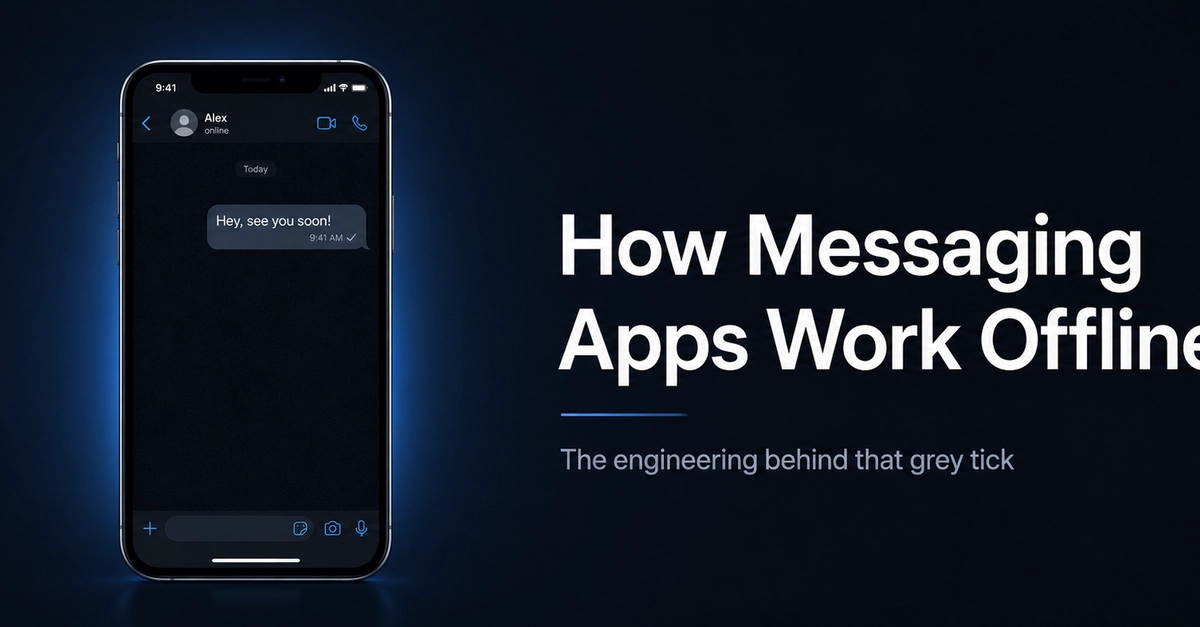
You're on the subway, signal drops to zero, and you still tap send on that message. A single grey tick appears. Your phone didn't throw an error, the app didn't crash, and somehow that message will reach your friend the moment you get back above ground. How does that actually work? Let's break it down.x
Why Messaging Apps Need Offline Support
Think about how you actually use your phone. You're in an elevator, on a flight, driving through a tunnel, or just in a building with terrible WiFi. Connectivity is not a constant, it's a privilege that comes and goes. If WhatsApp only worked when you had a perfect internet connection, it would be practically useless in the real world.
This is why modern messaging apps are built with what engineers call an offline-first architecture. The core idea is simple: the app should work as close to normal as possible even without internet, and quietly reconcile everything with the server the moment connection returns. The user should barely notice the difference.
What Actually Happens When You Hit Send Without Internet