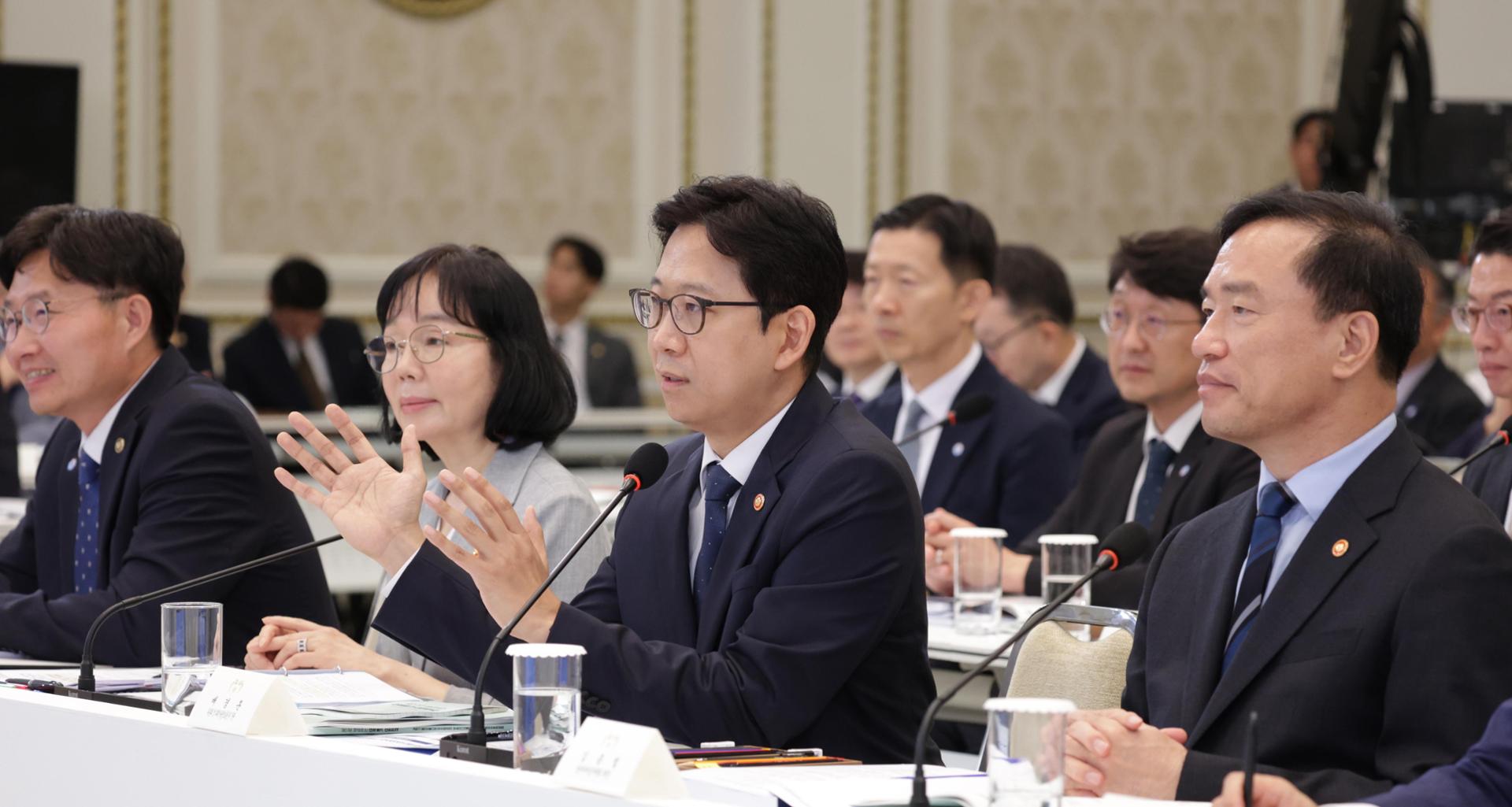
Bae Kyung-hoon says stronger investment in GPUs, data and talent is needed to secure sovereign AI capabilities Deputy Prime Minister and ICT Minister Bae Kyung-hoon speaks at a press conference in Seoul on Friday. (Ministry of Science and ICT) South Korea should now try to build frontier artificial intelligence models on par with those of the US and China, Deputy Prime Minister and ICT Minister Bae Kyung-hoon said Friday, calling for a broader AI strategy that goes beyond industrial applications.“We have reached a point where Korea, too, should take on the challenge of building frontier AI models at a level comparable to those of the US and China,” Bae said at a press conference in Seoul marking the government’s first year in office.Korea’s AI strategy has so far leaned heavily toward areas where the country already has industrial strengths, including semiconductors, manufacturing and physical AI.“To provide general AI services, we now need the level of capability seen in models such as Claude, Gemini and ChatGPT,” he said. “With the emergence of frontier models, a new question has been raised.”Frontier AI models refer to the most advanced general-purpose systems being developed by companies such as OpenAI, Google and Anthropic. Building them requires massive computing power, high-quality data and top-tier talent, all of which have become critical in the AI competition between the US and China.Bae, an artificial intelligence expert who previously headed LG AI Research, the artificial intelligence arm of LG Group, has been one of the key figures behind the government’s push to make Korea one of the world’s top three AI powers.Still, he acknowledged that Korea is not investing at the level of leading US technology companies.“The government’s entire AI budget is effectively around the level of investment made by a single US Big Tech company,” Bae said. “To build frontier-class models, technology alone is not enough. Talent, data and infrastructure are all necessary.”Korea’s technological capabilities have improved, he said, but the computing infrastructure available to local AI companies remains limited.“The infrastructure currently provided to companies developing sovereign AI foundation models is still far from enough for them to challenge frontier models,” Bae said. “But if investment in GPUs and AI infrastructure becomes more aggressive, I believe Korea can take on that challenge.”The gap is notable for a country that is home to Samsung Electronics and SK hynix, two of the world’s dominant memory chipmakers. But training cutting-edge AI models depends heavily on large-scale GPU clusters and AI data centers, an area where Korea is still catching up.Bae said the government is discussing broader investment in GPUs, data and talent, while working to build public consensus around Korea’s entry into the frontier model race.He also said Korea’s AI strategy should not be reduced to securing foreign chip suppliers.“Advanced Micro Devices Inc. could be a partner, and Intel could also be a partner,” he said. “But rather than focusing on strengthening a partnership with a particular global company, what matters is creating a system in which the government can make use of the achievements of Korean AI semiconductor companies within the existing GPU procurement strategy.”In his opening remarks, Bae said Korea is “on course” to become one of the world’s top three AI powers. Citing the 2026 AI Index Report by Stanford University’s Institute for Human-Centered Artificial Intelligence, he said Korea’s tally of notable AI models rose to eight for 2025, up from one for 2024, placing the country third globally.But he stressed that global partnerships cannot replace Korea’s own AI capabilities.“Having our own AI capability is extremely important,” he said. “Only then can we apply AI in ways that suit our own needs. In cybersecurity as well, securing our own AI capability is essential.”As part of that effort, the ministry plans to announce the results of the second phase of Korea’s sovereign AI foundation model project in the second half of the year and begin construction of a national AI computing center. It also plans to support wider use of locally developed AI semiconductors in data centers and products made by major Korean companies.The public service, called “AI for All,” is expected to be introduced by the end of the year. Bae said it would be built on Korean foundation models and offer chatbot functions as well as personal AI agents, including versions designed for older adults and digitally vulnerable groups.The government aims to provide the service free of charge to all citizens through 2028.
Korea should join frontier AI race dominated by US, China: Science minister
South Korea should now try to build frontier artificial intelligence models on par with those of the US and China, Deputy Prime Minister and ICT Minister Bae Ky
737 words~3 min read