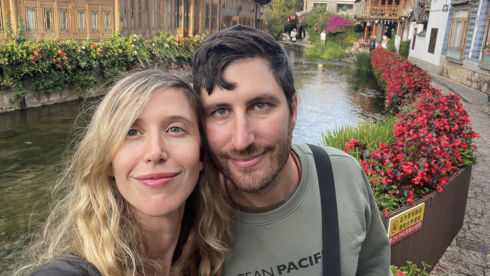
They planned to spend six months traveling before returning to their routine in Israel, but 3 years and 44 countries later, Roni and Eric are still working remotely, living out of suitcases and embracing a life of constant movement, despite fears about spending 24/7 togetherAssaf Kamar|Three years ago, Roni and Eric left their apartment in Tel Aviv and boarded a flight to Greece to see what life without a permanent address might look like. Since then, they have worked remotely, swapping countries like socks, sleeping in remote villages and trying to figure out how to live in the world with as few possessions as possible — and as many experiences as they can fit in."We've been together for more than five years, and for more than three of those years we've been traveling around the world," Roni, 33, from Tel Aviv, told ynet.5 View gallery Roni and Eric Her partner, Eric, 37, added: "We work from our laptops and travel the world with nothing but a carry-on suitcase and a backpack. We've already been to 44 countries over the past three years."Before becoming digital nomads, their lives looked fairly conventional. Eric studied engineering at the Technion – Israel Institute of Technology and worked as an analyst. Roni, a graduate of Shenkar College's visual communications program, worked as a graphic designer."We loved our life in Israel," Eric said. "It's not like we were miserable and running away from something. We were happy, and it was hard to give up a comfortable routine for some distant dream."Then came the coronavirus pandemic. "We found ourselves spending hours at home with our laptops," Roni said. "And then we asked ourselves: Why not do this from somewhere else in the world?"In March 2023, several months before the outbreak of the October 7th war, they decided to take the plunge. "We just booked the first flight we saw and flew to Greece." From there they continued to Thailand, then another country, and another, and another."We approached it with an open mind," Eric said with a smile. "We told ourselves we'd go on a six-month adventure and then return to our routine. That also made it easier to make the decision, because it's a very scary one."What exactly was frightening? "We were afraid of everything," he said with a laugh. "We worried about work, we worried about what would happen to us as a couple spending 24/7 together, we worried about not having anywhere to return to. But in the end, we were more afraid of missing out on our dreams than of the uncertainty."Roni agreed. "We also realized we could always come back. It's better to be brave and take that step than stay in the same routine and spend the rest of your life wondering what would have happened if you'd tried."5 View gallery Enjoying a festival in the Chinese city of Kaifeng 5 View gallery For these digital nomads, the office can be just about anywhere Unlike many digital nomads who spend months in the same location, the couple prefers to keep moving."We're really living the nomadic lifestyle," Roni said proudly. "A lot of the time we move somewhere new every week." China, in particular, became one of their most memorable destinations. "We visited 20 different cities there," she said. "Not just Shanghai or the most Westernized places. We went to villages, nature reserves, Tibetan regions and places at incredible altitudes.""I really miss China," Roni said. "It was an incredible surprise for me. It's a huge country, almost the size of Europe. There are different cultures, languages and customs. We traveled there for three months, and every few days it felt like we were entering a different world."On one hand, everything is incredibly advanced — amazing trains, technology and massive cities. On the other hand, there are very authentic villages and regions that look as if time has stood still."Their most unsettling experience in China took place in one of the country's more remote regions."We arrived in a Tibetan area called Kham," Eric said. "It's a stunning mountainous region with a very different culture, and while we were there we witnessed a traditional Tibetan sky burial ceremony."According to Eric, the religious ritual involves vultures consuming the deceased's body. "In their belief, the vultures carry the person to the heavens. For them, it's a final act of giving back to the world and to nature."How can anyone watch something so disturbing? "It's very unsettling," he admitted. "We stood there with the deceased person's family and friends, and the atmosphere was nothing like the funerals we're used to. People were eating, talking. There wasn't a sense of hysteria or devastation. For them, death is a natural part of the cycle of life."Roni said the experience reflected an entirely different worldview. "We try to arrive in places without judgment, to understand how other people live and what we can learn from them."In the heart of a gray Chinese city far from the tourist trail, the couple set out to find traces of one of the world's most mysterious Jewish communities."We heard about a Jewish community that arrived in China from Persia around a thousand years ago," Eric said. "These are people who feel Jewish, but no one really accepts them because their Jewish identity was passed down through the father rather than the mother."Over the years, he said, their Jewish identity gradually eroded. "Their synagogue was destroyed more than a century ago, and the tradition slowly disappeared."The couple traveled to the ancient city of Kaifeng in search of descendants of the community — only to discover that they had become the attraction themselves. "It was a crazy place," Roni said with a laugh. "There were huge crowds, costumes, performances, animals and giant attractions — and not a single Westerner besides us."Within minutes, they found themselves attracting attention from every direction. "People just stopped to stare at us. Children ran after us, people came up to say hello, and some even thought we were part of the festival entertainment."Eric laughed. "There were decorated donkeys and horses there, so from their perspective, a Western couple they'd never seen before in their city was just another attraction.""People were literally lining up to take pictures with us," Roni added.But behind the amusing experience was a search that ultimately came up empty."The day after the festival we went looking for remnants of the ancient Jewish community," Eric said. "We knew the synagogue no longer existed. We'd read that another building had been constructed on top of it, but we thought maybe there were still buildings in the area that had once belonged to Jewish families."The couple spent hours wandering through the narrow alleys of Kaifeng's historic Jewish quarter."We didn't really find any physical trace of Jewish life," Roni recalled. "But those places without tourists were actually the ones that moved us the most."From there they continued to a futuristic city that made them feel as if they had stepped into a science fiction film. "Chongqing is one of the craziest cities in the world," Eric declared.According to him, the city is built in a way that's almost impossible to explain to someone who has never been there. "It's extremely mountainous, and they've come up with incredible engineering solutions. You're constantly losing your sense of direction."One of the city's most iconic landmarks is a subway line that passes directly through a residential building. "It's become an attraction in itself. People stand there taking pictures as if it's a show." Roni described the city's skyline as "Manhattan on steroids."5 View gallery Chongqing (Photo: Eric Zav)Remote work from China, however, proved more complicated than expected."China requires preparation," Eric said carefully. "The internet is restricted, so you need to download a VPN and various apps in advance. But once you understand how things work, it's actually a great place to work.""People think we're sightseeing all day," Roni said with a laugh. "But in reality, we work completely normal jobs. The only difference is that instead of an office in Tel Aviv, it might be a café in China."According to the couple, the lifestyle requires almost obsessive planning."We plan everything in advance," Eric said. "We have organized spreadsheets, workdays, places with reliable internet and schedules that match Israeli business hours across different time zones. But at the end of the day, we just sit down with our laptops and work."And what about money? Life on the road, they said, is significantly cheaper than maintaining a middle-class lifestyle in Israel."China really surprised us in terms of prices," Roni said. "You can find excellent hotels at very reasonable rates. Food is inexpensive and the transportation system is fantastic."Still, they stress that their lives are far removed from any millionaire fantasy. "We're not living in a movie," Roni said candidly when asked whether everything is really perfect. "We argue like any other couple. We just talk about everything. Communication is the most important thing in a relationship."One of their solutions is simply not spending every moment together. "We try to rent apartments with two rooms," Eric said. "That way each of us has our own space to work and spend some time alone."5 View gallery Roni and Eric in China (Photo: Courtesy)But alongside the romance of constant travel came some very difficult moments. Early in their journey, while in Thailand, Eric contracted a severe tropical disease transmitted by mosquitoes."I got a pretty serious case of dengue fever on Koh Tao," he said. "I spent two weeks in a small hospital with a high fever and severe pain. There was one doctor who came by once a day — and I'm not even sure he was really a doctor."His condition deteriorated rapidly. "Eventually they transferred me by sea ambulance to a hospital on Koh Samui — basically a rescue boat with a paramedic on board. And even that boat broke down in the middle of the sea. It was right at the beginning of our journey. I was convinced the whole thing was over."Yet out of the chaos, both say they emerged changed."We're much more flexible today," Eric said. "And more humble. Life is unpredictable, and the control we think we have is largely an illusion."Even when you're living the dream, there are still fears, tensions and crises," he said. "The trick is learning how to make lemonade out of lemons."
44 countries in 3 years: 'We loved our life in Israel, but we were afraid of missing our dreams'
They planned to spend six months traveling before returning to their routine in Israel, but 3 years and 44 countries later, Roni and Eric are still working remotely, living out of suitcases and embracing a life of constant movement, despite fears about spending 24/7 together
1,720 words~8 min read