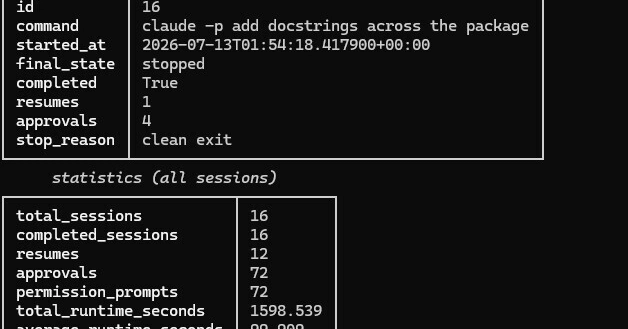
Most people use Claude one prompt at a time. But the interesting territory is unattended operation: an agent that wakes up on a schedule, reads its own notes from last time, does real work with tools, writes down what it learned, and goes back to sleep — for days or weeks, without you babysitting it.
We run Claude this way in production — a long-lived agent operating inside a sandboxed container — so this guide is the patterns that actually hold up, not a thought experiment. It covers the four things every autonomous Claude setup needs: a loop, memory, a schedule, and guardrails.
TL;DR
An autonomous agent is a loop: read state → decide → act with tools → write state → repeat.
Memory is the hard part. Each session starts fresh, so the agent must persist state to disk (or a store) and reconstruct context at the start of every run. No memory = an amnesiac that repeats itself.