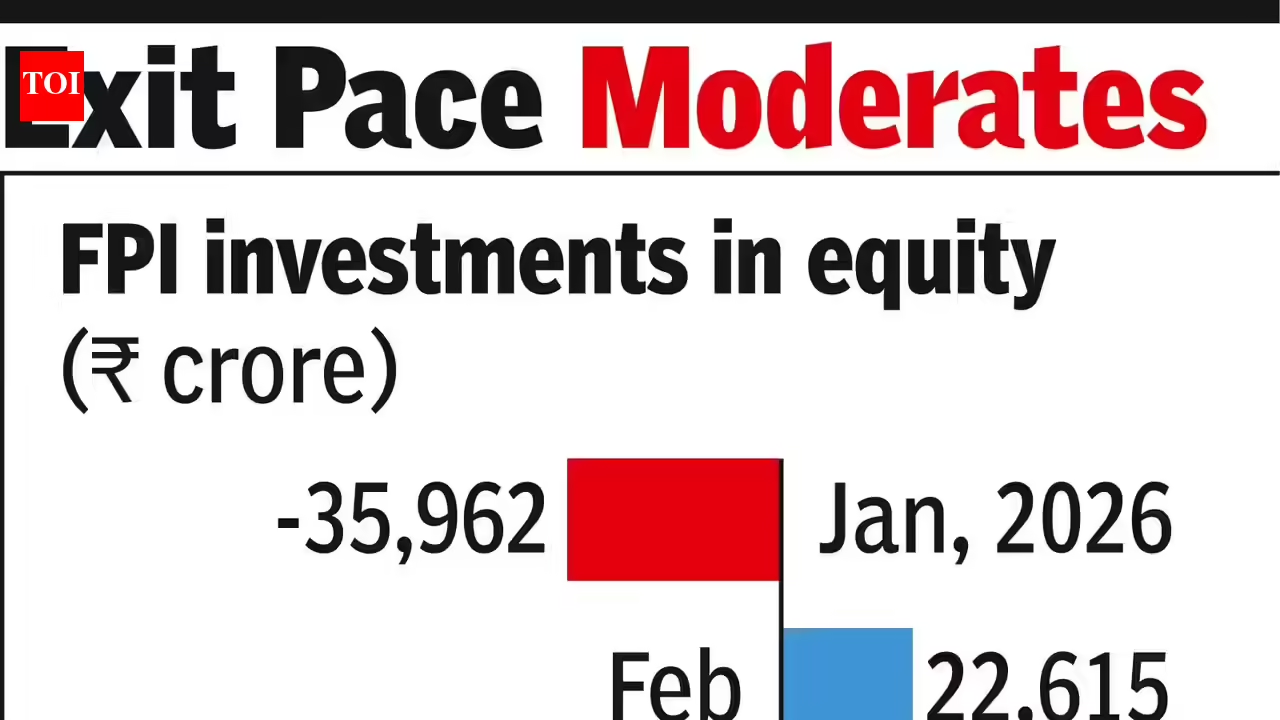
Foreign Portfolio Investors (FPIs) remained net sellers in Indian equities for the third consecutive month in 2026, with net outflows of ₹32,963 crore during May, according to data from the National Securities Depository Limited (NSDL).The selling, however, showed signs of easing in the final week. NSDL data for the four trading sessions of the week ending May 29 showed a mixed picture.On May 25, FPIs recorded a net outflow of ₹6,176.80 crore across all segments. The trend reversed on May 26, when net inflows of ₹2,564.20 crore were recorded.Selling resumed on May 27, with net outflows of ₹1,330.07 crore. The final session of the month, May 29, closed with a marginal net inflow of ₹502.06 crore, pointing to a tentative stabilisation.In equities specifically, the week ended on a positive note. On May 29, equity net investment stood at ₹1,505.22 crore. This followed a net equity outflow of ₹1,029.89 crore on May 27 and net equity inflows of ₹2,194.68 crore on May 26. May 25 saw the steepest single-day equity outflow of the week at ₹5,259.31 crore.Debt markets reflected continued caution. In the Debt-VRR segment, FPIs were net sellers across all four sessions, with the sharpest outflow recorded on May 29 at ₹976.41 crore.The Debt-FAR segment, by contrast, posted net inflows in three of the four sessions — ₹180.54 crore on May 25, ₹224.91 crore on May 26, and ₹99.22 crore on May 29 — while recording an outflow of ₹360.35 crore on May 27.On the monthly tally, FPI selling has accumulated significantly across 2026. According to NSDL data, FPIs had sold equities worth ₹60,847 crore in April and ₹1,17,775 crore in March — the highest monthly outflow of the year.February briefly reversed the trend with net inflows of ₹22,615 crore, while January saw outflows of ₹35,962 crore. Total net FPI outflows from Indian equities in 2026 now stand at ₹2,24,932 crore, with ₹15,497 crore coming in through the primary market route.According to Prashant Shah, Co-founder and CEO of Definedge Securities, “Indian benchmark indices corrected sharply with the Nifty and Sensex falling nearly 8–10 per cent from their early-2026 highs by May end. Between January and April 2026, FPIs pulled out nearly ₹1.8–2 lakh crore from Indian equities, already exceeding the total outflows seen during the whole of 2025. Bond flows also remained negative during the period, although the magnitude was smaller compared to equities.”Analysts attribute the sustained selling to a combination of geopolitical and macroeconomic pressures. “...The primary catalyst for this large-scale withdrawal has been escalating geopolitical tensions in West Asia, which have heightened global uncertainty and risk aversion. This has been compounded by several macroeconomic pressures such as weakening Indian Rupee, higher crude prices,” said Pabitro Mukherjee, Deputy Vice President – Technical, Bajaj Broking.The rupee’s trajectory has been a key concern. “...Rupee which was about 90 to the dollar at the beginning of this year steadily depreciated to 96.96 recently,” noted Dr. V.K. Vijayakumar, Chief Investment Strategist at Geojit Investments Limited.He added that the currency had since recovered to around ₹95 per dollar by May 29. He pointed to the decline in Brent crude as a supporting factor: “...The sharp decline in Brent crude to $92 contributed significantly to the stability in the rupee.”Meanwhile, global capital flows towards AI-driven markets have drawn money away from India. “...Poor earnings growth in India, much superior earnings growth in countries like the US, Japan, South Korea and Taiwan and the strong AI-related trade in these countries...contributed significantly to the FPI selling in India,” Vijayakumar said, pulling flows away from emerging markets like India.Domestic Institutional Investors (DIIs), however, have provided a strong counterweight. Bajaj Broking’s Mukherjee noted that DIIs injected ₹826.68 billion during May, absorbing the ₹559.63 billion in FPI outflows. “...DIIs maintained a flawless buying streak every single day,” he added.“The FII ownership in Indian equities has fallen to a 14-year low of 14.7 per cent, while DII ownership has risen sharply to 18.9 per cent,” Shah pointed out.Looking ahead, market participants see the outlook hinging on several variables. “...Institutional flows in the coming month are likely to remain sensitive to developments around US–Iran tensions, oil-price trajectories and RBI monetary policy outcome and progress of the Monsoons,” Mukherjee said.Vijayakumar added that a turn in AI-related valuations could revive interest: “...Now that there are concerns surrounding the valuations of AI-related stocks and the concentration risk involved...FPI flows into this segment might decline and India may again start attracting FPI flows.”Published on May 30, 2026
FPIs turn net sellers for third straight month in May; DIIs absorb pressure
Selling resumed on May 27, with net outflows of ₹1,330.07 crore; the final session of the month, May 29, closed with a marginal net inflow of ₹502.06 crore, pointing to a tentative stabilisation
741 words~3 min read