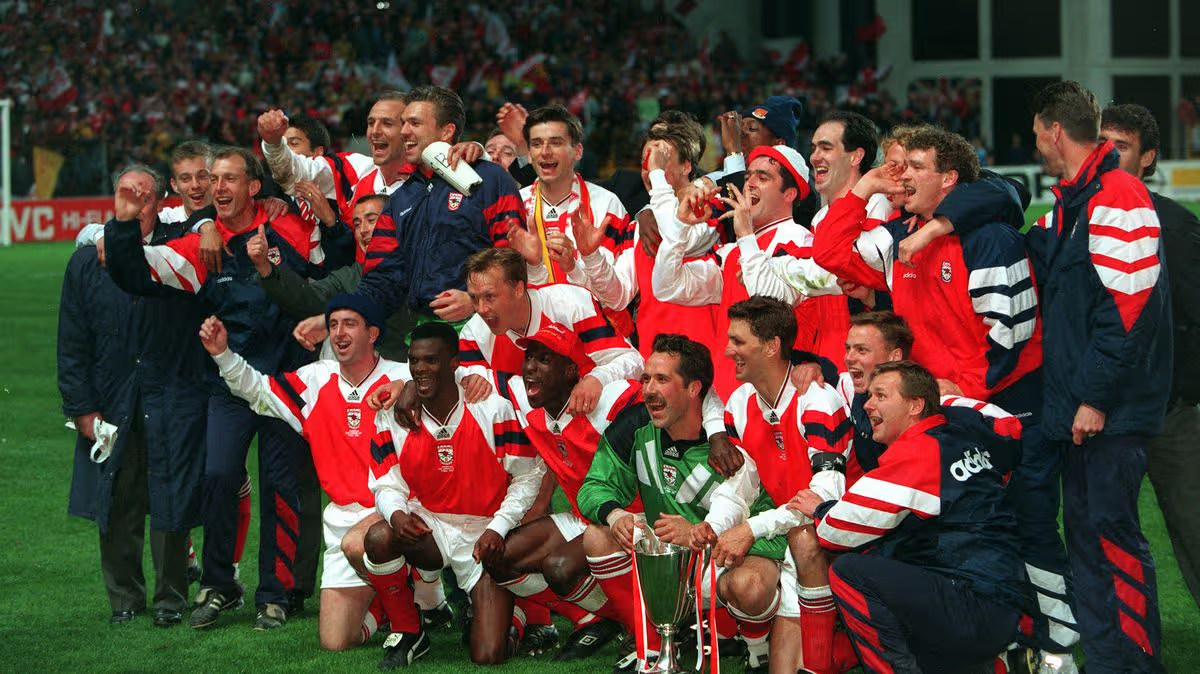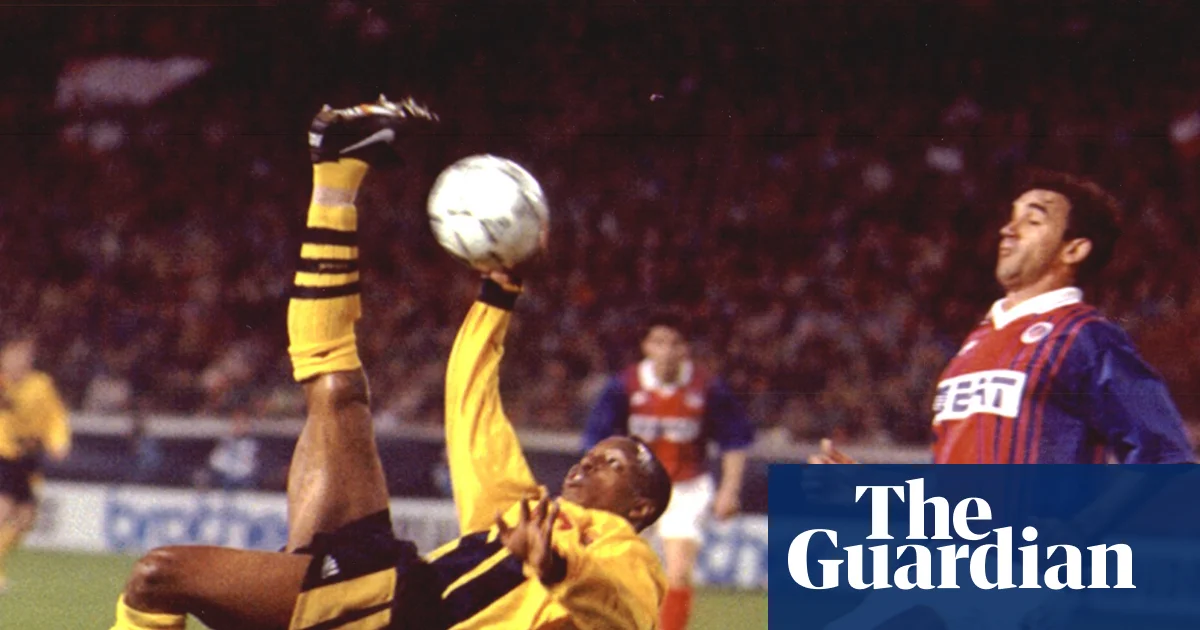
The Cup Winners’ Cup would become a victim of the Champions League’s expansion in the late 1990s, but there could be no questioning the quality of the competition when Arsenal won it in the 1993-94 season. Real Madrid, Ajax, Parma, Torino, Bayer Leverkusen, Benfica and Paris Saint-Germain stood in Arsenal’s way as they tried to win their first European trophy since the Fairs Cup in 1970.The first round was far from encouraging. Arsenal limped past Danish club Odense 3-2 on aggregate. But the 10-0 demolition of Standard Liège – including a 7-0 win in Belgium – took George Graham’s side into a testing quarter-final against Torino.Graham had learned from his previous experience in Europe. Arsenal had been brutally exposed by Benfica in the European Cup in 1991-92 and Graham would not make that mistake again. His team put in a defensive masterclass in Turin, earning a 0-0 draw in the first leg, before Tony Adams headed in the winner at Highbury in the return fixture.Tony Adams heads home the only goal at Highbury to put Arsenal into the Cup Winners’ Cup semi-final. Photograph: Butler/PAArsenal would have to beat PSG to reach the final in Copenhagen. Managed by Artur Jorge – who had won the European Cup with Porto in 1987 – PSG were on their way to their second French title and were stocked with star players, including Valdo, Raí, David Ginola and future Ballon d’Or winner George Weah. They had beaten Real Madrid the quarter-finals and were unbeaten in 35 matches, but Graham thought his side would offer a fresh challenge in the first leg in Paris.“They’ve got a great defence but I don’t think it’s tested week in and week out, like ours,” said Graham. Most fans expected Arsenal to adopt the approach that had worked so well in Turin. Despite playing the same formation – John Jensen, Ian Selley and Paul Davis in midfield, with Ian Wright and Paul Merson supporting lone striker Alan Smith – Arsenal played with attacking intent at the Parc des Princes.Jensen went close to opening the scoring – yes, you read that correctly – before a Davis free-kick (set piece again, ole, ole) was headed home by Wright in the 35th minute. It is often reported that this was the night a new club chant was invented, although some claim to have heard this ditty after the Torino win. What is known is that Go West by the Pet Shop Boys was played at half-time, the PSG fans singing “Allez, Paris Saint-Germain” to the tune. Arsenal fans were quick to respond, adapting this to “One-nil to the Arsenal”. Whatever the origin, it would be the soundtrack to Arsenal’s run-in.John Jensen fights for the ball with PSG player Patrick Colleter. Photograph: Lionel Cironneau/APIan Wright heads home in Paris. Photograph: Anton Want/Getty ImagesGinola nodded home an equaliser early in the second half but Arsenal, led by the inspirational Adams, returned to London with a superb 1-1 draw. “There is still plenty of work left,” said Graham. “Paris Saint Germain are a top-quality side and can play better than they did last night, but so can we.” There was an understandable feeling of caution before the second leg. PSG had won at the Bernabéu in the previous round, and eight Arsenal players went into the second leg with bookings against their name, walking a suspension tightrope should the team reach the final. On a night of pure joy there would be one Arsenal man tasting disappointment on that front.Again Graham must have been tempted to go for a 0-0 draw, knowing it would take his team through on away goals. But Arsenal came out flying in front of a passionate Highbury crowd. They survived an early scare, when David Seaman threw the ball straight to Valdo, and scored the only goal of the game a few minutes later.Lee Dixon’s cross was met with a firm header from Kevin Campbell, beating Bernard Lama at his near post in the seventh minute. Highbury exploded as the ball squeezed home, Campbell lifting his arms to the heavens. For a player who had been struggling with his confidence all season, this was his moment to shine.Kevin Campbell scores at Highbury. Photograph: Colorsport/ShutterstockSadly, attention soon turned to another Arsenal forward. After a senseless tackle from behind on Alain Roche, Wright broke down in tears as the referee reached for his yellow card. “Shades of Paul Gascoigne in 1990,” said commentator Brian Moore, with Wright now ruled out of the final. Wise words from Adams helped Wright regain his composure at the interval and the striker was superb in the second half.An emotional Wright receives the yellow card that will keep him out of the final. Photograph: Mark Leech/Offside/Getty ImagesThe famous back four of Dixon, Steve Bould, Adams and Nigel Winterburn earned the main plaudits, as Arsenal refused to buckle. A delicious one-nil to the Arsenal had set up their first European final in 14 years. “Arsenal’s was a rain-swept triumph for disciplined defending, power, pace and penetration on the break – and above all a typically English intensity, which French teams will always find hard to live with,” David Lacey wrote in the Guardian. The scramble to get to Copenhagen for the final against Parma was now on.Thousands upon thousands of Arsenal fans took planes, trains and automobiles (and possibly boats) to the Danish capital. Arsenal were the underdogs against their expensively assembled opponents. Already without the suspended Wright, their preparations were further derailed when Martin Keown, Jensen and David Hillier were ruled out through injury.“The greater the odds against us, the better we seem to perform,” said an upbeat Graham on the eve of the match. But even the most optimistic fan would recognise that Parma were daunting opponents. Backed by the food corporation Parmalat, the club had taken a shortcut to success. They had reached Serie A for the first time in 1990, qualified for Europe in 1991, won the Italian Cup in 1992 and the Cup Winners’ Cup in 1993. Containing the attacking talents of Faustino Asprilla, Gianfranco Zola and Tomas Brolin, and five of Italy’s squad for the World Cup later that summer, it was little wonder that Parma were 10/11 favourites.“Asprilla, Zola and Brolin may give Graham’s team a footballing lesson, but the final is more likely to be dominated by defences,” wrote Lacey in his Guardian preview. “In which case it would be most unwise to write off Arsenal.” A battle between the irresistible force and the immovable object awaited.If Arsenal needed a 12th man, the crowd in the Parken Stadium helped. The ground was turned into Highbury for the day, with the atmosphere growing after a slow start from Arsenal. Parma began on the front foot, with a brilliant Bould tackle denying Asprilla in the first minute, and Brolin headed on to the roof of the net shortly after. He went close again, hammering an effort past Seaman, but the ball rebounded off the post and to safety. And then, after 20 minutes, came the moment the Arsenal fans had hoped for.Arsenal fans at the Parken Stadium in Copenhagen. Photograph: PA Images/AlamyDixon’s floated through ball was miskicked in comical fashion by sweeper Lorenzo Minotti, his bicycle kick landing at the feet of Smith. The Arsenal forward drew back his left foot and struck a stunning shot from just outside the box, the ball kissing the post before nestling into the back of the net. Delight on the face of Smith. Ecstasy in the stands.A thumping shot from Alan Smith gives Arsenal the lead against Parma. Photograph: PA Images/AlamySmith celebrates his goal in Copenhagen. Photograph: Action ImagesThe goal was a welcome boost for Smith, who had felt marginalised since Wright’s arrival at the club. “This goal felt like a port in a storm after so many testing days when the whole business of football lost its appeal,” he wrote in his autobiography Heads Up. “Because, when that ball hit the net in Copenhagen, it was like turning back the clock to 1991, a much happier time when these kinds of moments, these sort of feelings, regularly came around.”One-nil to the Arsenal: Graham’s dream scenario and a chant that would become the soundtrack for the evening. Seaman pulled off a fine save from Zola before half-time – not bad considering the keeper was playing with a painkilling injection for a cracked rib – and Dixon was lucky not to give away a penalty. But Graham’s masterplan was halfway there.Try as they might, Parma simply could not find a way through. Arsenal’s mighty back four would not break. There were some scary moments – Parma had a goal ruled out for offside – but Arsenal broke the spirit of their opponents.The celebrations started as soon as the final whistle sounded. Graham had plotted his way to European glory and was grinning from ear to ear. Little did we know that his trophy-filled reign at Arsenal would be over by the following February.David Seaman and Steve Bould are all smiles after the final whistle. Photograph: Action Images/Action Images/ReutersPaul Merson and Ian Wright celebrate Arsenal’s victory. Photograph: Colorsport/ShutterstockThe Arsenal players line up with the trophy. Photograph: Action Images“His teams may not win hearts, but they do win trophies,” Lacey wrote in his match report. Yes, the final was not a classic and it may not have entertained many neutrals but it was a night Arsenal fans will never forget.This article is by Steven Pye for That 1980s Sports Blog
When Arsenal beat PSG on their way to winning the Cup Winners’ Cup
Arsenal relied on their brilliant defence to see off PSG in the semi-finals and frustrate Parma in the final in 1994
1,581 words~7 min read