AI has brought a rapid reconfiguration in all three key components of higher education: reading, thinking, and writing.
| Photo Credit: Getty Images/iStockPhoto
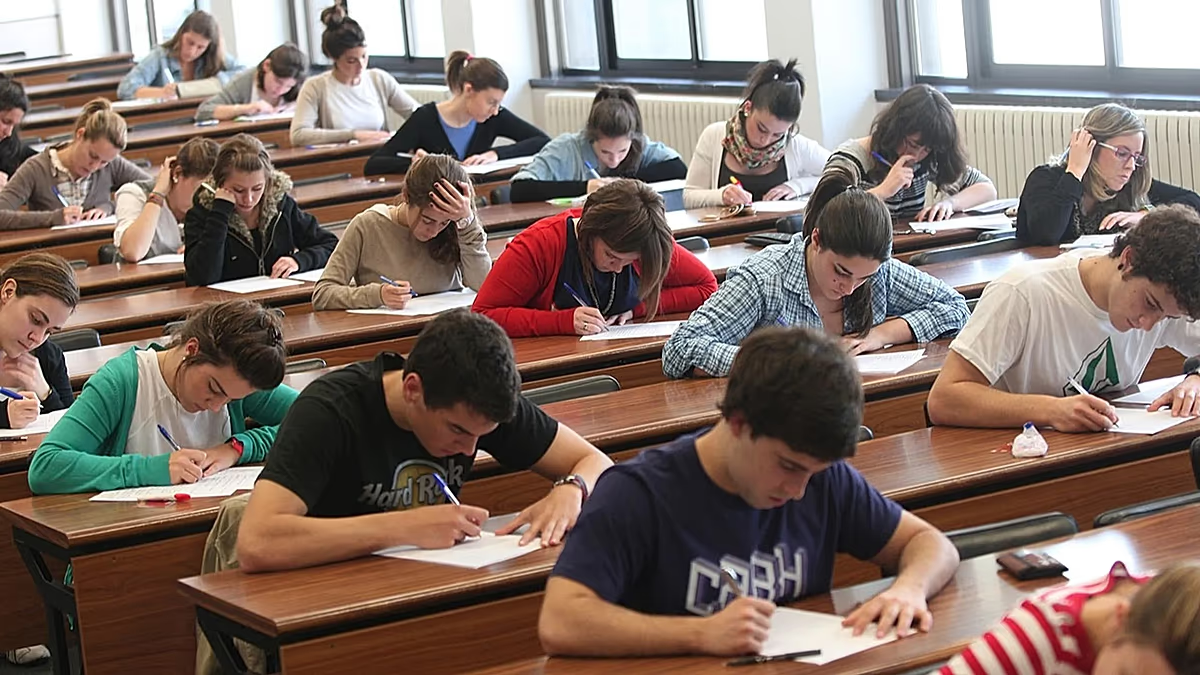
Artificial Intelligence (AI) has unsettled the field of Social sciences in unimaginable and unpredictable ways. The mere possibility that much information can be gathered quickly, e-mails can be drafted easily, and tables and figures can be prepared speedily is an achievement that AI has facilitated. Yet, AI has more haters than lovers. Most teachers tend to decry AI’s excessive use by students but not using it is neither possible nor desirable. Thus, the question is who uses it better and how we, as faculty, can enhance students’ productivity through AI without stifling their creativity.AI has brought a rapid reconfiguration in all three key components of higher education: reading, thinking, and writing. The single most important transformation is the widening distrust between students and faculty. This makes meaningful classroom engagement difficult.Need for teachersAI has not only made many existing teachers redundant but also displaced the centrality of the teacher in the classroom. One can sense students’ scepticism about the ability of their faculty to offer something that ChatGPT cannot. The main reason they turn up for the class is due to the strict attendance policies that most universities insist upon. There is a dire need to rethink what constitutes teaching now.One common cause of concern is that students today hardly read. A few days ago, my students asked “What is the point of reading long articles when we can get good marks by reading the summary, which is just a click/prompt away?” More than being an enabling device, students appear to be dependent on ChatGPT for most of their work.It is also true that excessive reliance on technology may stem from a lack of institutional training among both students and faculty. However, there is a serious need to think about the extent to which AI training and awareness can make students take reading and thinking seriously. It is hard for faculty to explain why the easiest ways of doing things are not always the best, that thinking cannot be outsourced to ChatGPT, and that a single text can have a plurality of meanings without dismissing AI’s enabling aspect.A trust deficitApart from displacing the centrality of faculty, AI also appears to have generated a heightened sense of distrust among teachers. This is evident in the fact that, whenever a student writes a thoughtful assignment, teachers find it hard to believe that it was not generated using AI. Although AI-detecting tools are available, can it remedy the growing distrust towards students among teachers? This might have a debilitating impact on students who are motivated to write well.The burgeoning mutual distrust has resulted in a growing trend in which universities are going back to the idea of exams as the most reliable method of evaluation. The underlying logic is that, despite its limitations, exams are better than using assignments generated using AI. From a push to foster critical thinking through written assignments, universities are now settling for exams or class tests that emphasise memorisation and rote learning. Doesn’t it endanger the primary goal of cultivating a critical self in Liberal Arts programmes?Originality mattersEven though at a symbolic level, AI tools appear to be a levelling device by making language accessible to everyone and denting the privilege that used to come with command over English. Yet, it is also undeniable that the biggest casualty of the AI revolution is writing as a distinct genre.. It is no secret that, within academia, a lot of importance used to be placed upon writing.In the era of producing generalised content, what truly separates one from the other is originality. Most importantly, though the sanctity of evaluation can be maintained by mechanisms such as viva and exams, are there similar ways to retain the centrality of writing in higher education?Despite the fact that AI has transformed the universe of Liberal Arts at various levels, the plea here is not to condemn or resist its inevitable march. Understanding such reconfigurations is essential for redesigning curricula, integrating AI into the overall setup, developing alternative teaching methods, and tackle the growing mutual distrust between the faculty and students.The writer is Assistant Professor of Department of Political Science, GITAM (Deemed-to-be University), Bengaluru. Published - May 30, 2026 03:30 pm IST