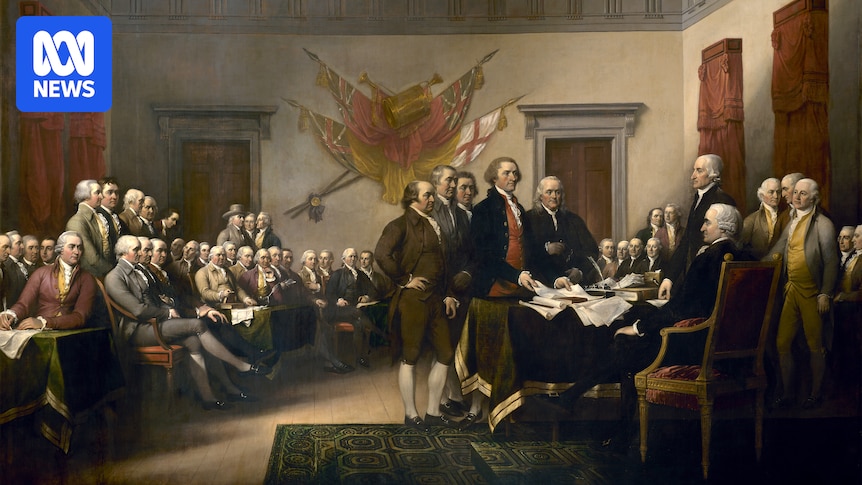
Present politics seems to explain discordant interpretations being placed upon the US brief foundational statementThe US will mark the 250th anniversary of the signing of the nation's Declaration of Independence on July 4th. Photo: Manuel Balce Ceneta/AP Nicholas CannySat May 30 2026 - 06:00 • 8 MIN READJuly 4th of this year will mark the 250th anniversary of the adoption by the “Representatives of the United States in General Congress assembled” of that country’s Declaration of Independence. The document was penned by a 33-year-old Thomas Jefferson and later signed by 56 members of US Congress. Current indications are that commemorating the declaration in 2026 is likely to foster more division than unity because the United States seems more polarised politically than at any time since the years of the nation’s civil war (1861-65). Present politics seem to explain the discordant interpretations that are being placed upon this brief foundational statement. This makes it appropriate to give thought to the circumstances in which the declaration was drawn up, what were the ambitions of its authors and how variant interpretations are being used today to lend authority to political positions that seem irreconcilable. The declaration was a pledge by its signatories to move beyond resisting incursions by the British government upon the “liberties” of 13 of Britain’s colonies on mainland North America, to asserting the “right” of these “united Colonies” to become “Free and Independent States” that would be “absolved from all allegiance to the British Crown”. The principal issue that had given rise to resistance, which had taken the form of riot and armed conflict, was a sequence of enactments made by the Westminster parliament, the most notorious of which was the Stamp Act of 1765, that authorised the British government to impose taxes on the colonies. The British authorities expected these taxes to generate an equitable contribution from the colonists towards the cost of providing for their defence. This legislation had been enacted without consultation with the colonial assemblies that had customarily approved the collection of taxes to meet infrastructural and defence needs in each of the colonies. Radicals, especially those who had taken to describing themselves variously as “patriots” and “the sons of liberty” had obstructed and attacked the officials appointed by the government to collect the tax on the grounds that there should be “no legislation without representation”. Sporadic fighting with the troops that the government assigned to restore order in the colonies combined with sympathetic protests in London, and even Dublin, provoked the British government into enforcing its will. In doing so, it made an example of Boston by imposing martial law in the city. The dissidents had cited these actions in 1774 to justify their request to the assemblies in each of the colonies to nominate representatives to a so-called Continental Congress that would convene in Philadelphia to oversee and co-ordinate their efforts to defend their “rights”. That congress, as already mentioned, went one step further in 1776 when it embarked upon the revolutionary action of pronouncing its intention to sever connections between the colonies and the British government.The reason given by the signatories for their shift from resistance to revolution was that the British authorities had proven themselves deaf to the appeals made by the colonists “to their native justice and magnanimity”, and had, instead, established “an absolute tyranny over these states”. To justify this assertion, the authors dedicated much of the declaration to explaining how “the history of the present king of Great Britain [king George III]” was “no less than a history of repeated injuries and usurpations, all having in direct object the establishment of an absolute tyranny over these states”. Then, drawing upon what was the accepted liberal social contract theory of the time, the declaration pronounced that since all governments were instituted by free and equal people to enable them to enjoy “certain unalienable rights” including “life, liberty and the pursuit of happiness”, it became the “duty” of these same people to withdraw their “consent” and “to institute a new government” whenever an existing government became an “absolute despotism”, as, they asserted, had occurred in the colonies.Engraving of 'Signing the Declaration of Independence' published in Popular Descriptive Portraiture of The Great Events of Our Past Century by RM Devens in 1877. Photo: Getty Images The authors of the declaration made it clear that they were not seeking to overthrow the government of British king George in Britain itself or in any of his other jurisdictions because, apart from the support offered by some urban radicals, their populations had proven themselves “deaf to the voice of justice and of consanguinity”. The lack of concern of the general population in Britain and its dominions over the “tyranny” being played out in the colonies had, according to the declaration, brought the colonists to recognise that they had become “one people” who were entitled to enjoy “among the powers of the earth, the separate and equal station to which the laws of nature and of nature’s God entitle them”. The many people in the United States today for whom the word liberal has become a term of derision and to whom social contract theory is anathema, take this latter passage in the declaration to mean that when “nature’s God” had left America geographically separate from Britain at the moment of creation, it had been meant as a signal to those who would reside there that they might enjoy an independent status. Those attracted by this interpretation find confirmation of their belief that the political independence of their country was divinely ordained by the further pledge by the authors of the declaration that they would place their “firm reliance on the protection of divine providence”. That the colonists had not, until 1776, taken advantage of the God-given licence to enjoy an independent existence, occasions no difficulty for exponents of providential history because of their ability to cite evidence that the colonists had enjoyed special divine favour from the moment the “pilgrim fathers” had disembarked from the Mayflower on to the coast of Massachusetts in 1620. [ The Irishman who printed the US Declaration of IndependenceOpens in new window ]They see also how the Mayflower landing links neatly with the declaration of 1776 because the most malevolent early actions of the British against the colonists had occurred in Massachusetts, as had also the principal early challenges to British aggression including the Boston Tea Party and the activities of the “minutemen”. Since these actions preceded the issuance of the declaration, it becomes possible to give them credit for having brought about the independence of the United States. This explains why in this providential narrative, lesser attention is given to the prolonged military struggle with Britain that persisted until 1781. Such attention is not considered necessary because its outcome was foreordained given that the authors of the declaration had, in 1776, placed their trust in “providence”. In this version, also, the colonists themselves, under God, are given principal credit for achieving independence for their country, and the major military assistance supplied by the French monarchy to the rebellious colonists during the interlude 1777-1781 is treated as incidental.Those in the US who think that the outcome of worldly events is influenced more by the ambitions and actions of people rather than by divine intervention in human affairs, represent the declaration as a staging post in a long process. The radical “patriots”, it is suggested, paused to issue the declaration as a call for support upon their many fellow colonists who had remained neutral in the conflict even in the face of rough treatment by crown forces. They were calling also upon the French monarch to provide military assistance, and the “patriots” expected that this would be forthcoming because they had declared themselves enemies of the British government with which France was regularly at war. Subscribers to this secular view, like the British generals of the time, accept that the colonists lacked the capacity to defeat the forces of the crown, and they recognise that Gen Cornwallis was forced, after the battle of Yorktown of 1781, to surrender the British army under his command to the army led by George Washington, composed of colonists with their French allies, only because Cornwallis found himself unable either to secure reinforcements or to evacuate his troops because he had been pinned in by the French navy. Those who are persuaded by this well-documented case consider the victory at Yorktown to be that which led to the Treaty of Paris of 1783 where Britain acknowledged its failure to retain control over the 13 rebellious colonies. [ Ambassador Edward Walsh: Ireland’s future is to be a bridge and interpreter between US and EuropeOpens in new window ]Many adherents to this more secular explanation of how America’s independence was achieved are, in 2026, proving themselves every bit as adept as their providential opposites at bringing America’s Declaration of Independence into present politics. They are doing so particularly in the No Kings protest movement where they draw parallels between what they depict as the unconstitutional actions of US president Trump and those cited in the document of 1776 to justify the claim that king George was “unfit to be the ruler of a free people”. The charges cited against king George in the declaration, to which the No Kings protesters allude, include that king George had “obstructed the administration of justice”, that he had “made judges dependent on his will alone”, that he had “erected a multitude of new offices, and sent ... swarms of officers to harass our people”, and, most particularly, that he had quartered “large bodies of armed troops among us” and protected them “from punishment for any murders which they should commit on the inhabitants of these states”. One unforeseen consequence of the No Kings protests is that, in 2026, one hears less of what previously have been represented as the shortcomings of the US Declaration of Independence. The principal criticism of the document that was made even as it was being composed was that its author and its supporters refused to recognise the glaring contradiction between white male property owners protesting that they were being denied “liberties” while they themselves continued to possess human property in the form of African slaves who were being deprived by their owners of almost all human rights and dignity. Another criticism, voiced more loudly in recent decades, was that credit for the revolution and the declaration that shaped it, was being given to the Masonic-sounding “sons of liberty” with scant mention of the many women who had been active participants in the revolutionary movement. And a third anomaly is that the only mention in the declaration of the native American population who had been displaced by the colonists and whose land continued to be seized by colonists, many of them from Ulster, as the revolutionary war was being fought, was to the effect that the agents of British king George had “endeavoured to bring on ... the merciless Indian Savages, whose known rules of warfare, is an undistinguished destruction of all ages, sexes and conditions”.Liberal authors, who have been to the fore in documenting such criticism in the past, seem to be remaining mute over their misgivings in 2026. Their relative silence, I would suggest, is because they consider the declaration itself, together with the US constitution that would be framed in a similar spirit in 1787, to be the principal bulwark that protects those liberties that Americans did win at the time of their revolution against what they suspect is the design of their own government to revoke those liberties as part of what is being represented as a divinely-ordained plan to “Make America Great Again”.Nicholas Canny is professor emeritus of history at the University of GalwayIN THIS SECTION
Commemorating the US Declaration of Independence in Donald Trump’s America proves tricky
Present politics seem to explain the discordant interpretations being placed upon the US brief foundational statement
1,963 words~9 min read