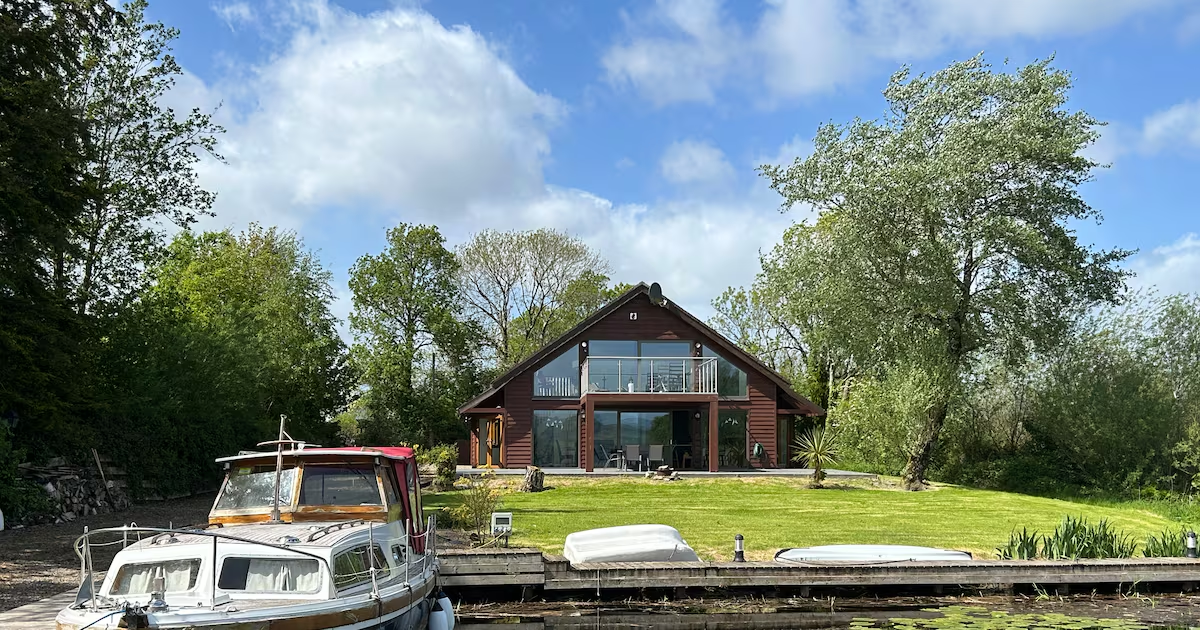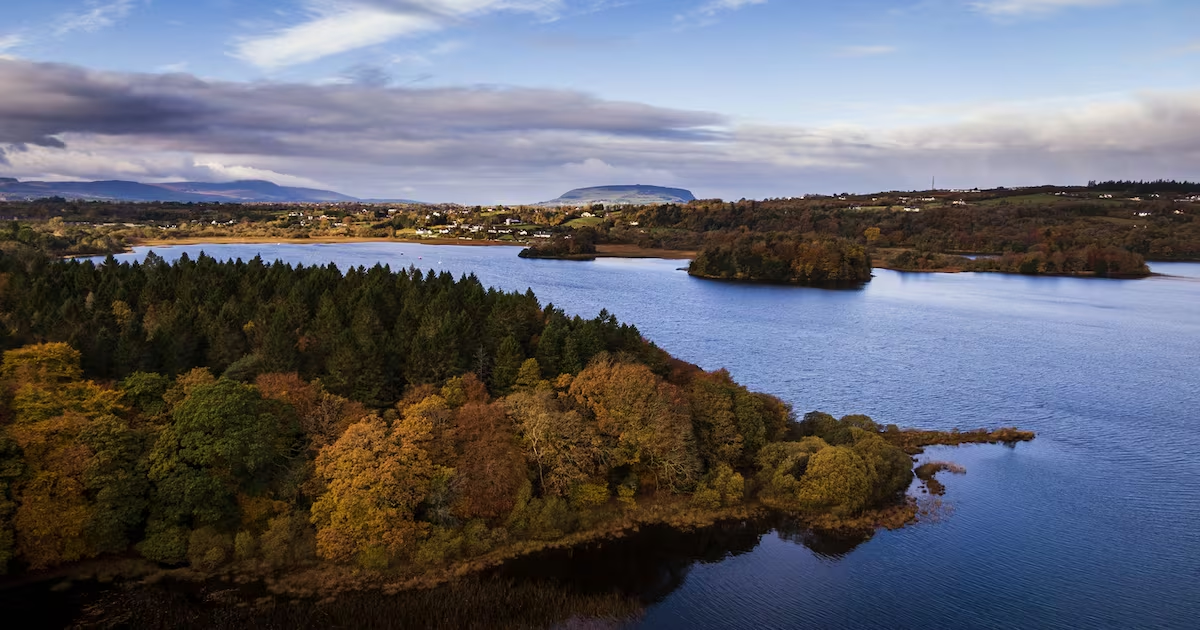
The biggest island on Lough Gill has, over the centuries, been a centre for religious, poetic and agricultural communitiesLough Gill and Dooney forest, with Knocknarea mountain on the horizon Stephen RyanSat May 30 2026 - 06:00 • 4 MIN READOne afternoon in late August of last year I took my kayak out on to Lough Gill in my native Sligo, launching from the Holywell pier on the lake’s western shore. Shafts of sunlight poured through gaps in the clouds hitting the gently wind-rippled water in which I moved. I was heading east, to the 40-acre Church Island, the largest of the lough’s 20 islands, and a place to which I have been venturing out since the start of my teens a decade ago. Having recently completed the gruelling Warriors Run up Knocknarea mountain and submitted my thesis for a master’s in wildlife conservation, I felt a strong sense of liberation as I plied the lake’s tranquil waters, flanked on either side by landmarks immortalised by Yeats such as Dooney Rock, Hazelwood and Benbulben.I reached Church just under an hour after launching and, after finding a place to drop my camping gear, I went on a ramble through the dense woodland that covers the island. Strolling through the trees amid bird song put me in mind of prehistoric times, when Ireland was a land of great deciduous forests, in which lurked bears, wolves, wild boar and other creatures now lost to this place.Much of the island’s trees, though, such as its beech and many conifers, are non-natives, acting as reminders that the hand of man has been shaping it for a very long time. The most blatant reminder of human influence is the structure from which the islands name is derived, the church.Erected during medieval times under the patronage of the O’Rourke rulers of Breifne, which encompassed parts of modern-day Sligo, Leitrim and Cavan, its ruins still hold a commanding presence, despite it being badly damaged by a fire in 1416. Entrance is gained through a low archway on its southern wall leading into a large open space with a smaller annex-like room on its western side.If paddling through Lough Gill is to move past reminders of Ireland’s literary history, then walking around the island continues this trend. During medieval times, the O’Cuirnin family of poets operated out of the church itself. With the O’Rourkes as their patrons, their most notable member was Cormac, whose 15th-century account of the Battle of Moyturra is preserved in Trinity College. Many of the family’s works, though, were tragically destroyed in the 1416 fire.After a few minutes in the church, I traipsed west, through trees and brambles, to the cabin, a quaint structure made of brick and stone. Inside are a few couches and a fireplace that, when lit, makes for a lovely place to sit beside and have food. I do not know exactly when the cabin was built but a structure with similar dimensions is recorded where it now stands on both the 6in and 25in ordnance survey maps, compiled in the 1830s and the turn of the 20th century respectively. [ Six Irish islands to exploreOpens in new window ]The 1911 census reveals a farming family of Gallaghers living here, consisting of an elderly widow and her three adult children. Walking through the tree-cloaked island these days, it is hard to imagine it being worked by human hands a little more than a century ago.After leaving the cabin and erecting my tent I rustled up some food. After a long day of paddling and walking, sitting back in my chair watching the sun set with some grub in one hand and a cool drink in the other felt very satisfying.As twilight enveloped the island, throngs of rooks and jackdaws flew on to it to roost, their raucous calls giving my surroundings a pleasingly raw, primal quality. At nine the next morning, I kayaked a few hundred metres to St Angela’s College on the lake’s northern shore to have breakfast and get the campus bus into Sligo to buy food. I headed back to the island in the afternoon and walked through its interior, towards its western tip. As blackbirds chattered and treecreepers and red squirrels scuttled up trees around me, I thought about the island’s many past lives as the centre of religious, poetic and agricultural communities.After reaching its westernmost point, I waded through inky black water back to my campsite, as scores of minnows and lubeens darted away from me, trying to avoid the mushroom clouds of silt created by my feet. [ ‘If I didn’t do it now, I would be too old’: Skellig Michael opens to first summer weekend visitorsOpens in new window ]I spent an hour after dinner watching the sun set as the crows came back for the night.The next morning, I packed up my gear and made a final visit to the church and cabin, leaving a box of firelighters in the latter. I then loaded up the kayak and left, arriving at the Holywell a little more than an hour later. Later that evening, as the sun set, my mind drifted back to the island, where the throngs of crows must now have been chattering among themselves, their strange, atonal choir acting as a backdrop to the darkness descending around them. I imagined this taking place every night over the centuries as humans came and went, building churches, writing poetry and farming the land. To have borne witness to it for two nights made me feel briefly part of the island’s rich history. I will return soon. IN THIS SECTION
A strong sense of liberation comes from paddling to Church Island
The biggest island on Lough Gill has, over the centuries, been a centre for religious, poetic and agricultural communities
935 words~4 min read