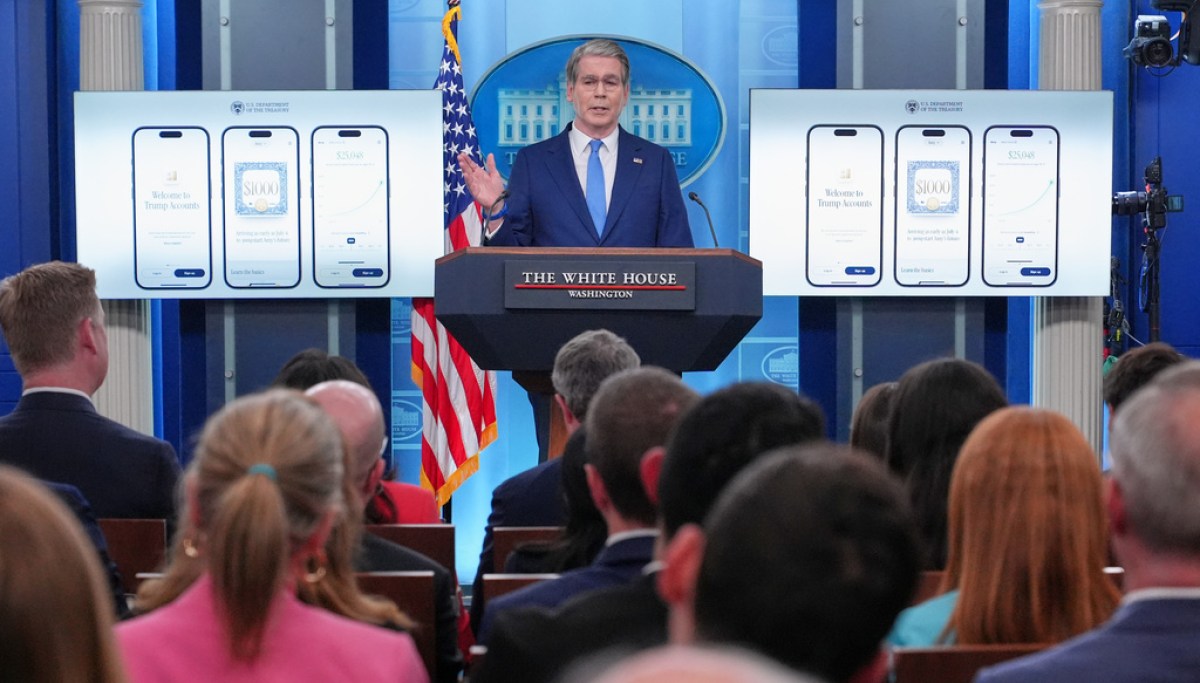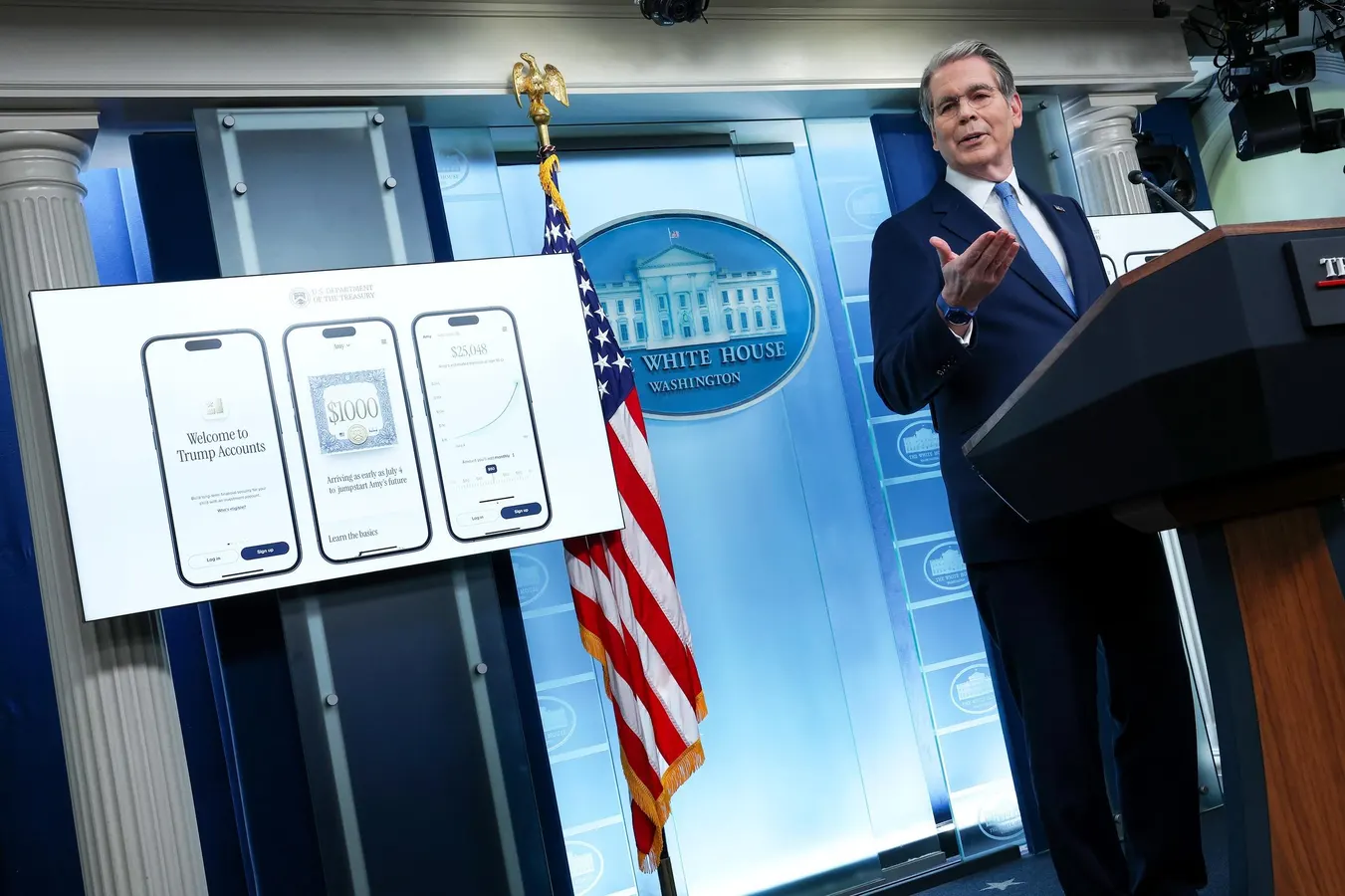
U.S. Treasury Secretary Scott Bessent speaks on the Trump Accounts during a press conference at the White House on May 28, 2026 in Washington, DC. (Photo by Win McNamee/Getty Images)Getty ImagesThe U.S. Department of the Treasury has launched the Trump Accounts app, giving families a new way to activate and manage accounts for eligible children ahead of the program’s official July 4, 2026, debut.The app, now available on major mobile app stores, is expected to serve as the main interface for Trump Accounts, also known as 530A plans, a new type of tax-advantaged savings account created for children under the One Big Beautiful Bill Act. Parents and legal guardians who have already elected to open an account by submitting IRS Form 4547 will begin receiving activation emails with instructions to complete setup through the app or online at TrumpAccounts.gov.Invite page on the Trump Accounts app.Kelly Phillips ErbTreasury says activation emails will be sent in phases. While families can begin the activation process now, the accounts cannot accept contributions until July 4, 2026. That includes contributions from parents, grandparents, employers, charities, governments, and the Treasury’s own $1,000 pilot program contribution for eligible children.Treasury Secretary Scott Bessent framed the app as part of a broader effort to expand long-term financial opportunity for young Americans, calling it “a simple, secure way for households to begin engaging with a program designed to build long-term financial strength from day one.”The launch also comes with a warning that, as activation begins, scammers are likely to try to take advantage of confusion around the new accounts.Watch For Scams During Activation Treasury is urging families to be cautious. During the initial rollout period, legitimate Trump Account activation emails will come only from no-reply@TrumpAccounts.Treasury.gov.Treasury says it will not contact families by text message or phone call about account activation. If you receive a call or text about activating a Trump Account, and you did not take steps to sign up, do not respond. It is a scam. However, as part of the sign-on process, you will receive an activation code via text after you enter your phone number (see more below).The worry about scams isn’t just coming from Treasury. Tax professionals have been raising red flags about the potential for related scams for weeks. Earlier this month, Catharine Drake Madeley, a CPA with Salling Madeley PLLC, based in Austin, Texas, expressed concern about fake websites or other inappropriate contacts during the rollout. Madeley noted that she expected additional guidance from Treasury.To prevent becoming a victim of an impersonation scam, access accounts only through the official Trump Accounts app or by typing TrumpAccounts.gov directly into a browser. Simply doing a search isn’t enough, since results can include sponsored links, lookalike websites, or fraudulent customer-service numbers. According to Treasury, customer support will be available only through secure in-app or online callback requests. Also be wary of anyone asking for personal information, payment, account credentials, or identity-verification details outside the official app or website. Remember that there is no cost to open a Trump Account, and families should not pay a third party to activate one.Using The App I checked out the app by downloading it from the Google Play Store, where it’s described as “Trump Accounts: Official App.” The app was designed with help from the National Design Studio, the White House initiative led by Airbnb co-founder Joe Gebbia (his official title is now Chief Design Officer of the United States), to modernize federal digital services. Welcome screen from the Trump Accounts app.Kelly Phillips ErbIt’s intended to create an experience similar to that of a consumer finance app, a goal that former IRS Commissioner Danny Werfel often championed for taxpayers. The sign-on process requires you to log in with an email address. You’ll initially receive a confirmation code by email. You’ll next enter your phone number, receive a text confirmation, and be prompted to enter a PIN (you can also choose to use biometrics, but I declined). The whole process takes less than five minutes. But since the accounts aren’t yet up and running, there are few bells and whistles on the app. The settings tab, for example, is fairly bare-bones. You won’t even be prompted to enter information about you or your child at this stage. The centerpiece seems to be the “Learn the Basics” feature, which offers brief slideshows on topics like “What is an investment?” and “What is a Trump Account?” Most have an estimated read time of 4-5 minutes (though it will take you much less time to swipe through). If you want more information, you can click through to articles on government websites, such as investor.gov, which is managed by the U.S. Securities and Exchange Commission (SEC).Learn the basics screenshot from Trump Accounts app.Kelly Phillips ErbTreasury has said it will retain control over the app and operations for the initial accounts. What Happens If You Already Signed Up? Parents and legal guardians who already submitted IRS Form 4547 should watch for an email confirming that the election to open the child’s account has been processed. That email will prompt the responsible party, the contact person who works with Treasury to establish and administer the account, to complete account activation. Beginning July 4, activated accounts will be able to accept contributions, subject to the applicable limits. Also beginning July 4, eligible children will start receiving the $1,000 federal pilot program contribution from Treasury, deposited directly into their account. What If You Haven’t Signed Up Yet? Parents, guardians, and other authorized individuals can still elect to open an account by submitting IRS Form 4547, Trump Account Election(s). The form can be filed with a 2025 federal income tax return, either on paper or electronically. The instructions also indicate that Form 4547 may be filed after tax season, including through an online portal once available. The form is short, but it does two different things. First, it allows an authorized individual to elect to open an initial Trump Account for a qualifying child. Second, it allows the taxpayer to separately request the $1,000 federal pilot program contribution if the child is eligible—simply opening the account does not automatically trigger the $1,000 deposit. A taxpayer who wants the pilot contribution must affirmatively request it by checking the appropriate box. Who Can Open A Trump Account? Accounts can be opened for qualifying children who are under age 18 at the end of the calendar year and who have a valid Social Security number.The rules draw a distinction between who can open the account and request the $1,000 pilot contribution. For an initial account, the IRS provides a priority order for who may qualify as an authorized individual, beginning with a legal guardian, followed by a parent, an adult sibling, and then a grandparent. But if the taxpayer is also requesting the $1,000 pilot contribution, the rules are more restrictive. In that case, the authorized individual must anticipate that the child will be their qualifying child for the applicable tax year.A taxpayer does not necessarily need to have already claimed the child as a dependent on the 2025 return to file Form 4547. But requesting the pilot contribution involves a representation about the qualifying child status. Taxpayers should check to make sure that they meet the applicable rules for the election year. Who Gets The $1,000 Contribution? The federal government will deposit a one-time $1,000 pilot program contribution into the Trump Account of an eligible child, but only if the required election is made. The pilot contribution is available for eligible children who are U.S. citizens and whose birth dates fall between January 1, 2025, and December 31, 2028. The $1,000 contribution does not count against the annual contribution limit. How Much Can Be Contributed? Trump Accounts are subject to a $5,000 annual contribution limit, adjusted for inflation after 2027. But not every contribution counts toward that limit.Contributions made by parents, grandparents, and other individuals count toward the $5,000 annual cap. Employer contributions also count toward the $5,000 limit, but employers may contribute no more than $2,500 per year, adjusted for inflation. Employer contributions are excluded from the employee’s taxable income. Other contributions do not reduce the $5,000 annual limit. These include the $1,000 federal pilot program contribution, qualified general contributions made by governments or charities, and certain rollover contributions. What About The Dell Seed Money? In addition to the federal pilot contribution, Michael and Susan Dell have pledged $6.25 billion to seed accounts with $250 each for roughly 25 million children under age 10 who were born before 2025 and therefore are not eligible for the $1,000 federal pilot contribution.According to information referenced on the Trump Account website, eligibility for that additional $250 contribution is expected to be tied to children living in ZIP codes with a median household income below $150,000. If not enough families with children under age 10 open accounts, the remaining funds could be allocated to older children. However, details about that seed money do not yet appear in Form 4547, the form instructions, or the IRS guidance. Families should watch for separate information about that program. Can Money Be Withdrawn? Trump Accounts are designed as long-term savings vehicles. While the beneficiary is under age 18, distributions are generally prohibited.There are limited exceptions, including rolling the account into another Trump Account, correcting excess contributions, or distributing the account upon the beneficiary’s death. Certain qualified rollovers may also be allowed, including limited rollovers to ABLE accounts, tax-advantaged accounts for individuals with disabilities, once the beneficiary reaches age 17.Notably, hardship withdrawals are not permitted. Families also cannot simply close the account and distribute the funds because their circumstances have changed.Once the beneficiary turns 18, many of those restrictions fall away, and the account generally begins to operate more like a traditional IRA.Why Basis Matters Trump Accounts can receive different types of contributions, and those contributions may have different tax treatment. Some contributions, including the federal pilot contribution, qualified general contributions, and employer contributions, do not create basis in the account. By contrast, after-tax contributions from parents, grandparents, or others do create basis.Basis is essentially the amount that has already been taxed. That matters because, after the beneficiary turns 18, withdrawals from a Trump Account will generally be treated like distributions from a traditional IRA. Part of a distribution may be taxable, while part may be a tax-free return of basis.To prevent after-tax contributions from being taxed twice, basis will need to be tracked. That could require careful recordkeeping, especially for accounts that receive money from multiple sources over time.How Can Trump Accounts Be Invested? Trump Accounts are subject to investment restrictions. Eligible investments generally must track U.S. stock indexes, carry no leverage, and have annual fees capped at 0.1%. Cash and money market funds generally are not permitted, except in limited circumstances.Treasury has designated BNY (formerly BNY Mellon) as the financial agent for the Trump Accounts program, with BNY managing the initial account infrastructure and collaborating with Robinhood, which will provide initial trustee and brokerage services.ForbesHow To Open A Trump Account In 2026: What To Know About IRS Form 4547By Kelly Phillips ErbForbesThe Tax Rules Around The Dells’ $6.25 Billion Contribution To Trump AccountsBy Kelly Phillips ErbForbesIRS Releases Guidance On New Trump Accounts For ChildrenBy Kelly Phillips Erb
Treasury Launches Trump Accounts App As Funding Date Approaches
The accounts still can’t accept contributions until July 4. Amid fears scammers could target the rollout, Treasury warned families to use only official channels.
1,869 words~8 min read