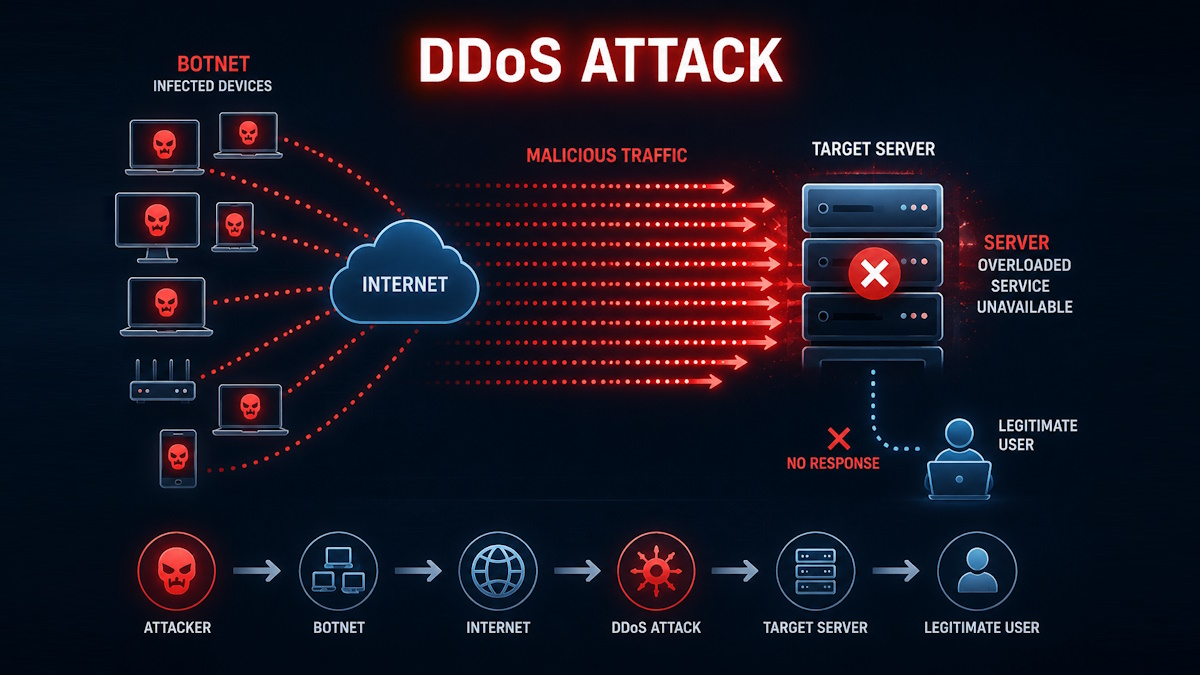
You have probably experienced the following scenario yourself. A website suddenly stops loading, a login page times out, or an online service becomes unreachable at the worst possible moment. Sometimes the cause is not an internal outage, but a Distributed Denial-of-Service (DDoS) attack designed to overwhelm the service from the outside.
DDoS attacks have long been one of the simplest ways to disrupt an online service:flooding it with enough traffic, exhausting its infrastructure, and making it unreachable without breaking into the target’s systems. Now more than ever DDoS is being packaged, branded, and sold with the language of a mature online service, and the impact is well recorded in the real world.
Cloudflare reported blocking a 7.3 Tbps attack in 2025 and later said it mitigated a 31.4 Tbps attack in its Q4 2025 DDoS report. Microsoft also said Azure mitigated a 15.72 Tbps attack in October 2025, attributing the activity to the Aisuru botnet.
Behind those incidents, underground sellers are competing over the same buyers with an increasingly polished pitch. Recent underground activity analyzed by Flare researchers describe attack panels, API access, monthly plans, reseller options, customer support, botnet-backed capacity, game-server methods, and Cloudflare bypass claims.