Pre-Signature Risk Packet for AI-Enabled Wallet Scams
Disclosure: AI tools were used for source collection and editorial review. The article was written by a human author, who checked the facts, code, and conclusions.
Crypto risk disclosure: This article is a technical explanation, not investment advice. It is not a recommendation to buy, sell or hold any cryptoasset.
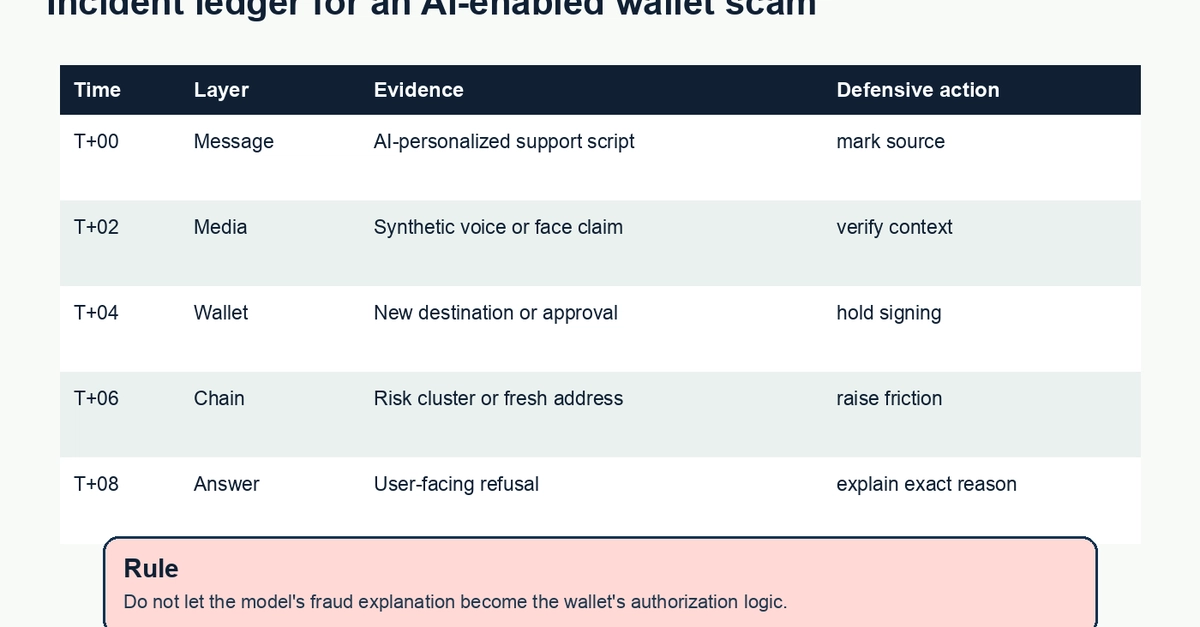
A boring failure starts the design: a user reaches a wallet prompt before the product has connected the request path, the spender, the chain, and the approval scope. Research on LLM spear phishing, lateral phishing with LLMs, and phishing content generation supports only a narrow claim: language models can make lures cheaper and more plausible. The wallet-safety packet keeps that model signal in the evidence lane; the model does not get to release the signature.
This is a response to proximity, not panic. A risky off-wallet path can sit near a typed-data signature, token approval, Permit2 allowance, or WalletConnect session request in the same user journey. Google Cloud's Cybersecurity Forecast 2026 treats AI-enabled social engineering as threat context, and Chainalysis' 2026 scams report treats impersonation and AI-enabled scams as material context in its own methodology. The engineering object sits between that context and the wallet action.