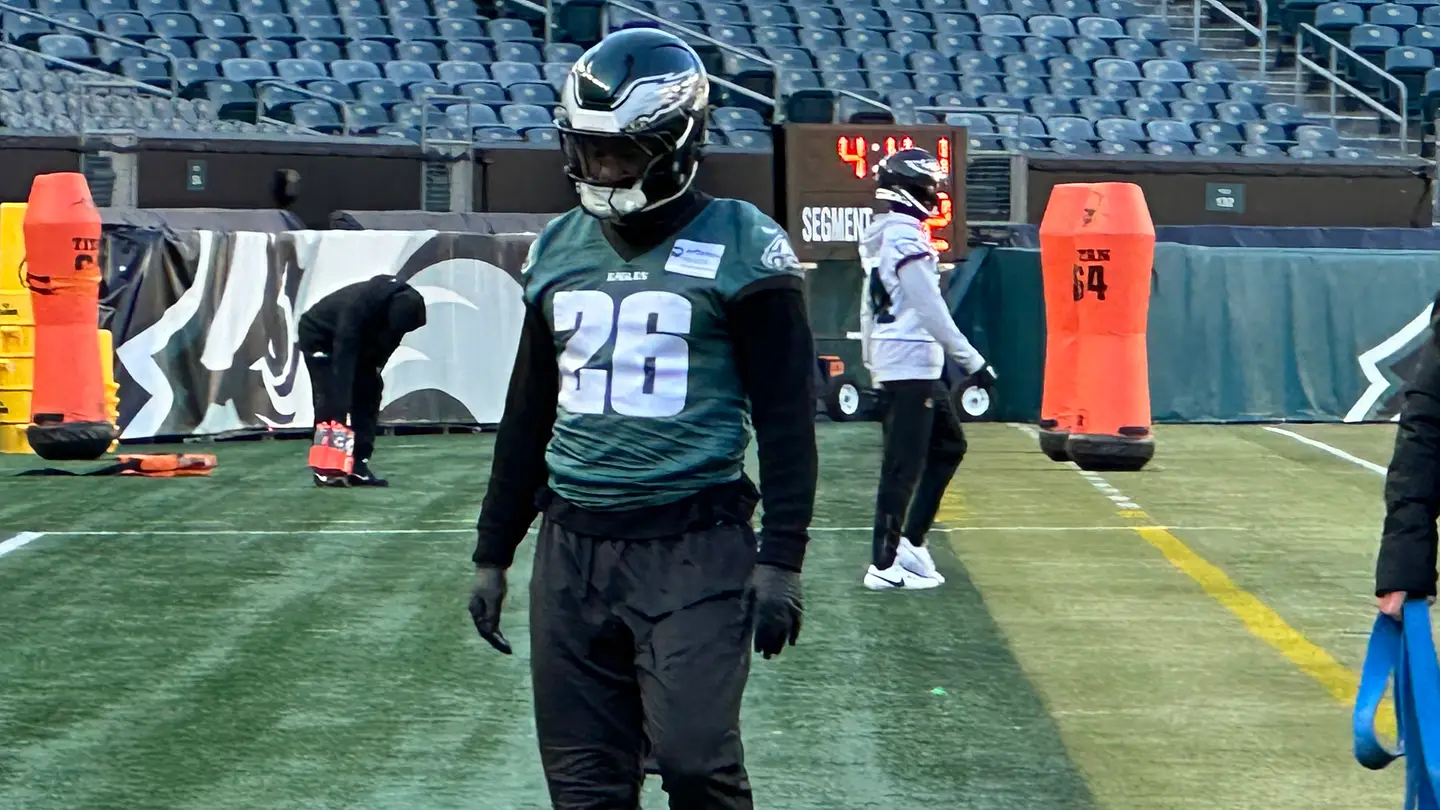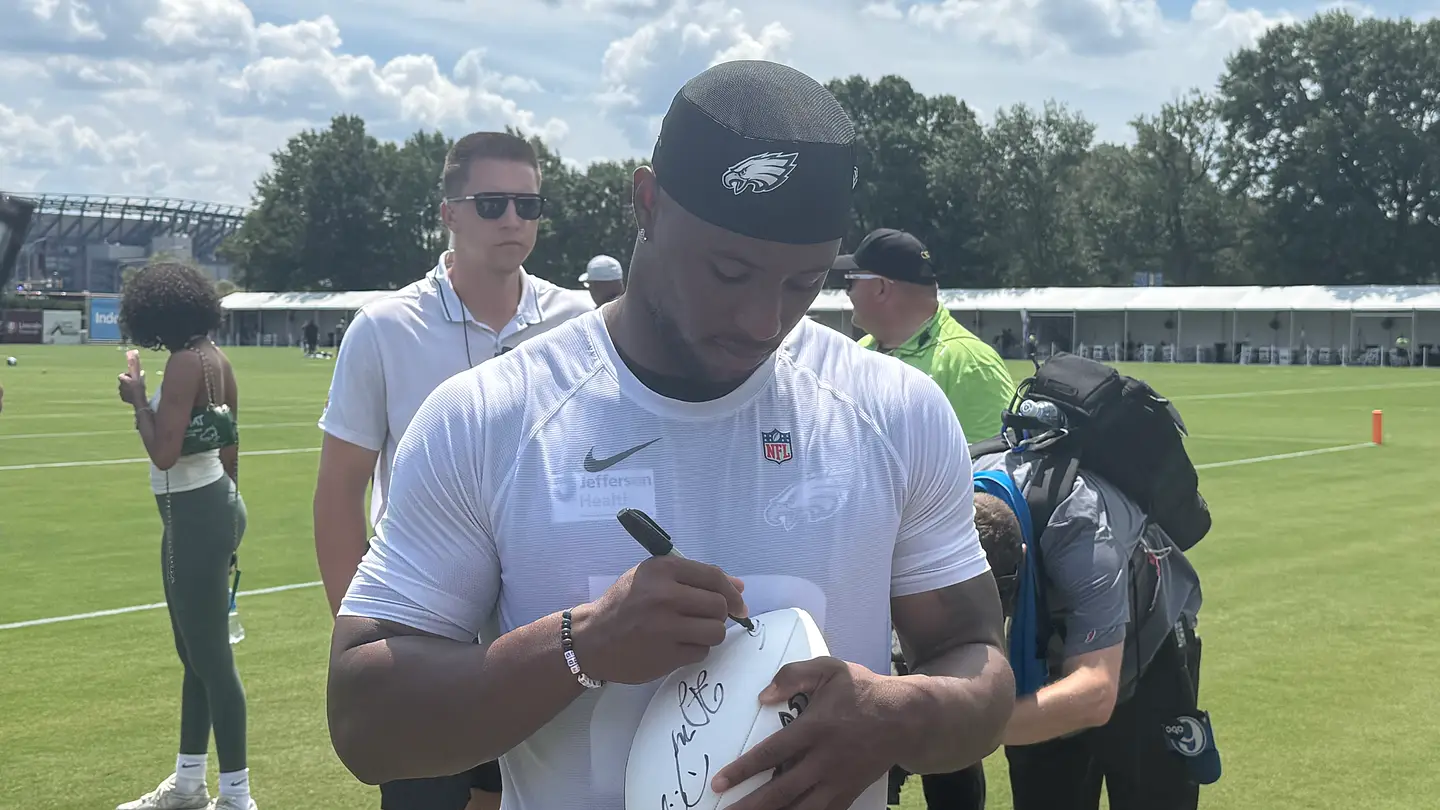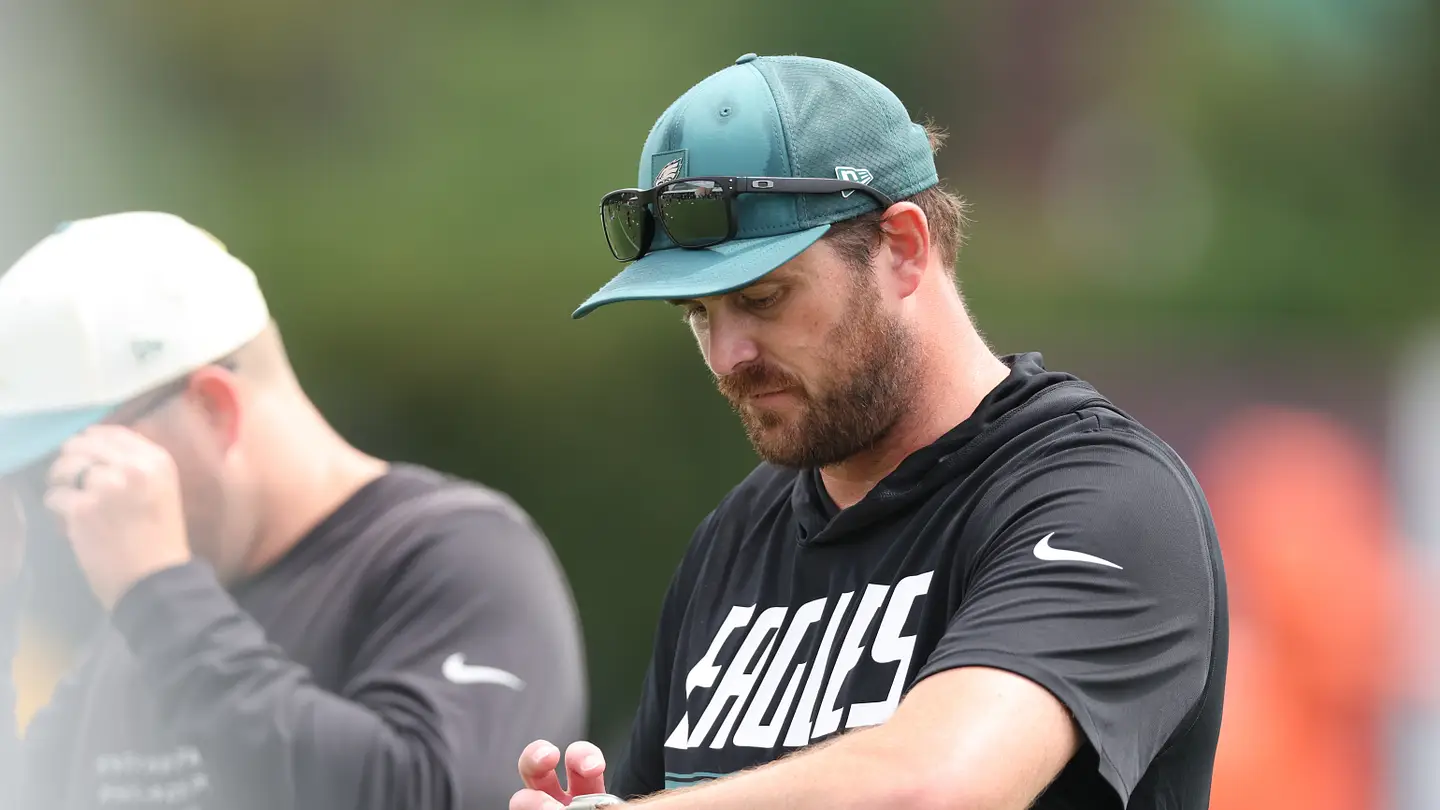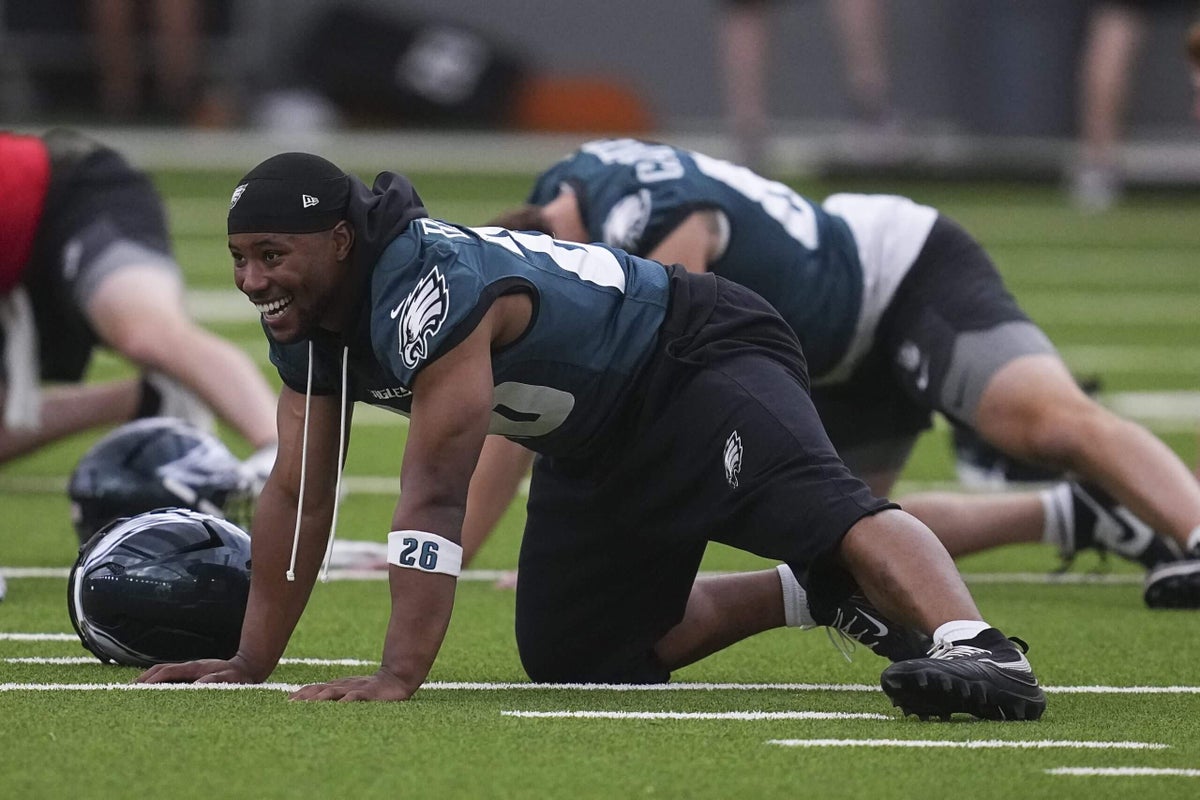
PHILADELPHIA — There was so much urgency to spot differences when the doors to the Philadelphia Eagles’ indoor facility swung open that it was easy to almost overlook what’s arguably the most important one.Maybe it was the rain. Maybe it was the first sight of new offensive coordinator Sean Mannion overseeing a wide receiver corps without A.J. Brown. Maybe it was simply because there’s not much compelling about watching players in shirts and shorts run the ball with minimal contact and a quick whistle.But there was Jalen Hurts, under center, handing the ball off to Saquon Barkley within a wide zone scheme. Most important difference?Philadelphia’s run game is easy to neglect in an offseason dominated by the Brown trade countdown and reports of Hurts’ reluctance to fully cooperate in a bygone system that was the least efficient in sixth-year coach Nick Sirianni’s tenure. But as the days since former offensive coordinator Kevin Patullo’s departure stack up, and as Hurts commits to under-center looks under Mannion, a critical difference is emerging in the players’ rhetoric about the scheme changes.“I think you can throw anyone under center,” Hurts said. “I think the question you ask is, ‘Why? Why are you doing what you’re doing? What are you doing? What are you complementing? What’s your (motivation) behind what you do?’ And so philosophically, it’s different than what we’ve done in the past. I think generally speaking in a (play-action) game, you’re influencing different players, running different play-action schemes — where it’s a pull scheme, or a gap scheme, or inside zone, outside zone. So, there’s a whole idea.”There’s a whole idea. Securing philosophical cohesion is critical for an Eagles offense that spent the entirety of last season searching for an identity — and never did. That the 2025 Eagles logged era lows in several statistical categories — points scored per game (22.29), total rush EPA (-24.81), total pass EPA (34.09), etc. — indicated their primary issue was systemic. Hurts notably said “You can see the vision,” when asked about working with Mannion. Trust is a necessity to secure Hurts’ willingness, and Hurts said Mannion is “able to answer all of my questions” and has been “very instructive, very helpful.”This is a strong early endorsement for Mannion, the man tasked with restoring a schematic advantage for his players. Sensibility is certainly a step forward, a departure from feckless game plans that more often than not embodied Patullo’s December admission that there “were a couple of plays where we were just running it to run it” during their previous game.The run game has consistently been among the strongest indicators of a season’s success in the Sirianni era. Kellen Moore leveraged Barkley’s 2024 arrival into a Super Bowl-winning system defined by a run-heavy approach in which Barkley set the NFL’s full-season rushing record and a conservative passing game in which Hurts traded ball security over downfield risks and exploited one-on-one matchups the run game created. Mannion must also leverage Barkley in his apparent attempt to mask the run and passing games with similar-looking concepts.It is quite relevant that Barkley said he reached out to Todd Gurley after watching the former running back’s highlights. Gurley, a three-time All-Pro for the Los Angeles Rams, was Mannion’s teammate within coach Sean McVay’s system. Gurley’s dominance in zone schemes defined a two-year stretch in which he won the NFL’s Offensive Player of the Year award in 2017 and scored a league-high 17 rushing touchdowns in a 2018 season in which the Rams reached Super Bowl LIII. That Barkley also studied Atlanta Falcons running back Bijan Robinson, who has also flourished in zone schemes, creates an obvious blueprint.“It’s no secret what the system is about,” Barkley said.Barkley’s success in a similar system isn’t a given. Barkley’s rushes of 20-plus yards dropped substantially from 2024 (17) to 2025 (4) under Patullo, a first-time play-caller, and Mannion, a first-time coordinator in just his third year as an NFL coach, has yet to prove he can adapt to defenses across a full season. The state of the Eagles’ offensive line is also as precarious as it’s been since Sirianni arrived. Right tackle Lane Johnson, 36, is returning from a season-ending Lisfranc injury, and there isn’t yet certainty that center Cam Jurgens’ (back) and left guard Landon Dickerson’s (knee) separate trips to Colombia for stem cell treatments will mitigate the pain they played through last year. Barkley, who was self-critical of his own performance in 2025, also acknowledged the challenge of preparing for a system he said includes “probably the most” under-center and outside zone concepts he’s ever run in his career.Philadelphia Eagles running back Saquon Barkley rushed for 1,140 yards and seven touchdown on 280 carries in 2025. (Mitchell Leff / Getty Images)The new offense does offer advantages, Barkley said. More under-center runs mean more plays in which Barkley can more easily get his shoulders square, which makes it easier for him to see the whole field. He can get downhill quicker. He can get a head start toward the edge on wide zone concepts, stretching defenders until they overextend themselves while in pursuit. Then, he must recognize his moment to strike. He must plant his foot and charge — and do it fast and violently.One cut. That’s the trick, Barkley said. The outside-zone backs — Gurley, Robinson, etc. — plant one foot and go. This requires Barkley to confront his comfort zone. Since tearing the ACL in his right knee in 2020, Barkley has preferred to make his cuts after planting both feet. He’s returning to his fundamentals to become comfortable cutting on one foot again. He likens the process to being “a little kid again,” working on his steps and all the little details. But the stakes of the wide zone are risky as well as difficult. He knows both of his legs are exposed. He knows Gurley battled arthritis after tearing his left ACL in college, and the chronic injury slowed him in his Super Bowl LIII loss and ended his career at age 26.Barkley, 29, said he feels fine physically. It’s his self-critical, corrective mentality he’s harnessing. He said the marathon of Philadelphia’s Super Bowl season “was more of a mental drain” than the physical toll of a career-high 345 rushing attempts. He is still one year away from beginning the two-year, $41.2 million extension that projects the presumable timeline of his prime. Barkley, ever-conscious of his place in history among the NFL’s greatest, said the distaste of his own performance in 2025 has driven him to be a bigger self-critic, to dive into his unfavorable film and find what he can do better.Soon enough, Barkley will fully apply his lessons to his new scheme. Barkley said it’s “too early to get too deep into the Xs and Os right now.” But in the early stages of Mannion’s system, Barkley has noticed an important sense of cohesion between the players and coaches — a sense he called “being together.”“I feel like we had that really well in ‘24,” Barkley said. “And I think that’s a big part of why we were able to accomplish what we want to accomplish.”
Saquon Barkley is preparing for a system that will leverage him: ‘It’s no secret’
Barkley is invested in adapting to new play-caller Sean Mannion's system in hopes of regaining 2024's success.
1,205 words~5 min read