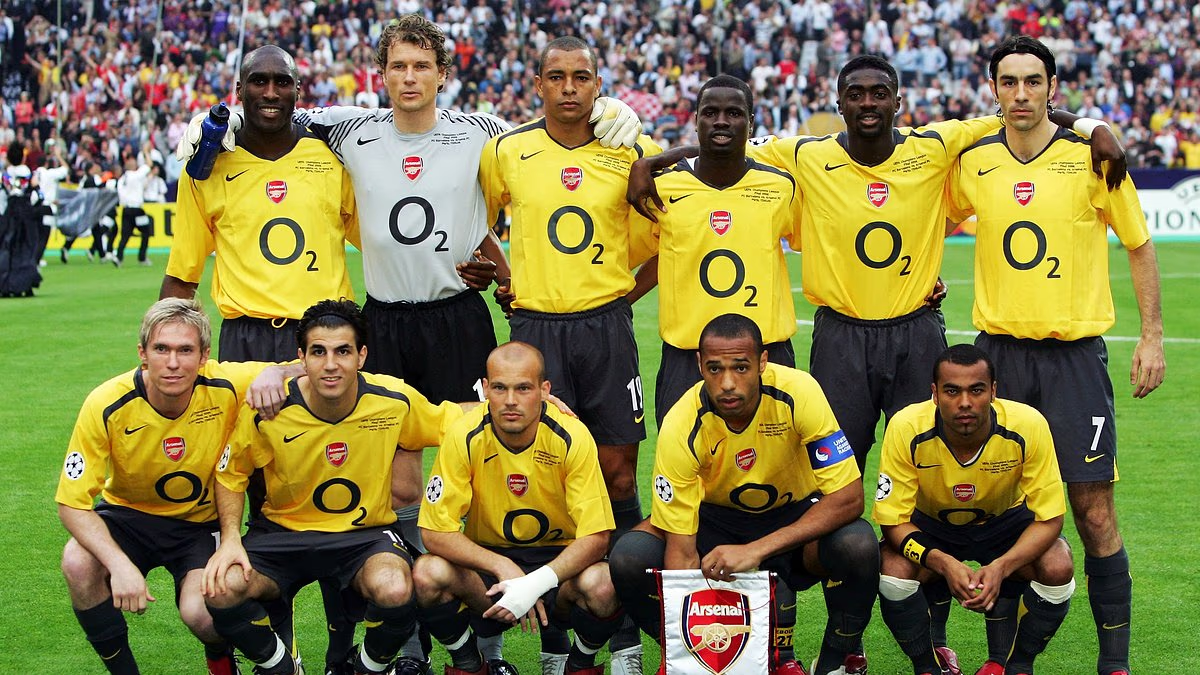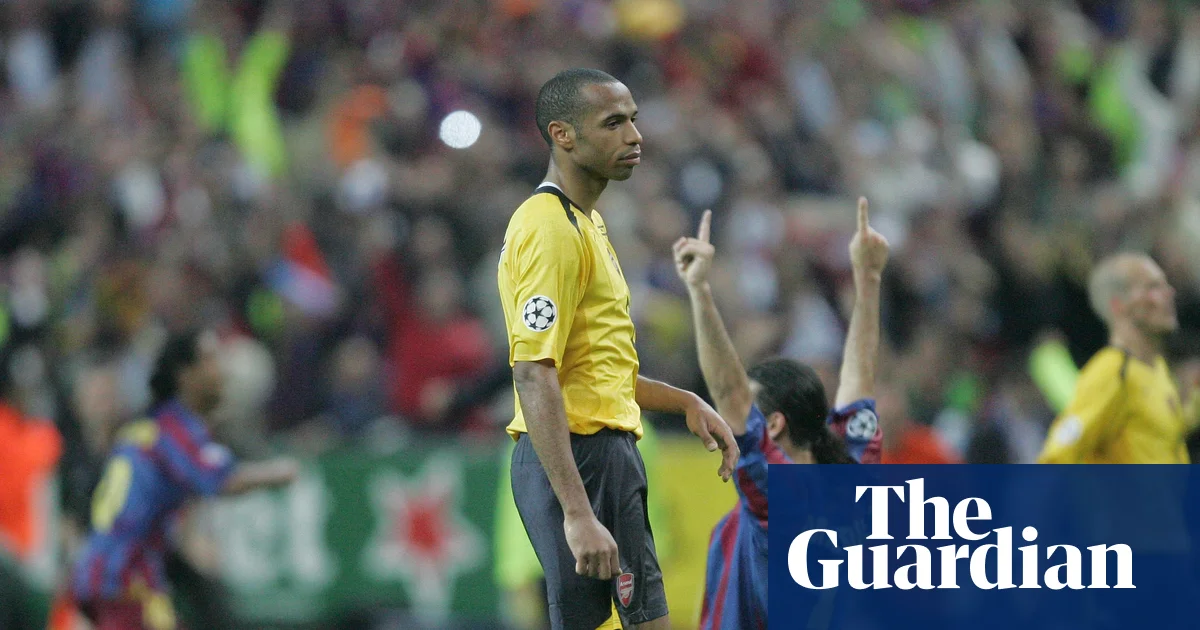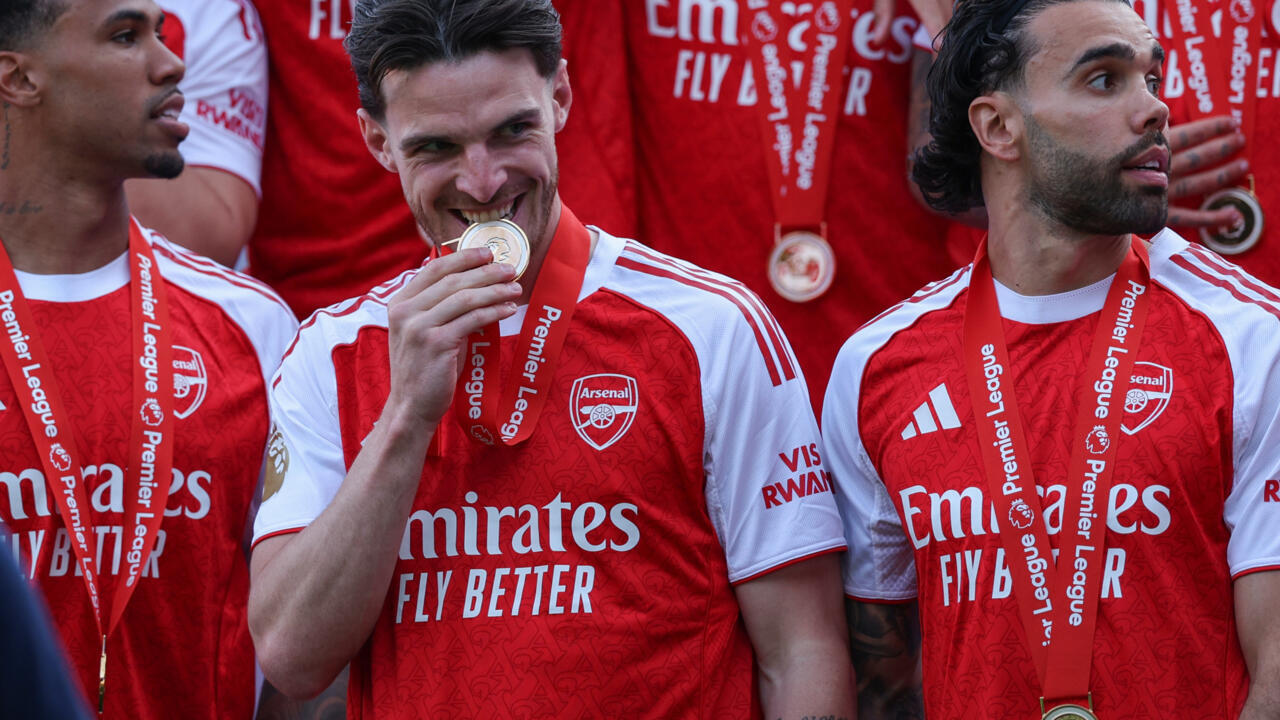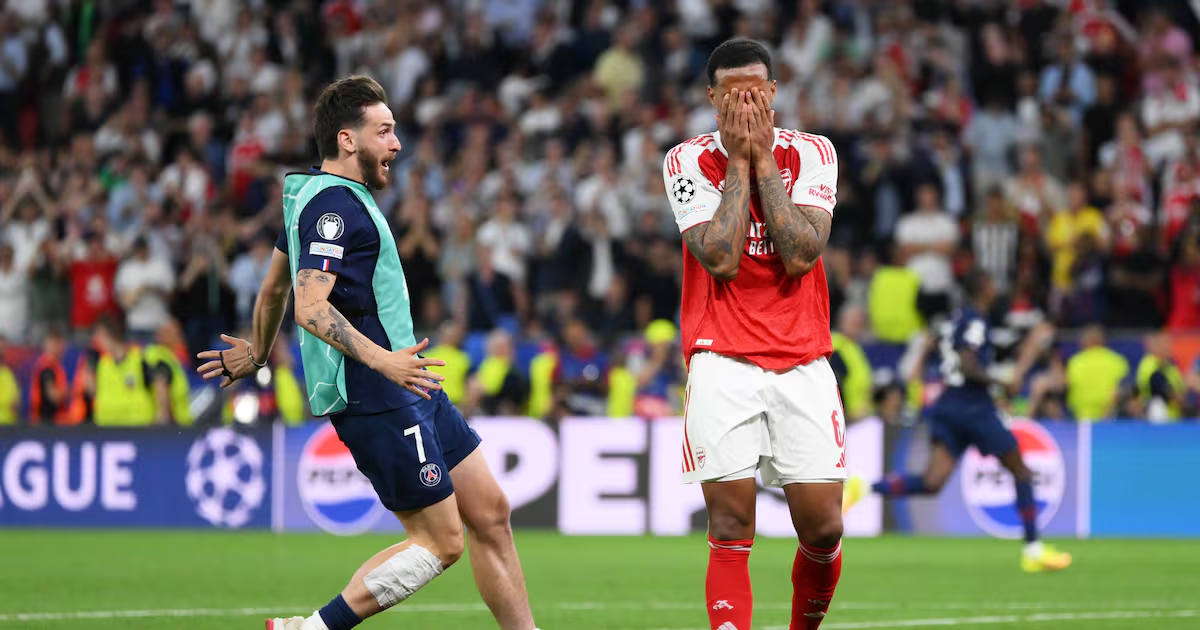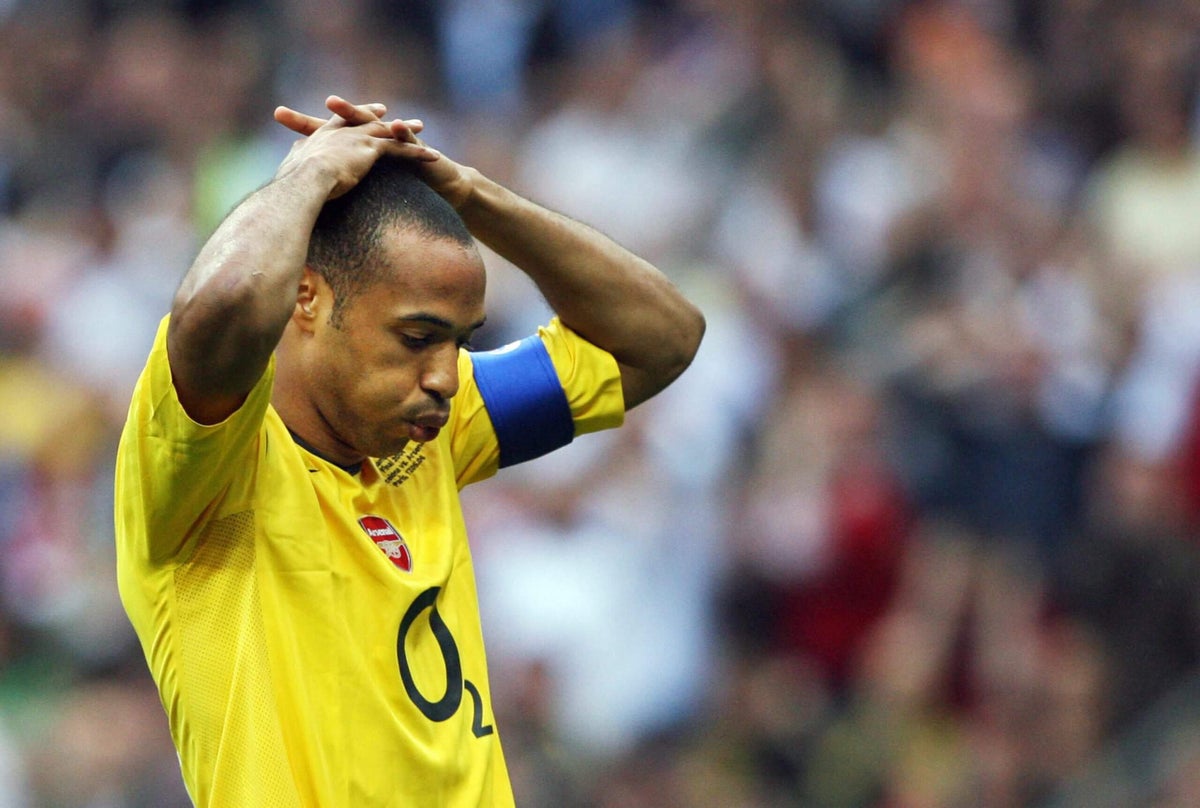
“If we had VAR back then, we would have been waiting half an hour,” Henrik Larsson tells The Athletic.Arsenal would have happily waited all night if it meant that Norwegian referee Terje Hauge would have changed his mind. His decision to send off goalkeeper Jens Lehmann 18 minutes into the 2006 Champions League final, a game they lost 2-1 to Barcelona, is a call that still haunts the mind of those in Paris that evening.Until Mikel Arteta guided his team there, it remains the closest Arsenal have come to being crowned champions of Europe.Despite Barcelona being second best in the early stages, Ronaldinho split the Arsenal defence open with a through ball to Samuel Eto’o. He nicked the ball past Lehmann and the German’s desperate dive brought down the striker. Ludovic Giuly was there to tap home into the empty net.Ashley Cole tries to console Jens Lehmann after his red card (Odd Andersen / AFP via Getty Images)Rather than play advantage to allow the goal, however, Hauge reacted to the linesman’s flag and awarded a free kick. With Carles Puyol and Mark van Bommel in his face, and Edmilson waving an imaginary card, the referee soon showed a real one.“He could have played advantage but I think the right decision was the red card,” says Larsson. “Although, his foot was on the line and everyone knows that the line includes a penalty.”While Barcelona were hoping for the double jeopardy of a penalty and a red card, Arsenal were left permanently disadvantaged with a long 72 minutes ahead.“Who knows what would have happened if we had kept 11 men, even if we had been 1-0 down?,” Ashley Cole tells The Athletic.“I was devastated for two people. You had Jens getting sent off and Robert Pires had to come off. He was the one sacrificed. You never want that in a final, you want it to be 11 v 11 and a case of: the best squad wins the game. “I was really disappointed. We could have still lost the game but we might have had a better chance to win. It is something we will never know, though.”Hauge reflected the day after the game, aware that his call had effectively decapitated Arsenal’s ability to play on the front foot.“At this point, I would have liked to have taken a few more seconds before I made my decision,” he told Norwegian newspaper Dagbladet. “If I’d done that, I could have given the goal and eventually given a yellow card.”Thierry Henry did not wait so long before venting his anger.“I don’t know if the referee was wearing a Barcelona shirt,” he told reporters after the game. “If he didn’t want us to win, he should have said so from the off. Some of the calls were very strange. I believe the referee did not do his job. I would have liked a proper referee.”As much as Arsenal felt aggrieved, they put up a valiant fight. They took the lead in the 37th minute through Sol Campbell, the unlikeliest of sources. Three months earlier, the defender, then 31, looked to be done under Arsene Wenger after he asked to come off at half-time against West Ham and left the ground. He felt mentally and physically burned out.Campbell made the squad only once in the next dozen Premier League games, until an injury to Philippe Senderos left a hole in the defence.“I think in his head, he had this view that once you were past a certain age, you were done,” Campbell tells The Athletic.“He had this hard line — which he broke after a while — that once you were over 31, he didn’t want to know. To this day, I don’t think I would’ve played the final if Senderos was fully fit… but then I showed him.”The leap Campbell produced to meet Henry’s free-kick delivery, rising high above Oleguer, did not look like the biomechanics of a man done at this level.“I was thinking: ‘I’ve got a chance here. If it comes to me, I’m going to stick it away,’” he says.Sol Campbell celebrates scoring in the Champions League final (Lluis Gene/AFP via Getty Images)“It was like a fairytale. I’d been through so many ups and downs. To come to the Champions League final and score was beautiful.”Arsenal got to half-time ahead, with an Eto’o strike against the post the only real scare. Barcelona manager Frank Rijkaard had seen enough.“Rijkaard told to me get ready so I stayed out to warm up at half-time, but they waited a bit,” says Larsson.Andreas Iniesta, then only 22 and still to become a regular starter, was brought on for Edmilson in central midfield. Barcelona played with more fluency but their attempts at beating Manuel Almunia in goal were restricted to long-range efforts. Ronaldinho was becoming more frustrated and even mishit a shot 30 yards wide with his instep.They were running out of inspiration and Arsenal were finding the energy to spring counterattacks. Alexander Hleb dragged an effort wide from the edge of the box and Freddie Ljungberg had a shot from a tight angle palmed away by Victor Valdes. But the best chance fell to Henry, who had already missed a glaring chance from six yards out with the match goalless.Hleb sliced open the defence and Henry took the ball perfectly in his stride. Rafa Marquez was closing from his left, but he had a clear route to goal from inside the penalty area. However, his finish lacked the usual conviction and disguise.Thierry Henry had a chance to score a second for Arsenal (Shaun Botterill/Getty Images)It appeared that he was caught in several minds as to whether he should lob the goalkeeper or blast it high at the near post. He did neither. Instead, telegraphing a low, curled effort straight at Valdes.“One more and they would have been dead,” says Campbell. “We had the chances to take the game away from them, and we just couldn’t convert the next one. We had a couple of breaks where we just passed to the wrong person in a two-on-one scenario. They were there for the taking.”Rijkaard removed right-back Oleguer, replacing him with Juliano Belletti. Mark van Bommel was then sacrificed for Larsson, who came on at centre-forward and pushed Eto’o out to the left wing.“He knew I could compete with defenders both in the air and be strong enough to hold them off,” says Larsson. “I was good at playing with my back to goal, so it was a way to get Ronaldinho a little bit more central and closer to the goal.”Larsson had become accustomed to life as an impact sub. In the first leg of Barcelona’s last-16 tie at Stamford Bridge, he was introduced in the 66th minute at 1-0 down. Rijkaard made an identical switch (this time on 61 minutes) with Larsson becoming the focal point. Within 14 minutes, Barcelona were ahead.Most of Larsson’s starts in La Liga had been on the right wing because Rijkaard valued his work ethic. On this occasion, though, he required the Swede to produce magic.In the 76th minute, he found the spell. With Iniesta looking for movement ahead of him in the left channel, Larsson made an intelligent run across both centre-backs, darting in front of Campbell and into Kolo Toure’s blind spot. The ball was threaded through to him and he produced the deftest of touches to slide Eto’o through on goal.“I was trying to be available for Iniesta because I knew if he could see me, he would pass to me,” says Larsson.“I had already seen Eto’o making a move off the side. I knew it would be tough to turn inside and shoot with my left side as there are a lot of defenders. I could have done that but it would be a low chance of scoring.“The timing of the run and the speed of the pass meant I could just slow the ball down a little and let him run on to it, and he was already past the centre-half.”A little more than three minutes later, sensing that the equaliser had broken Arsenal’s spirit, Larsson had his second assist.Having received the ball on the run, heading towards the corner flag, no danger appeared imminent. But with one twist of the hips and one reverse pass, he carved open Arsenal for Belletti to score the winning goal, the Brazilian’s driven strike ricocheting off Almunia’s leg from a tight angle.Ronaldinho and Giovanni van Bronckhorst congratulate Juliano Belletti on scoring the winner (Laurence Griffiths/Getty Images)“I was a little bit too far outside the goal to attack it but Sol had to follow me as, if he didn’t, then I could turn and face,” says Larsson.“He and two others tried to cut off the passing lane but when Juliano plays a pass I know he will keep running forward. I realised straight away that he was on his way.“To give myself a little credit, I am really threading the ball through the eye of a needle. There wasn’t much room and it had to be the perfect weight. There was no other support. When I saw it go in, it was such a relief.”Belletti told The Athletic previously that had Larsson not been introduced, Barcelona would not have staged their late comeback.“His character made the difference at a difficult moment when we needed him,” Belletti said. “The lead-up to my goal was proof that two people can think the same thing at exactly the right moment. It was an incredible, emotional moment.”Campbell admits that Larsson changed the game by operating in different positions. Despite suffering a second career-threatening ACL injury the season before, the 34-year-old remained untraceable and was able to confound Arenal’s tiring defence.The Swede’s two assists have led to some christening it ‘The Larsson Final’, even if he is too modest to subscribe to that tag.“I always remind people that, yes, my assists were good, but Belletti scored his only goal for Barcelona that day,” says Larsson. “The speed maybe wasn’t there over 30-40 metres anymore, but over the first 15 metres it was still there. If you read the game well, then you know what’s going to happen and it gives you a bit of an advantage.“I’m enormously proud that people talk about it and think about me. I loved to play finals. I was still carrying the memories of the Porto loss in 2003 with Celtic (in the UEFA Cup final). It was something difficult because I didn’t feel like going into two European finals and losing another one.”For many of that Arsenal team, it was their last shot at European glory.The Invincibles team of 2003-04 had already started to disintegrate. Patrick Vieira had departed for Juventus in 2005 and this final marked a goodbye for Pires and Dennis Bergkamp, too. Lauren, Cole and Campbell also left that summer with the defeat leaving a sour taste.“It’s just f***ing sh**, isn’t it?,” says Campbell. “But I knew that was going to be the last time I was going to be there — playing in the Champions League, playing in a final, at that level. I knew this was my only chance.”Cole went on to win reach the final twice more with Chelsea, winning at the second attempt in 2012, but it took a while for him to digest the disappointment of Paris.“The whole day was magical,” says Cole. “To have the opportunity to play in a Champions League final for my boyhood club was my dream come true but, like everything, it is not always perfect.“To be sucker-punched how we did so late on in the game, it definitely hurt. You just had to use that feeling, that emotion after the game, knowing you were so close, to use it to get there again. I used it as fuel.”It did not light a fire under Arsenal. If there was a feeling heading into that final that the glory era was tipping into decline, the years after the Champions League proved barren.Hamstrung by the financial commitment of moving to the Emirates later that year, Arsenal failed to win a trophy between 2005 and 2014.It took 22 long, painful years for Arsenal to reclaim the Premier League. It has taken two decades for Arsenal to reach the Champions League final again.For Lehmann, an Arsenal victory over PSG would be cathartic.“Please, do us a favour and play 90 minutes or 95 or 96 minutes… do not get sent off!,” Lehmann pleaded with David Raya on the pitch at Selhurst Park on Saturday.“I can tell you honestly: we missed it 20 years ago and if you win it now you are giving something back to the fans that we couldn’t, because I didn’t deliver, I got sent off. So, for us, it would mean something as well.”
Arsenal’s night of magic and regret: Reliving the 2006 Champions League final
The Athletic speaks to Thierry Henry, Henrik Larsson, Sol Campbell, Ashley Cole and others about the last time Arsenal were in the final
2,128 words~10 min read