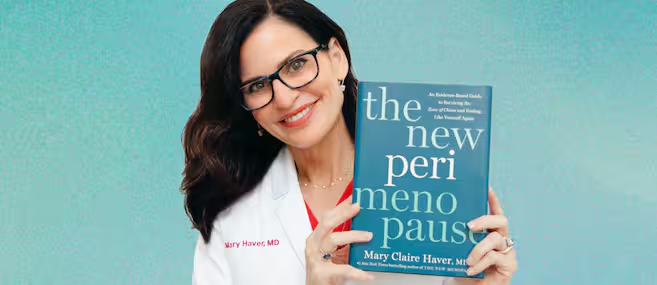
The Power of Hormones Author: Dr Louise NewsonISBN-13: 9781399749930Publisher: Hodder & StoughtonGuideline Price: £22The New Perimenopause: An Evidence-Based Guide to Surviving the Zone of Chaos and Feeling Like Yourself Again Author: Dr Mary Claire HaverISBN-13: 9781785046308Publisher: VermilionGuideline Price: £25Has the time come for us all to learn more about hormones? With obesity pills available on prescription and an exercise drug on its way, we are moving into a new era of medicine which will hold traps for the unwary. These two practical guides by specialist medics are a starting point for women, and part of their message is that oestrogen regulates the female body for life, not just for the reproductive elements of it. Both books campaign for a better understanding – and not just by women themselves, but by the medical profession itself, which has often ignored or misdiagnosed their symptoms, issuing instead millions of prescriptions for depression. And while expensive hormone treatments, such as obesity drugs, are overpromoted, the ones that could help them the most – those associated with reproductive cycles – are vastly underused. In her lucid explanations of the nature and history of hormonal treatment, Louise Newson lists conditions which “have been ‘medicalised’ wrongly for years” – and treated with antidepressants, antipsychotics, painkillers and sleeping tablets. Those conditions include hormone changes due to perimenopause, menopause, PMS [Premenstrual syndrome] and postnatal depression. The correct solution for most women, she adds, is to treat the underlying problem, rather than to put these sufferers on several drugs for the individual symptoms. Some women need one hormone, whereas others need all three – oestrogen, progesterone and testosterone – but only 5 per cent of potential beneficiaries are receiving such treatment. Newson’s explanation – beginning with the discovery of hormones in 1905, followed by insulin in 1921 and the subsequent history – is a fascinating analysis of anatomy and of the brave contrarians who developed this area of research, especially as it affected women. Even today, our understanding is largely based on misconceptions. Oestrogen, progesterone and testosterone are vital for both sexes; young women have four times the quantity of testosterone in their bodies as they have of estradiol, the main type of oestrogen. Underprescribed and “highly misunderstood”, testosterone is necessary for energy, confidence, mood (including libido), muscle strength, mental clarity and many other functions. Newson, founder of a noted clinic in Stratford-upon-Avon, produces some remarkable statistics to back her case – such as the 68 per cent success rate of progesterone-based treatment for postnatal depression, compared to a mere 10 per cent for other options. Newson was subject to various media and professional accusations, as she relates, but was cleared (and praised) last year by the regulator.Both Newson and Haver are sceptical about the pharmaceutical and medical industries, and warn us, female and male, to be on our guardMaking many of the same points, Mary Claire Haver talks of “medical gaslighting”, and explains why doctors are a long way from understanding the complexity of our mind-body systems. She talks of the need to reveal the “truth about the multi-organ system involvement” of oestrogen, progesterone and testosterone. Instead of dismissing hot flushes, back ache and depression as necessary signs of female ageing, GPs could – says Haver, founder of a clinic in Galveston, Texas – have been preventing many of these problems by encouraging clients from their 20s onwards to build muscle, take cardio exercise and consider talking therapy before opting for antidepressants. Regarding the perimenopause (the four– to 10– year transition to menopause), women should be discussing hormone treatment with their medical advisers, as many – though not all – would stand to benefit from it.Mary Claire Haver cites a range of advantages for hormonal therapy, including the mitigation of 'cognitive decline associated with perimenopause', better sleeping patterns and improvements in mood. In her own practice, Haver is particularly keen on transdermal estradiol, a form of oestrogen delivered through a patch, gel or spray. Absorbing the treatment through the skin avoids possible complications when tablets are digested and broken down by the liver. She cites a range of advantages for hormonal therapy, including the mitigation of “cognitive decline associated with perimenopause”, better sleeping patterns and improvements in mood. Oestrogen receptors are located in “in almost every cell and organ”, and she highlights their role in bone, skeletal muscle, skin, pancreas, brain and other locations. It is hard for any anatomical book to avoid repetition but, even so, this one could have been better edited. Despite that, it is an important contribution. Underfunding, she says, has held back research “around female-specific conditions, such as uterine fibroids, endometriosis, and polycystic ovary syndrome”, as well as about “the distinct ways certain diseases, such as cardiovascular disease, affect women”. Both Newson and Haver are sceptical about the pharmaceutical and medical industries, and warn us, female and male, to be on our guard. Many drugs that were launched as miracle cures turned out to be harmful. The arthritis treatments Vioxx and Bextra were withdrawn due to their association with heart disease and stroke. [ Menstrual month: how to exercise effectively at every stage of your cycleOpens in new window ]As well as examining particular angles of women’s health, these two titles teach us some basic self defence in a commercialised medical world which enriches itself by over-prescribing. Nutrition, exercise and sleep are nature’s preventive measures, but they are often ignored because they do not make profits for pharma giants. Neasa MacErlean is an author and critic
The Power of Hormones, and The New Perimenopause: Practical guides by specialist medics a starting point for women
Has the time come for us all to learn more about hormones?
912 words~4 min read