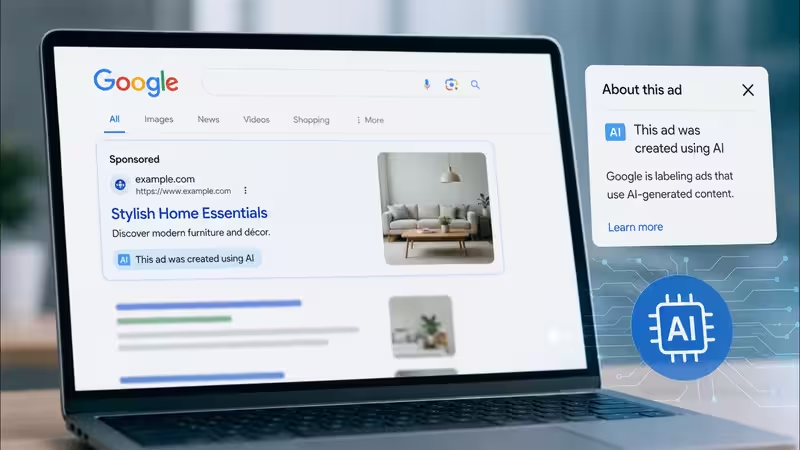
Watching an OTT show over the weekend, I caught something more consequential than the show itself. It was the advertising between episodes. In OpenAI’s campaign, a lawyer leans on ChatGPT and a UPSC aspirant prepares smarter. In Google’s, a child asks Gemini whether a microwave emits radiation, then uses the answer to correct his father. Nothing looked dangerous. That is precisely why it matters.These ads are not selling software. They are selling trust, teaching ordinary users that AI can advise, explain, fact-check and decide. When a probabilistic system becomes a daily adviser, who is accountable when it is wrong? The honest answer today is: everyone a little, and no one enough. That is what India must fix. The country needs a Consumer AI Safety Code: a practical, risk-based set of rules for general-purpose AI marketed at population scale as tutor, adviser and fact-checker. Not a ban. Not a licensing regime. A code.India is adopting AI faster than it can govern it. That concern has now sharpened. The first phase was about access. The second is about authority. A bad tool slows you down. A bad authority misleads you with confidence.India is unusually exposed. It is a young, mobile-first, exam-obsessed, multilingual market with uneven digital literacy and a fast-rising appetite for AI, where a first-time internet user may meet a hallucination before a verified source.The dangersThe industry will say users are warned, and technically they are. The same OpenAI whose ad shows a lawyer at work publishes support material admitting its system can produce misleading output and sound confident even when wrong. Google documents that Gemini can present inaccurate information as factual. So the advertisements say trust the AI, while the fine print says verify it. A disclaimer that says “AI can make mistakes” is not a consumer safety framework. Neither is privacy law: the Digital Personal Data Protection Act governs how data is collected and handled, not whether a system that advises millions can be trusted to be right.Consider the child correcting a parent. The arbiter is no longer a textbook or a teacher, but a conversational system, and the child is using AI to settle what is true. A fact-checker that can hallucinate is not useless, but it is not self-certifying either. Hallucinations do not arrive wearing clown shoes. They arrive in fluent sentences and remarkable confidence, and for users with low AI literacy, they do not look like mistakes. They look like facts.India has done a version of this before. When a cheap, frictionless WhatsApp outran public literacy, the cost was counted in rumour, in panic, and in real-world violence. The lesson was not that the channel was evil. It was that a powerful new way to move information had arrived years before the public learned to use it safely. AI is the same arrival, with one difference. WhatsApp carried what people wrote. AI writes it.Shadow AI threatThere is a quieter version of this risk inside organisations, one we see constantly at Greyhound Research in our advisory work with large global companies. It has a name: shadow AI. Employees paste contracts, client data and source code into consumer chatbots because the tools are useful and the friction is low. Where companies do have a policy, it often continues anyway, with employees buying their own subscriptions and running them from personal laptops, beyond the reach of IT. Most firms cannot say what proprietary material has already left the building.The cost of getting this wrong is not hypothetical. Courts in the US have sanctioned lawyers who filed briefs citing cases the AI had simply invented. In Australia, Deloitte had to refund part of its fee for a government report that contained fabricated academic references and a quote attributed to a Federal Court judge who never said it. The pattern holds: the AI never flagged its error. It presented fiction in the confident register of fact, and a professional signed underneath. If trained lawyers and a global consulting firm, with every incentive to check, could not catch the machine inventing things, what chance does an ordinary consumer have?None of this is an argument against adoption. AI is here and it is useful. But usefulness is not safety, and adoption is not readiness. So what would the Consumer AI Safety Code require? It would begin with advertising: if a tool is marketed for education, legal, health or financial decisions, the advertisement should carry clear, use-case-specific disclosure, a standard the Advertising Standards Council of India can help shape but that the Ministry of Electronics and Information Technology (MeitY), the Central Consumer Protection Authority and sector regulators must jointly anchor.Fact-checking normsIt would set a standard for fact-checking claims, so that words like verify or research assistant carry a defined meaning: whether the system cites sources, signals uncertainty, and performs reliably in Indian languages. It would require sensitive-data warnings at the point of risk, not buried in a privacy policy. It would treat AI literacy as education policy and draw sector-specific lines through the bodies that already hold professional accountability: the Bar Council of India, the National Medical Commission and the financial regulators. And it would ask platforms to publish India-specific safety transparency reporting.Technology companies will argue that regulation must not slow progress. Fair enough. But governance is not the opponent of innovation. It is the discipline that lets adoption scale without citizens absorbing the cost of every error.Consider the use case the ads never show. India carries a serious mental-health burden, with too few professionals, deep stigma, and millions who will never see a clinician. Into that silence steps a free chatbot that listens patiently at midnight. It will not feel like software. It will feel like care.So ask the question personally. If it were your parent, your child or your closest friend leaning on an AI system for support in a hard hour, what would you want to be true about it? That it had been tested for that conversation. That it would not improvise. That someone, somewhere, was accountable for what it said.The question is no longer whether Indians will use AI. They already do. It is whether India will build the disclosures, the literacy and the institutions that trust demands before AI becomes the voice the country turns to. If AI is going to advise India, teach India, sell to India, soothe India and fact-check India, then India must first decide whether trust this large can be left to the companies that profit from it.The writer is the Chief Analyst at Greyhound ResearchPublished on May 29, 2026
AI now advises India. Who decides it’s safe?
Given the pace at which AI is being adopted, there is an urgent need to put in place a Consumer AI Safety Code
1,086 words~5 min read