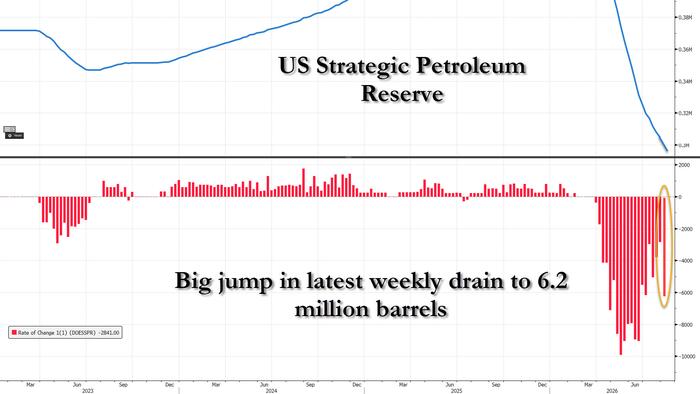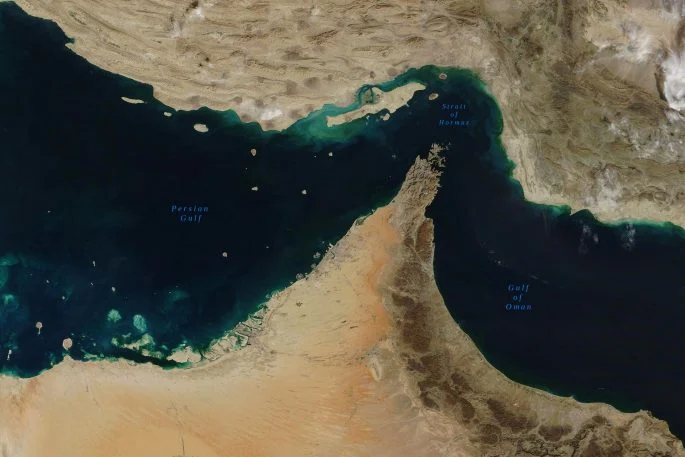
Oil prices have pulled back sharply from recent highs, suggesting that the market was optimistically pricing in at least a partial reopening of the Strait of Hormuz and an eventual normalization, following positive statements from the US. According to commodity analysts at Standard Chartered, these statements were met with heavy algo-selling despite contradictory messaging from the U.S. and Iran, with Washington maintaining its aggressive rhetoric, tightening balances and accumulating lost barrels. Brent crude for July delivery fell 0.6% to trade at $93.73 per barrel at 13.40 pm ET, down more than $12 per barrel from Friday’s intraday high of $106.13/bbl. Oil prices remain largely headline-driven, taking direction from escalations and de-escalations of the U.S.-Iran conflict in the near term. However, another hidden catalyst has been driving oil prices lower–surging exports. U.S. crude and petroleum exports recently spiked to an all-time record of nearly 12.9 million barrels per day (bpd), driven by massive drawdowns from the Strategic Petroleum Reserve (SPR). The rolling four-week average also hit an all-time high of 5.57mb/d for the week ended 15th May.The U.S. has effectively become the world’s last-resort crude supplier, with exports of crude alone briefly hitting a record 6.4 million bpd. An armada of tankers continues to pull barrels toward Europe and Asia, where countries are seeking alternatives to Middle Eastern oil following the blockade at the Strait of Hormuz. To help offset global shortages, the U.S. committed to releasing 172 million barrels on a loan basis, with single-week releases peaking at nearly 10 million barrels. Data from Kpler indicates that approximately half of the crude released from the emergency stockpile in recent months was directly exported rather than refined domestically. Foreign buyers, particularly in Europe and Asia, have aggressively snapped up roughly 40 to 50 percent of the crude released from the U.S. emergency stockpile. However, there’s a clear limit to the selling spree: whereas the strategy has temporarily helped suppress extreme price spikes, analysts caution that these buffer capacities are finite. Once these emergency inventories thin out, global oil markets could face renewed upward pressure on prices. To wit, sustained export surges mean that U.S. commercial and emergency reserves are shrinking at an accelerated rate. Indeed, total stockpiles in the Strategic Petroleum Reserve (SPR) have plummeted to approximately 365 million barrels--the lowest level since mid-April 2024. U.S. crude oil inventories have tightened by 7.88 mb w/w (a 9.09 mb draw against the five-year average), taking the total crude inventory to 445.01mb, 10.28 mb below the five-year average and the fourth consecutive weekly draw. U.S. gasoline inventories are near six-month lows of 214.16 mb and are below the five-year range. Distillate inventories have also tightened and currently stand at 102.91 mb.These large drawdowns are rapidly eroding the country's safety cushion ahead of the peak summer driving season. The accelerated shrinking of both commercial and emergency reserves has prompted analysts to debate the possibility of the U.S. restricting exports to protect domestic supply and lower pump prices.Looking further ahead, StanChart has predicted that oil markets are likely to experience ‘persistent vulnerability’ even if transit through the strait fully resumes. This should be higher for Brent than for WTI, supporting strong prompt differentials. Indeed, Brent crude and WTI crude recently moved in opposite directions primarily due to recent U.S. military strikes on Iranian targets. Brent serves as the global benchmark and is highly sensitive to maritime shipping risks in the Middle East. Fresh U.S. strikes on Iranian missile sites and naval assets directly threaten traffic through the Strait of Hormuz. This raises insurance and freight costs for seaborne barrels, spiking Brent prices. Conversely, West Texas Intermediate (WTI) reflects landlocked U.S. domestic supply, leaving it mostly insulated from immediate Persian Gulf shipping disruptions.As the U.S. and Iran negotiate a fragile cease-fire extension, the two benchmarks interpret diplomatic shifts differently. Brent traders heavily price in immediate physical supply risks if the deal falters. WTI responds more aggressively to headline-driven expectations of potential government policy interventions, such as a Strategic Petroleum Reserve (SPR) release or export limits designed to keep U.S. barrels at home.Meanwhile, natural gas markets have continued coping remarkably well with the near-term loss of the majority of Middle East gas supply. Disruptions to Qatari LNG (with damage to two of the 14 LNG trains at Ras Laffan and force majeure in effect) as well as UAE LNG cargoes is being broadly balanced by expected LNG supply growth in 2026, most notably from the U.S. StanChart has predicted that prices could soften notably from current levels when the force majeure is lifted. U.S. gas prices have recently been surging, driven by lower output and higher LNG flows. Henry Hub gas prices were up 7.6% to trade at $3.27/MMBtu in Thursday’s intraday session, the highest level since February. StanChart sees prices rising towards $4/MMBtu by year-end, driven by medium-term demand for data-centre power generation, heating/cooling and LNG exports.By Alex Kimani for Oilprice.comMore Top Reads From Oilprice.comSuriname Wants Two Wins From One Block: Gas Is Done, Oil Could FollowIndia's Energy Investment Set for Record $170 Billion in 2026Uniper Sees Gas Shortage in Winter If Storage Rates Don't Speed Up
U.S. Crude Exports Surge To All-Time Highs Amid SPR Releases | OilPrice.com
Oil prices have retreated from recent highs as markets price in hopes of partial Hormuz reopening, while record U.S. crude exports and massive SPR releases temporarily ease global supply pressures.
851 words~4 min read