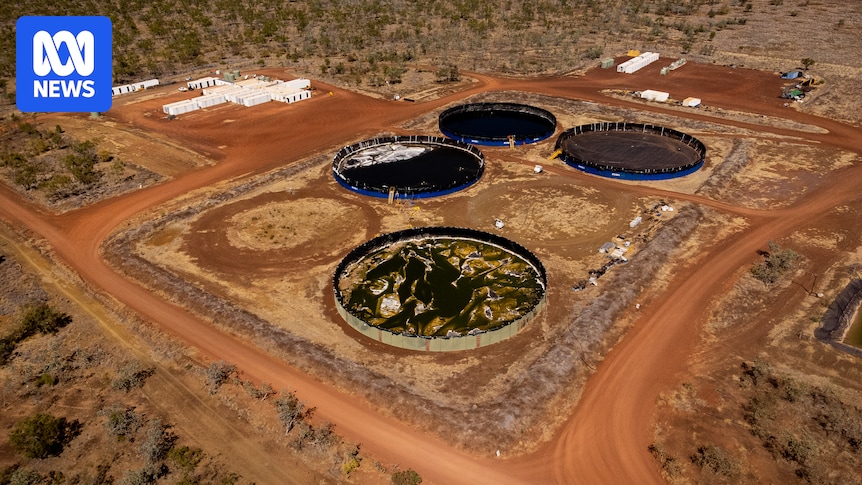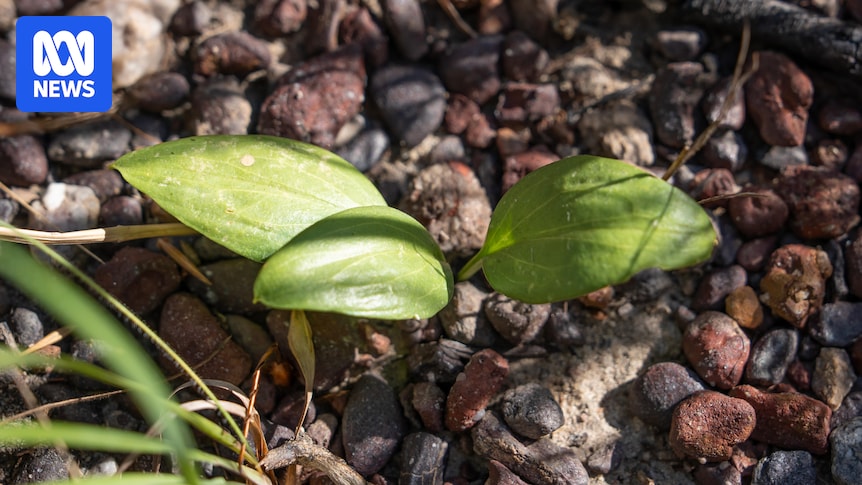
A tiny endangered herb that has just been added to Australia's national threatened species list could potentially stop the Northern Territory government's plan to build a new mega gas industry precinct on Darwin Harbour.The NT government hopes its planned Middle Arm Precinct will host gas, petrochemical, minerals and hydrogen processing, and a carbon capture and storage project to bury emissions from a new Beetaloo Basin gas field underground.The federal government has committed $1.5 billion to Middle Arm project infrastructure, including gas export jetties.The Middle Arm gas project has been in the works for years, with fierce opposition from environmental groups. (ABC News: Michael Donnelly)But the ABC can reveal the NT government's own draft environmental impact assessment of the project has found it would have a "significant impact" several endangered species, protected by federal Environment Protection and Biodiversity Conservation (EPBC) law.At the top of the NT government's list is the Typhonium sp. Cox Peninsula herb.Naturalist and botanical author John Brock showed the ABC the plant on Middle Arm."The whole plant is only six to seven centimetres high," he said. "At the beginning of the wet season it produces a spathe — a purple bract — within which is its spike, which is its flowering part, with both tiny male and female flowers at the base of that spike," he said.John Brock is worried the herb could be lost only a few years after it was identified. (ABC News: Jane Bardon)The herb flourishes during the Wet in Darwin and lies dormant underground during the Dry."It is endemic to this part of Darwin Harbour, and it's one of three NT typhoniums which are now listed as nationally endangered, which means it's a significant little plant," Mr Brock added.The Typhonium sp. Cox Peninsula was only identified in 2021, and was listed as endangered in February 2026.A leaked draft of the NT government's Middle Arm Precinct Terrestrial Ecosystems Draft Environmental Impact Assessment found most of the endangered herb's population is growing on Middle Arm, and the project's impact on the species would be "significant".The draft found 86 per cent of the endangered herb's population could be wiped out. (ABC News: Tristan Hooft)"Middle Arm Peninsula supports the largest known sub-population of Typhonium sp. Cox Peninsula," the assessment said."Given the size and location of this sub-population, it is a key source population for breeding and/or dispersal, as well as necessary for maintaining genetic diversity."Land clearing for the Middle Arm Precinct will result in the loss of the entire Middle Arm sub-population of Typhonium sp. Cox Peninsula, and therefore 86 per cent of the total known population of the species."That would happen, the assessment found, despite a plan to try to mitigate impacts by "translocating" all of the herbs "to an area of suitable habitat within or adjacent to Middle Arm Peninsula that will not be impacted by future development".John Brock says the plant should be preserved. (ABC News: Tristan Hooft)"The push for this major development would be catastrophic for this particular species and all of our habitat here," Mr Brock said."There would be, I would assume, a permanent loss of this herb."There is a core responsibility of the NT and federal government, to protect this species."Impact on local animalsShorebird researcher Amanda Lilleyman is also worried by the draft assessment's findings, with the potential of reducing the critically endangered Far Eastern curlew populations that feed on local salt marshes and mudflats.Amanda Lilleyman is calling on the NT and federal governments to protect Middle Arm's endangered species. (ABC News: Jane Bardon)It also found there would be a significant impact on endangered black-footed tree-rats."There are development footprints all over this nationally-significant habitat for the Far Eastern curlew," Dr Lilleyman said."The Territory and federal governments have to prioritise the recovery of this threatened species; we can no longer accept that damaging and interfering with nationally significant habitat is an okay thing to do in this day and age."The draft assessment found there would be significant impacts on the Far Eastern curlew. (Supplied: Amanda Lilleyman)Director of the Environment Centre NT, Kirsty Howey, obtained the leaked draft document."What this draft assessment makes clear is that the scale of impact on numerous threatened species, in this incredibly biodiverse important ecosystem, are unacceptable," she said.Kirsty Howey is calling for the Middle Arm project to be dumped because of the threat to endangered species. (ABC News: Tristan Hooft)NT government says judgement 'is premature'The NT government responded by saying the draft environmental impact statement (EIS) has not been finalised, and is expected to be released publicly in 2027."It is premature to make judgements about potential impacts and how they might be managed until the assessments are finalised, particularly as the proposal gets refined as planning progresses," the NT's iInfrastructure department, which is leading the development plan, said."The EIS will describe the commitments to avoid, mitigate or offset impacts to ensure the long-term protection of the environment."The Far Eastern curlew is deemed a critically endangered species. (Supplied: Amanda Lilleyman)The department said the "Middle Arm Precinct will unlock development across the Northern Territory, help to rebuild the economy and enable the NT to further participate in the global energy market".Dr Howey said, rather than pushing more gas developments, the global fuel crisis has suggested Australia needs to reduce its reliance on fossil fuels."The gas industry will always respond in a crisis by arguing that its products are indispensable, but this crisis was caused by dependence on fossil fuels — and projects like the Middle Arm project will just deepen our dependence on fossil fuels," she said."It will be gas companies that continue to rake in billions, and it's communities and species like the typhonium that will miss out."
Darwin's Middle Arm precinct could be roadblocked by endangered herb
The NT government is arguing its planned mega Middle Arm gas industry precinct will be needed to help shore up Australia's future fuel and energy supplies — but it has just identified that a tiny endangered herb could be growing in the way.
939 words~4 min read