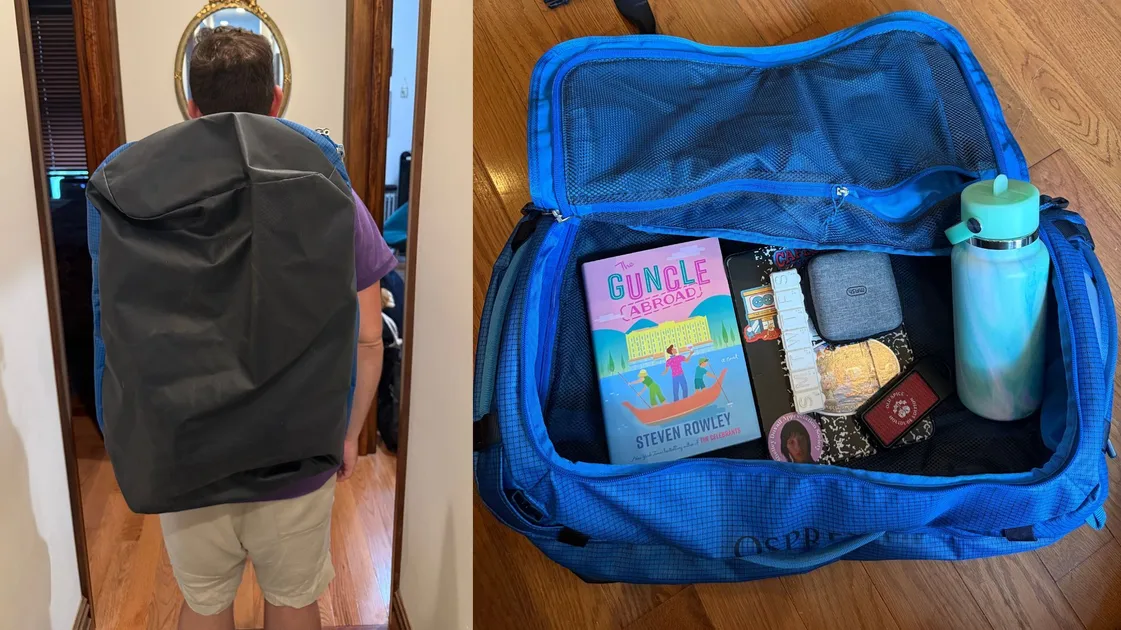
It would be easy for me to start this by saying that from the moment I put on the backpack it was love. That 20 years ago I stepped out of the airport in Vietnam and realised my life would never be the same again, that I’d be forever doomed to wander the world with the world on my shoulders, searching for something I’d never experienced before.The reality is far less glamorous. My first backpacking experience started with a mild panic attack in the back seat of a taxi. There were no seatbelts, no air-conditioning, and as I rolled up the window to put a barrier between me and the motorbikes swarming beyond, all I could see was my dopey face staring back in the reflection.Twenty years after landing in Vietnam, the reality of backpacking is far less glamorous than it first appeared.iStockDon’t judge me too harshly. I was only 18 at the time, having been sheltered from the realities of this world by the walls Australia builds around us. But after cutting my teeth by crossing South-East Asian streets, by flooding guest-house bathrooms and catching infections straight out of the Pacific War, those walls came crumbling down and I fell in love with this wayward way of travelling through these wonderful parts of the world.Since then my (admittedly battered) backpack and I have hit the road more times than I can count. And while I no longer spend 30 minutes walking up and down Haad Rin in search of the cheapest bungalow on the beach, I’m still yet to grow out of my backpack and what it represents: the most liberating means of travel.To honour those 20 years of cold showers, sleeping at train stations and wearing the same T-shirt for more consecutive days than I’m game to put in writing, these are the top 20 lessons I’ve gathered from my life as a backpacker who never grew up.Sign up for the Traveller Deals newsletterGet exclusive travel deals delivered straight to your inbox. Sign up now.LESSON ONE: You can’t dodge gastro by hiding in a hotel restaurantYou’re just as likely to get sick from a Western-style breakfast as you are from street food in places like Bangkok.iStockOur guts are just as much tourists as we are. They, too, experience wonderful, new and potentially ill-advised things for the first time. Thankfully, I’ve built up a resistance to the most nebulous pieces of street food and learnt a valuable lesson in the process: you’re just as likely to get sick from a Western-style breakfast.You can’t dodge gastro by hiding in a hotel restaurant. And why would you? The best meals are out there, on the streets and in the markets. It’s better to embrace the notion that when any meal can give you the shits, the best meals are those that make you shit like a traveller, not a tourist.LESSON TWO: Don’t call it cheapThe cost is the least interesting thing about these destinations.iStockSome backpackers don’t get it. They’ll travel to a country with incredible food, amazing culture, and the first thing that pops out of their mouth is: How cheap is it, mate? Cheap for whom? Certainly not the people who live there as the inflationary cost of living disproportionately affects people from lower-income countries.The cost is the least interesting thing about these destinations, and that’s coming from a man who is a celebrated stingy traveller. So the next time you hear someone raving about how cheap a place is, try to remember who the cheap ones really are.LESSON THREE: Always talk to the solo travellerA solo backpacker waits for a train on the platform of a Sri Lankan railway station.AlamyConversation to the solo traveller is like water to a thirsty man. Nothing quenches those lonely moments more than a stranger opening themselves up to you. It can be hard, too, to break the ice and, as I’ve skated over it more often than not, I now go to great lengths to make the solo traveller feel included.It should be a core tenet of any backpacking experience. After all, what is backpacking if not a chance to gain a deeper understanding of the world? And the best way to understand the world is through the eyes of the people we share it with.LESSON FOUR: You always pack too muchArrive in a city with a passport, a wallet and your underwear and buy what else you need when you get there.IStockYou could arrive in any capital city with nothing but a passport, a wallet and your underwear and within 24-hours you’d be re-equipped for your trip. Anything you need, want or forgot, you can buy when you get there, except maybe size-13 shoes for my clown-sized feet.It’s in this spirit that I now pack the bare minimum on my travels. I take a carry-on backpack only and have freed myself from the burdens of superfluous baggage. I’ll stroll past the carousel after an international flight, buoyed by the thought that I’ll never have to wrestle a suitcase off the conveyor belt again.LESSON FIVE: An overnight bus is never worth the moneyNo amount of time or money saved is worth spending 12 hours in an overnight bus.iStockTransportation? And accommodation? In the one ticket? To an 18-year-old me, this sounded too good to be true. Now, at 38, I’ve realised that no amount of time or money saved is worth spending 12 hours in the hell that is an overnight bus.The worst part isn’t what it does to your knees, back or bladder. It’s when you arrive at your destination some eight centimetres shorter, thanks to a compressed spine, and you can’t check in to your hotel for hours. You’ll have to find a park to sleep in, before the Serbian council workers swoop in and shoo you away for ruining the ambience.LESSON SIX: Time is the biggest luxuryLuxury is being on the road for a month and realising you can’t remember what day of week it is.iStockI’ve seen your fancy holidays but do you know what luxury is to me? Being on the road for a month and realising I can’t remember what day of week it is. These extended periods of wandering have a way of rewiring internal chemistry that make you impervious to the machinations of modern existence.It’s this kind of travel that I treasure the most. When the background noise of life fades, and the Sunday scaries seem far away, you look in the mirror and see more than a reflection staring back at you.LESSON SEVEN: The most dangerous thing is the roadsThe most dangerous thing you’ll encounter when you’re backpacking is the taxi from the airport.Alamy People like to talk about pickpockets, unsafe food and tropical diseases but the most dangerous thing you’ll encounter when you’re backpacking is the taxi from the airport.Statistically, anecdotally, the maths checks out, and I’ve had more close calls on dodgy roads than I’d ever care to admit (particularly when my mum is one of my readers).Unfortunately there’s no solution to this. Not unless you can convince an entire South-East Asian nation that seatbelts are a fantastic invention, and while those amulets of Buddha might look good dangling from the rearview mirror, they’re not going to be much help in the event of a crash.LESSON EIGHT: Hostels still suck (except for this one reason)Backpacker hostels can be hell at times but they remain great venues for making mates.iStockOn a recent trip to China I subjected myself to a hostel for reasons too long to elaborate on here. All you need to know is that, yes, it sucked in every way you think it would. Most nights I was kept awake until midnight, and although I didn’t share a dorm I’ve stayed in enough to never want to sleep in one again.That said, after being conversation-starved in a country where English is treated as an afterthought, the hostel was an absolute godsend for making mates. I’d sit down and grab a beer as my fellow backpackers were drawn to me like flies.LESSON NINE: Keep a few blank pagesThe author putting pen to paper on the road during his 20 years travelling the globe. It can be hard not to agonise over every tiny detail when planning your trip: from destinations to accommodation and even the bars and restaurants you’re going to hit up when you get there.But a great joy of backpacking is the blank pages it leaves in your itinerary. The ones where you can write your journey based on how you’re feeling, who you’re meeting, or simply where the sun is shining brightest. You might miss out on the best accommodation but this is a small sacrifice to make for the feeling of letting your feet, not your spreadsheets, do the planning.LESSON 10: Never take anything you can’t afford to loseBackpacking is hard on our personal belongings. Phones are dropped, wedding rings are lost (that one still hurts) and our favourite T-shirts will come out midriff-style after taking one spin too many through a Thai laundromat.As such, it’s important to remember never to take anything you can’t afford to lose. The good news is that when you accept this principle it makes you realise how little we actually need in this life to be happy, and how our possessions should never be extensions of who we are.LESSON 11: Border crossings are the best (but always prepare for the worst)Nothing compares to the excitement of entering a new country at a border crossing but be prepared for any eventuality.iStockI love border crossings. The excitement of entering a new country, the petty bureaucracy and the people you meet in the halfway houses between nations are some of the more interesting experiences you’ll enjoy on your travels.But it pays to be prepared lest you end up like me, stuck at the Cambodian border with a loan shark offering to spot me the US currency for the visa. This dude was dripping in gold chains, and all he wanted in exchange was to hold my passport as I crossed the border. Thankfully I never got to find out what ransom I’d have to pay to get it back as a fellow Australian loaned me the cash.LESSON 12: Timetables are aspirationalA conductor awaits passengers beside a Reunification Express rail carriage at Hue Railway Station, Vietnam.iStockIt was 26 hours into what was supposed to be a 12-hour train ride from Hanoi to Hue that I realised timetables are aspirational. I was holding down the top bunk while the couple below me imploded. They were screaming, crying and lamenting about the delay, which in their Eurocentric view of the world was unheard of.But if you go backpacking somewhere like Vietnam and expect buses, trains or ferries to run on schedule then you’re going to have a bad time. Better to accept that time moves at a different pace and that just because the train breaks down, that doesn’t mean your relationship has to, too.LESSON 13: A little language goes a long wayThe author, far right with new friends, says learning a little local lingo can open doors that may otherwise stay closed. The vast majority of backpackers will never learn how to say anything more than “hello”, “please” and “thank you”, which is fantastic news for you because it means all you have to do is learn three other words and it will separate you from 98 per cent of the other travellers in the country.“Delicious”, “cheers” and “see you again” are a good place to start and I’ve found that this small amount of effort goes a hell of a long way in the eyes of the locals. It opens doors that would have otherwise stayed closed, and cracks the kind of smiles that can brighten even the darkest travel day.LESSON 14: It’s not a competitionToo many backpackers treat travel like a game of one-upmanship. Getty ImagesI’ve met too many backpackers who treat travel like a competitive sport. They’re always talking about how long they’ve been travelling for, or how many countries they’ve visited, and listening to them makes me think that one of the more famous travel quotes has it all wrong. Don’t tell me how educated you are or how far you’ve travelled because I seriously don’t care.Travel is not a competition. There are no winners, no losers and no scores. You don’t have to do anything before a certain age, nor should you feel like you missed out because you didn’t see something “before it was cool”. It’s a personal experience that only matters to the most important person of all, that person being you.LESSON 15: Sometimes it’s worth waiting in lineSt Basil’s Cathedral in Red Square, Moscow, where the author was inadvertently caught in a queue for a Big Mac.iStockOnce, in Moscow, I saw this huge line wrapping around Red Square. Wondering what could inspire such patience from the Muscovites, I joined the queue and shuffled along with them for a good 10 minutes. Then, as we rounded the corner, I realised I was waiting in line for McDonald’s.This was an exception, not a rule, to my experiences because anywhere locals line up tells you more about a restaurant than any Google review ever will. Reviews can be bought but time is finite, and when someone dedicates it to waiting in a line, you damn well better believe the food is going to be good.LESSON 16: Don’t rob tomorrow for tonightDating to the late 14th century, Gyeongbokgung is a former royal palace in Seoul, South Korea.iStockLearning this coincided with me turning 30 and realising I can’t spend all night out on the lash and still expect to get through the following day of activities. Still, it can be fun to be swept off your feet and to bounce from barbecue to bar because you met a Seoul local who promises you the best makgeolli of your life.However fun these nights are, they aren’t worth the pain of having to drag your corpse out of bed the next morning, go to Gyeongbokgung Palace and force yourself to care about the Joseon Dynasty.LESSON 17: For the love of God, wear a proper helmetHelmets save lives and can be the difference between walking away from a crash or suffering a serious injury, or worse.iStockIt’s baffling to write this but you’d be amazed at how many backpackers I’ve seen flying around South-East Asia without their brains wrapped in polycarbonate. Helmets save lives. They can also be the difference between walking away from a crash with some missing skin or drinking your food through a straw.Sure, the locals might not wear them, but then the locals have also grown up on scooters since the time they could walk. They’re less likely to panic, mistake the brake for the throttle, and go hurtling into a rice paddy like a dart.LESSON 18: Talk is cheap, lived experience is pricelessRailay is a small peninsula between the city of Krabi and Ao Nang in Thailand. iStockOne of my favourite places in Thailand was one that I’d never heard about before. I had planned to go to the Phi Phi Islands, as one does when they’ve just watched The Beach and want to feel as though they’re living in a Danny Boyle movie.But then some random dude I met outside my bungalow said I should go to Railay instead. I figured, what the hell, why not? He seemed well-travelled and, following his advice, Railay ended up being a highlight of the trip. It was a good reminder that experience is the greatest commodity a backpacker has, and we should solicit it wisely.LESSON 19: Everything changesRailay will never go back to what it was.iStockOn the topic of Railay, it’s ruined now. Overdeveloped, over-touristed, it has been commandeered by day trippers from neighbouring Ao Nang, who leave a mountain of trash in their wake. Railay will never go back to what it was, in the same way that so many other parts of the world irrevocably change after we fall in love with them. It would be easy to lament this, but it’s important to remember that we’re only guests passing through.A place should never stay the same for our sense of nostalgia, and if the locals want craft beers and flat-screen televisions then far be it from us to stand in their way.LESSON 20: And nothing changes at allThe author reflects on his two decades of world travel with a backpack for a constant companion.Paul MarshallNo matter how much time I spend abroad, I’ll always come home and realise that nothing has changed. My friends are still right where I left them, albeit older, fatter and with less prominent hairlines. My coffee shop still serves the same long blacks, although they’ve had to bump up the price to $4.80 (still a bargain these days).But then it hits me. Something has changed, and that something is me. I can no longer look at home the same way, not after everything I’ve seen. I think this is what makes backpacking so beautiful. It’s the kind of travel where you go out searching for the world and end up finding something of yourself.FIVE REASONS TO KEEP BACKPACKING IN YOUR 40S (AND BEYOND)You have disposable incomeMost backpacking trips across Europe are spent eating the cheapest packet of spaghetti known to Carrefour. Some people see an entire continent and barely eat out the whole time, but as an older backpacker you have the disposable income to experience a country, as opposed to constructing it in a hostel kitchen.You don’t care what people thinkOne of the great joys of age is that you care less about what others think. You’ve got nothing to prove and can experience a country exactly the way you want to, not how others think you should. If you want to skip the Louvre then you damn well skip the Louvre, and your travels will be all the better for it.You actually appreciate the value of timeWhen you’re young, time is something you pass, as you have a whole lifetime of it ahead of you. But when the window narrows, you start to appreciate just how precious it is. It’s this appreciation that makes backpacking better with age, as you don’t just pass the time, you grab hold of it with both hands.Your knees are stronger than you thinkA soccer injury in my teens has left me with osteoarthritis in my 30s. It sounds like a rusty gate whenever I bend over, and even though I have more cholesterol than cartilage the physical demands of backpacking aren’t nearly as bad as you think. Just avoid overnight buses and the middle seat on a budget airline and you’ll be fine.You’re too sensible to buy a PorschePeople do crazy things during their midlife crises, whether it’s changing their hairstyles, buying fancy cars or trading in partners for newer models. The good news is that backpacking is a whole lot cheaper than a new Porsche, and if you’re going to have a midlife crisis a trip is way more fun than a new car.
I’ve been a backpacker for two decades. Here are 20 things I’ve learnt
Overnight buses are never worth it, hostels still suck, you always pack too much and the greatest luxury you’ll ever need is time.
3,174 words~14 min read