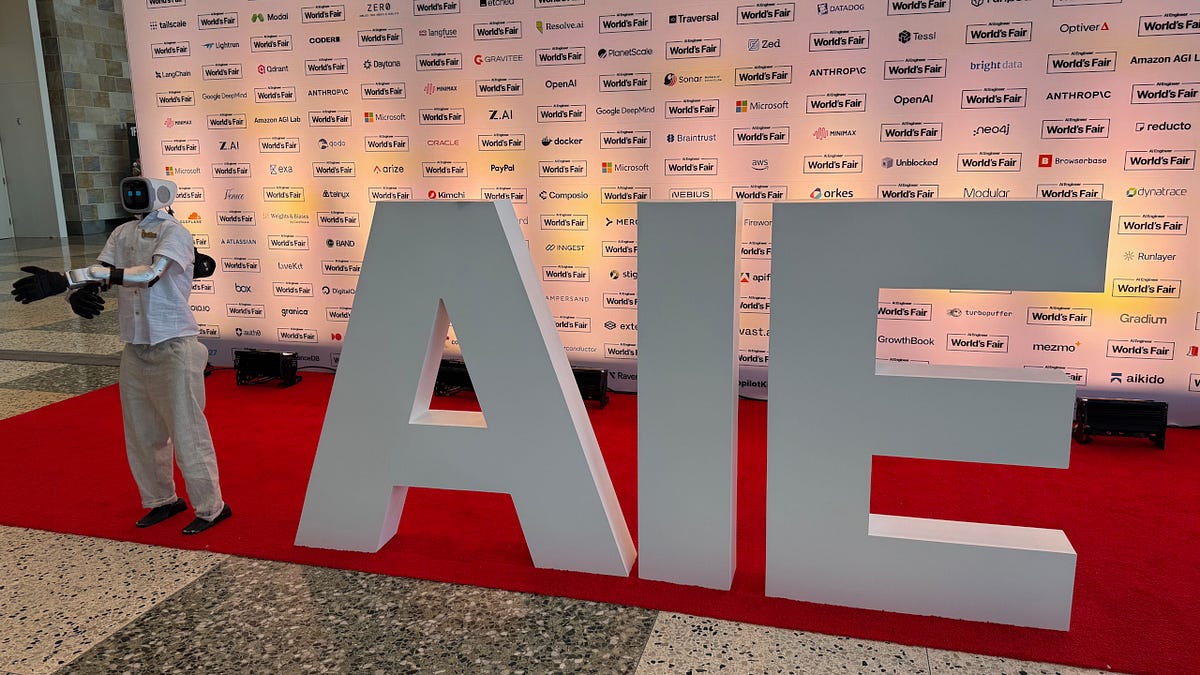
The new AIEWF website is live! CFPs close in 2 days and we will run our first New Engineer Orientation this weekend, get your tickets booked ASAP as they -will- sell out. Take the AI Engineering Survey and get >$2k in credits and free AIE WF tickets!One of the central tensions in the agents industry is that even while there are major decacorn agent labs like Sierra, Decagon, Notion and Cursor being built up, it is also true that it has never been easier to DIY agents, with a plethora of agent frameworks like LangGraph and Pydantic and Flue, and managed agents from Anthropic and Gemini and Amazon. There has been a wave of companies building their own background agents from Shopify to Stripe to Paradigm to Razorpay, and even Cognition’s friends Ramp have built their own coding agent with other friend Modal.You’d think Cognition might feel a bit threatened, but they’re not - even after all this, they were way oversubscribed for the $1B Series D they just announced:Cognition@cognition1/ We’ve raised over $1B at a $26B valuation, led by @Lux_Capital, @generalcatalyst, and @8vc.
Our enterprise usage has grown >10x since the start of this year, and our run-rate revenue grew to $492 M.
We launched Devin two years ago as the first AI software engineer. Since 3:39 PM · May 27, 2026 · 733K Views157 Replies · 194 Reposts · 2.37K LikesWalden Yan, coiner of context engineering and Chief Product Officer/Cofounder of Cognition, invited OpenInspect’s Cole Murray to talk about why the Devin is in the Details.Full conversation live on the pod today: In retrospect, async agents were the most AGI pilled bet you could make in 2024 - the models weren’t good enough yet to vibecode, and people didn’t trust AI enough to let it rip, nobody (including early Cognition) was sure about the form factors. Now it is obvious:The first wave of AI coding tools made the developer faster but remain heavily in the loop. Copilor and Cursor’s tab autocomplete are prime examples However, the workflow was still heavily centered around and bottlenecked by the developer’s local workflow: a developer in an IDE, watching the model, accepting or rejecting changes, and pushing code one interaction at a time.The second wave was local agents: Claude Code, Windsurf, Cursor’s agents pane: first one and increasingly many terminals all running concurrently.The current Age of Async Agents points to a different future focused more on agent orchestration which drives end-to-end development.According to previous guest Steve Yegge, there are finer-grained 8 levels to agent adoption, but we have collapsed it into three.As Cursor’s Michael Truell put it in The third era of AI software development:Cursor is no longer primarily about writing code. It is about helping developers build the factory that creates their software. This factory is made up of fleets of agents that they interact with as teammates: providing initial direction, equipping them with the tools to work independently, and reviewing their work.The agent should not sit solely inside the developer’s flow. It should be setup to work in the background so that you can give it a task, a repo, a machine, a shell, a browser, tests, memory, and review loops to go do the work somewhere else.In less than a year, the sentiment has shifted from avoiding multi-agent systems:Walden@walden_yanI see a lot of people make the same mistakes building agents. So we shared a few of the principles we use