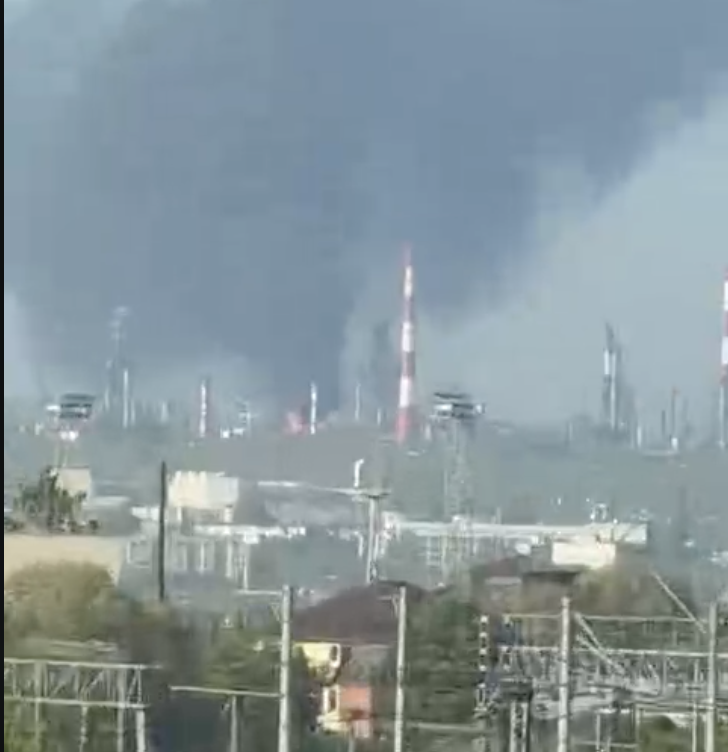
Key developments on May 28:Russia deploys new Pantsir systems on Moscow rooftops as Ukrainian drone threat grows3 Russian shadow fleet tankers attacked by drones near Turkey's Black Sea coastSweden announces 16 Gripens for UkraineUkraine strikes Tuapse oil refinery again, General Staff vows 'systematic' strikes on Russia's military-industrial targetsNorway opens talks on joining French nuclear deterrence initiativeRussia appears to have begun deploying new Pantsir-SMD-E air defense systems on the rooftops of civilian buildings in Moscow, according to footage by military analyst Massimo Frantarelli and Ukrainian defense outlet Militarnyi.Ukraine has intensified its long-range strike campaign against military, industrial, and energy targets inside Russia in recent months, with drones repeatedly reaching Moscow and other regions hundreds of kilometers from the Ukrainian border.🚁Mil Mi-26T.. heavy transport helicopter.Pantsir-SMD" ADMS?🎥"chegara.siz" pic.twitter.com/WEAwTKQLsg— Massimo Frantarelli (@MrFrantarelli) May 27, 2026
Video published online on May 27 shows a Russian Mi-26 heavy transport helicopter installing a Pantsir-SMD-E system on the roof of the Nordstar Tower business center in northern Moscow.The Pantsir-SMD-E is a newer version of Russia's Pantsir short-range air defense system designed specifically to counter drones and smaller aerial targets. Unlike the older Pantsir-S1, the SMD-E variant does not include 30 mm automatic cannons, according to Militarnyi.The system is armed with two types of missiles: standard 95Ya6 missiles with a reported interception range of up to 20 kilometers (12 miles), and smaller TKB-1055 missiles intended to target small drones at ranges of up to 7 kilometers (4 miles).According to Militarnyi, the radar suite includes an active phased-array surveillance radar with a detection range of up to 24 kilometers (15 miles), as well as a millimeter-wave targeting radar.Russia first began deploying Pantsir systems on rooftops in Moscow in 2023, including atop the Russian Defense Ministry headquarters, as Ukrainian drones were able to reach the capital.Sweden announces 16 Gripens for UkraineSweden plans to transfer 16 used Saab JAS 39 Gripen C/D fighter jets to Ukraine and support Kyiv in procuring up to 20 newer Gripen E aircraft, Swedish Prime Minister Ulf Kristersson announced on May 28."Ukraine has clearly identified Gripen as the priority choice for its air force in the long term and intends to acquire the newest version, Gripen E," Kristersson said at a joint news conference with President Volodymyr Zelensky in Uppsala.According to the Swedish government, Ukraine plans to finance the future purchase of Gripen E/F aircraft using 2.5 billion euros ($2.8 billion) from the European Union's Ukraine Support Loan mechanism.Kristersson said negotiations over the Gripen E procurement are ongoing and that deliveries of the newer aircraft could begin by 2030.He added that Sweden would also transfer 16 Gripen C/D aircraft currently used by the Swedish Air Force, with deliveries expected to begin in early 2027 after Ukraine finalizes the purchase agreement and Sweden secures the required export approvals.The transfer would further expand Ukraine's fleet of Western-supplied fighter aircraft, which already includes American F-16s and French Mirage 2000s but remains insufficient to fully defend Ukrainian cities and infrastructure from daily Russian missile and drone attacks."This is truly a historic event, a historic day for our cooperation and for our countries," Zelensky said during the press conference."We're talking specifically about a squadron of Gripens for Ukraine, and this is tremendously important support for us," he added.Zelensky said Ukraine expects to receive the "first capabilities" within the next 10 months and confirmed that Ukrainian pilots have already begun training related to the aircraft.3 Russian shadow fleet tankers attacked by drones near Turkey's Black Sea coastThree oil tankers previously identified as belonging to Russia's shadow fleet were attacked by drones in the Black Sea off the coast of Turkey on May 28, Reuters reported, citing a statement from the Tribeca shipping agency.Russia uses its shadow fleet of aging, often underinsured tankers to bypass international sanctions on its oil trade. Western officials have also raised concerns that the vessels may be linked to broader Russian hybrid activities in Europe, including espionage and drone operations.The tankers James II, Altura, and Velora were all around 50 miles (80 kilometers) off the coast of northern Turkey when the attacks occurred.No injuries were reported among the crews.Ukraine has not commented on the reports, but long-range Ukrainian drones have targeted Russia's shadow fleet tankers in the Mediterranean Sea and Turkey's Black Sea coast in recent months.Ukraine strikes Tuapse oil refinery again, General Staff vows 'systematic' strikes on Russia's military-industrial targetsUkraine struck Russia's Tuapse oil refinery and multiple Russian military targets overnight on May 27, including air defense systems, command posts, and automated reconnaissance systems used by the Russian Air Force, Ukraine's General Staff reported.The strikes are part of Ukraine's ongoing "long-range sanctions" campaign targeting Russia's military-industrial and energy infrastructure far behind the front line, as Kyiv seeks to impose higher costs on Moscow's war effort.According to the General Staff, Ukrainian forces struck the Tuapse oil refinery in Krasnodar Krai, triggering a fire and heavy smoke at the facility. The scale of the damage is still being assessed.The Tuapse refinery is one of the largest oil-processing facilities in southern Russia, with an annual processing capacity of around 12 million tons of oil. The plant produces fuel used in part to supply the Russian military and has become a frequent target in Ukraine's long-range strike campaign against Russia's oil infrastructure.The refinery and nearby port facilities have been repeatedly hit by Ukrainian drones and missiles over the past months, causing fires, temporary shutdowns, and disruptions to fuel exports through the Black Sea.Ukraine's Air Force also used Storm Shadow air-launched cruise missiles to strike Russian reconnaissance automation systems in the areas of Voronezh, Taganrog, and occupied Sevastopol in Crimea, the military said.Norway opens talks on joining French nuclear deterrence initiativeNorway will begin talks on joining France's nuclear umbrella, French President Emmanuel Macron and Norwegian Prime Minister Jonas Gahr Stoere announced May 27, as European countries seek to strengthen regional defense cooperation amid growing uncertainty over U.S. security commitments.The announcement came during a meeting in Paris, where France and Norway signed a mutual defense agreement that includes Norway participating in what France describes as "forward nuclear deterrence" — a framework that would involve European partners more closely in French strategic nuclear planning."This agreement establishes a principle of mutual assistance between our two countries," Macron said.Stoere said Norway's primary security guarantee would remain the NATO and the United States, but added that France's nuclear capabilities contribute to the alliance's broader deterrence posture."Our deterrence will continue to be provided by NATO. The U.S. has made it clear that its nuclear guarantee to Europe remains unchanged," the Norwegian leader said. "French capabilities are part of NATO's overall deterrence capability."The initiative reflects broader efforts across Europe to bolster defense capabilities and reduce reliance on the United States as concerns grow over Washington's reliability as a security partner and tensions with Russia remain high."In the face of threats to our continent and beyond, Europeans need to be stronger and more sovereign. Our strengthened partnership serves to demonstrate this," Macron wrote on social media after the meeting.As the European Union's only nuclear-armed state, France has expanded strategic cooperation with several European allies, including Germany, Poland, the Netherlands, Sweden, Denmark, Belgium, and Greece, all of which have joined the French nuclear deterrence initiative.