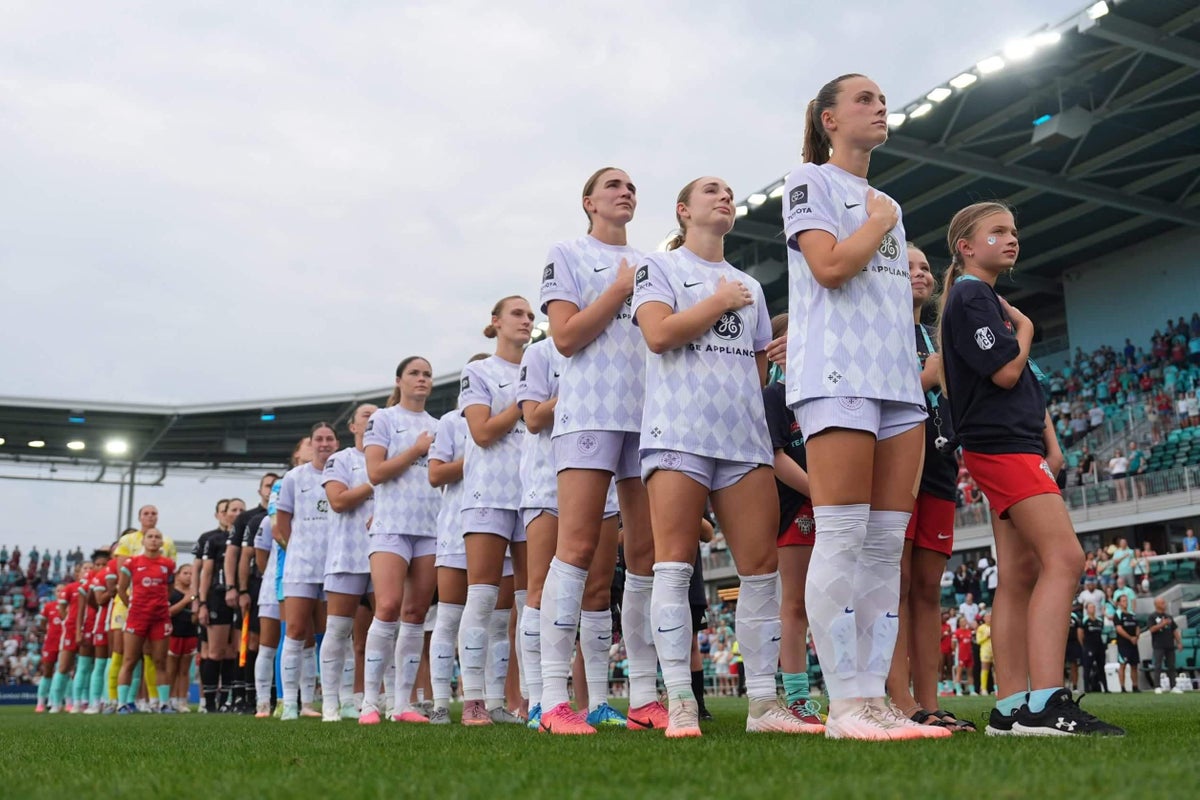
Moving sits at the epicenter of life’s most stressful experiences. It carries a unique blend of emotional strain and logistical nightmares. Even under the best circumstances, when professionals pack, transport and unpack an entire household, the disruption remains.For many in the NWSL, that level of support is out of reach and the timeline is even tighter, leaving little room to plan. Add a small child or a baby to the equation and things get even harder.“I’d be lying if I said it was an easy task to pick up your family, to move into a different market across the country,” said Crystal Dunn, a World Cup champion and Olympic gold medalist, who moved from Portland to New Jersey after the birth of her son, Marcel.The league has made several strides, however, in the last decade to improve those conditions.With massive distances between cities, it can mean changing time zones, climates, housing markets and family networks overnight. For mothers, it means moving a child, a partner, a nanny, a pediatrician, a nap schedule and an entire support system, all while trying to win a starting job.That is a hidden cost of mobility in women’s soccer.“You spend so much time building a community in one place, our people, your routines, your support system, and then suddenly you have to uproot all of it and start from scratch somewhere new,” said North Carolina Courage goalkeeper Kailen Sheridan, who recently had a baby and transferred to the East Coast team from San Diego Wave. “I was lucky. In Carolina, people really stepped in and helped make the transition feel manageable.“At the end of the day, everything we do is about making sure it’s not stressful for (our baby), that whatever we’re dealing with doesn’t spill over and affect her too much. That’s always the priority.”Kailen Sheridan moved from the San Diego Wave to the North Carolina Courage this offseason with her growing family. (Grant Halverson / Getty Images)The NWSL’s latest collective bargaining agreement reshaped the landscape for more support, eliminating trades without player consent while expanding parental leave and childcare benefits. That doesn’t eliminate all difficult moves, as was the case with Sheridan, but contracts are guaranteed, free agency has grown, and players have more control than they once did.“I feel like there aren’t many stories (before us) because people weren’t able to do it,” Sheridan said — except for a few big-name players, such as Alex Morgan, Julie Ertz and Dunn. Players who wanted to start families stopped playing, she said.“I used to talk to Alex (Morgan) all the time about how hard it was after she had (her daughter) Charlie, especially making that move from Orlando to San Diego,” Sheridan said. “You build a whole life in one place, then suddenly you’re trying to re-create it somewhere completely new. That kind of reset takes a toll. It’s a lot to carry in a short period of time, not just professionally, but personally, just to feel settled again.”But under the current CBA, the NWSL’s parental policy intends to treat parenthood as part of a player’s career, not a disruption to it. Under the latest provisions, players who are unable to compete due to pregnancy continue to receive 100 percent of their base salary, with full health insurance coverage maintained throughout their absence, whether they are placed on the injury or season-ending injury list or simply out through the remainder of their contract.If a contract expires during that window, clubs are required to offer at least a 30-day training camp opportunity to ease a player’s return. The league has also expanded its childcare support, now offering both a stipend (up to twice the IRS maximum), with an additional $5,000 per child for larger families. Parental leave extends beyond birth mothers, too: All parents are eligible for up to eight weeks of fully paid leave, according to the league.And for those who need to travel, the league now offers travel support for children up to 14 years old, which used to be capped at 5.In Sheridan’s case, the move was cross country. Now scale that up: relocating internationally, with a child who doesn’t speak English.Angel City FC’s Brazilian midfielder Ary Borges first moved to the U.S. to play for Racing Louisville in 2023 with her then-2-year-old son, Luca, who did not speak English.“Moving is hard but it is even harder with a toddler who does not speak the language,” she told The Athletic. “But everyone was super helpful and really eased our move to the U.S. helping us find everything we needed.”After two seasons in Kentucky, Borges and her pregnant partner packed everything and moved to Los Angeles this season, having signed with Angel City. “This time was easier for sure. My partner is pregnant, and we have all the support we need. And now Luca is the one among three of us who speaks better English,” she said.Angel City FC midfielder Ary Borges with her son, Luca. (Gina Ferazzi / Getty Images)Some players chose to move their families across continents. For others, transfers meant an even harder trade-off: leaving their children in a more stable environment, prioritizing the child’s well-being over proximity, even if it required long stretches apart.Dunn joined Gotham FC before later transferring to Paris Saint-Germain. “From Portland to New Jersey, I traveled with two cats, my nanny, my husband, my son, all on the same flight,” she said. “It’s a funny story now, but during, I thought I was going to go insane.”After that experience, Dunn knew she was not going to move to Paris with the entire family. That decision wasn’t easy.“Those are tough calls as a parent. You’re constantly asking, what’s actually best for my kid?” she said. “That’s the grace I had to give myself. It’s easy to feel like a bad mom because you’re not there every day. But I flipped it. I’m a good mom because I’ve made sure he’s surrounded by people who love him and can show up for him. That’s how I got through those last few years of my career. I couldn’t be there all the time, but I made sure he had a strong, loving support system. And that’s what I’m proud of.”
Transfers, moving and motherhood: The hidden cost of traveling as an NWSL player and mom
The Athletic explores the intersection of professional soccer and motherhood.
1,032 words~5 min read