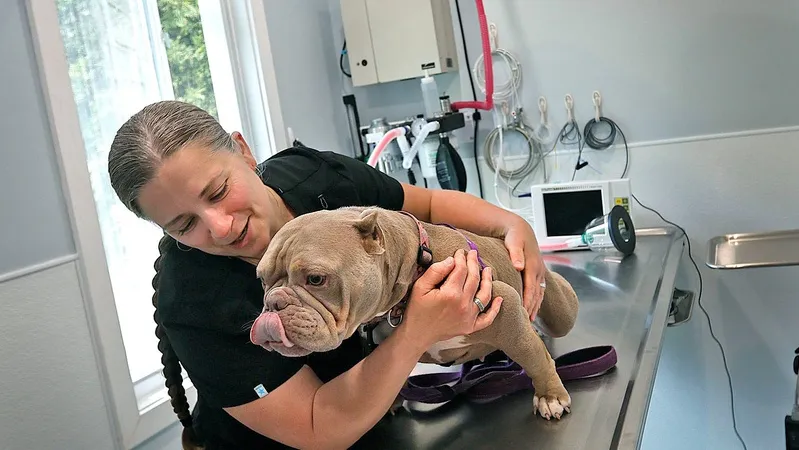
Show Caption
Olivia Sablan would do anything for her 3-year-old Golden Retriever, Lemon, including cutting other parts of her budget, if needed."She's my whole world," said Sablan, 27, who is a post-doctoral student in Seattle studying atmospheric science. Sablan rescued and adopted Lemon when the pup was 10 months old.But pets aren't cheap.Pet ownership is increasingly becoming more expensive, a new Bank of America Institute analysis finds. As costs, including veterinary care, go up, there has been a pullback on pet adoption rates and pet ownership, which may signal that affordability is playing a larger role among animal lovers, the Bank of America Institute said.Pet ownership in US remains strongThe U.S. pet market is still steadily growing, though at a slower pace, with 95 million households owning a pet (or around 71% of Americans). Spending for pets hit $158 billion in 2025, according to the National Pet Owners Survey by the American Pet Products Association, cited in the Bank of America analysis.Dog ownership is ahead of other pets at 68%, according to a survey from CivicScience. Cats were the second most popular pet at 46%, while ownership of fish, birds and small mammals was less common."Pet ownership is strong, but as is the case for many other facets of people's budgets, the cost of caring for pets is rising," Taylor Bowley, a Bank of America Institute economist told USA TODAY.Affordability constraints are increasingly shaping whether consumers are adding a pet to their household or how they shop for that pet, Bowley said.Bank of America global research found that pet adoptions slowed in the first half of 2025, with dog adoptions declining modestly year over year and cat adoptions staying stable. Bank of America data also shows that the share of households with pets has declined over the last two years, with the sharpest drop of nearly 0.7% between 2025 and 2026, among lower-income households.Pets are costing moreSpending on pet goods and services is increasing.Spending at pet stores was up 1% year over year in April, according to Bank of America data, while the biggest increase for pets came in veterinary care.Consumers spending at veterinary services rose nearly 6% year over year, according to the data. Some of that increase, according to Bank of America global research, is consolidation of veterinary services to private equity firms, which it said can erode competition and increase prices.But spending on pets differed among income groups.Spending in pet stores in April for lower-income Millennials dropped a little more than 2% compared to a 1% increase for higher-income Millennials, according to Bank of America data. For Gen X shoppers, there was an approximately 0.6% drop compared to an approximately 1.8% increase for higher income Gen Xers."The variation reflects 'selective spending' with households adjusting their outlays on discretionary categories (like toys, accessories and supplies) depending on the differences in their budgets," the report said.Bowley said Millennials and Gen Xers may be in the "crosswinds" of caring for children, aging parents and pets – which can all put a strain on already tight budgets.Where you live also affects pet-care costs. Bank of America Institute – using card data on pet store, pet insurance and veterinary spending across 20 large "core-based statistical areas" (CBSAs) relative to the national average – put Seattle on the top of the list. Average monthly spending in Seattle in the first four months of 2026 was nearly 23% above the U.S. monthly average. Portland, Oregon, and Portland, Maine, came in second and third.On the other end of the spectrum, Atlanta, Dallas and Orlando, Florida were below national averages for pet spending, hovering around 10% less. Differences in pet spending likely reflect regional differences in cost of living, Bowley said.Furry loved ones worth sacrifice, owner saysSablan, who chronicles life with Lemon on social media, recently outlined her monthly costs for pet ownership.She acknowledges that her costs for Lemon are pretty low compared to others she's seen, coming in at $118.73 a month. Costs include food, flea and heartworm medication and pet insurance. She also grooms Lemon herself, adding to her savings.Sablan mostly works from home, but said if she needed to send Lemon to doggy daycare, that would add significantly to her bills. Still, Sablan said she believes that she and other pet owners would make cuts in other parts of their budgets in order to continue to afford their furry companions."People are going to continue to pay it because we love our dogs, and you’re not going to just cut out those costs because they start costing more," she said. Betty Lin-Fisher is a consumer reporter for USA TODAY. Reach her at blinfisher@USATODAY.com or follow her on X, Facebook or Instagram @blinfisher and @blinfisher.bsky.social on Bluesky. Sign up for our free The Daily Money newsletter, which breaks down complex consumer and financial news. Subscribe here.