MINNEAPOLIS — The large sign on a wall in Jordan Halverson’s office is written in varsity font, like something an athlete taps for good luck on the way out to the field. It reads as a coaching mantra; a set of core values to help teams develop an identity:
Do I belong?
Is this meaningful?
Can I do this?
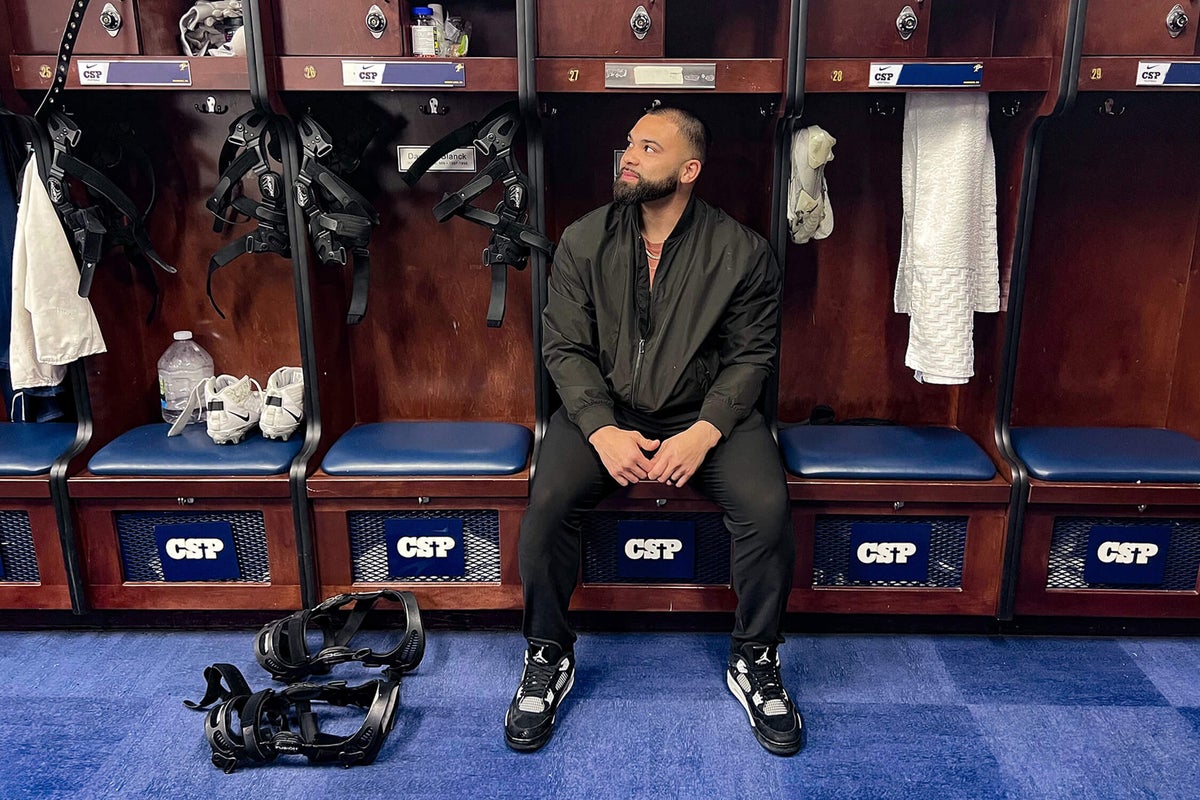
Halverson had the sign made last year when he became the principal at Fridley Middle School.His appointment sent a buzz through the 800-student school of fifth through eighth graders. Halverson was just 34 and a former local football star. Two of his old jerseys hang on his office wall: one a basketball jersey from Fridley High School, which is across the street, and the other from Concordia University-St. Paul, a small Division II college 20 minutes south.At Fridley High, Halverson was a quiet ninth-grade transfer as summer football practices started. He seemed to his teammates to already be an adult. He was the only underclassman on the team with a mustache; he was bigger and faster than most of his older teammates, too. He eventually became a team captain, broke the tackles record at CSP and even got a chance in the NFL at a rookie minicamp with the Minnesota Vikings. That was more than a decade ago.Halverson gestured to a telephone behind him on his office desk. Its red-orange voicemail button blinked constantly throughout the winter, when thousands of masked and heavily armed ICE agents descended upon the Twin Cities — the target of the Trump administration’s “Operation Metro Surge.”ICE said it was focused on undocumented immigrants with criminal records; its internal data showed that three-quarters of those taken into ICE custody during the operation had no criminal record at all.Minnesota leaders said federal agents were targeting schools — “All it does is cause terror and trauma to the children,” Gov. Tim Walz told the New York Times — and Fridley Middle, which draws from immigrant communities, was among several schools in the area that were directly impacted by the raids.Halverson knows multiple students who had a parent or other relative taken by ICE. At the height of agents’ activity, he said, between 100 and 150 of his students did not attend school in person because parents feared leaving their homes to transport their children or were afraid to send them via bus.Some mornings, Halverson estimated, he had 100 or so voicemails waiting for him, the phone’s light blinking constantly. Most were from parents.Jordan Halverson had a sign made featuring three core pillars when he took over at Fridley Middle school, which celebrates its diverse student body. (Jourdan Rodrigue / The Athletic)“You could hear the pain, the sadness. They’re asking me, ‘How are you going to protect my child?’ ” he said. “… You sit there, you’re a first-year principal, and you’re like, ‘I don’t have all the answers. I can’t guarantee 100 percent safety for your child.’ It was a lot of helplessness, and sitting in that.”Halverson goes back to No. 1 on his sign. Do I belong?“What I always tell people is that we’ve got to control the controllables,” he said, using a phrase commonly heard in football. “(We can) welcome these kids into the building each day and make them feel safe and that they are home.”Halverson knows firsthand how much that matters. As a teenager, he may have appeared to some as the imperturbable football star of Fridley High. In reality, his home life was turbulent. Food and shelter were frequently uncertain. Halverson’s friends, teachers and coaches across Fridley supported him — with meals, a bed and more.Now, the Fridley Middle staff and students looked to Halverson, their rookie principal, to lead them through a frightening and uncertain winter.No. 3. Can I do this? By the time Halverson’s mother moved them to Fridley the summer before he entered ninth grade, he was old enough to understand that something was wrong, but not old enough to understand what it was. All he knew was that they couldn’t ever keep an apartment for very long.“I was used to my mom calling me or sending me a text like, ‘We gotta get out of the house by this time because we can’t live there anymore,’ ” he said.During a particularly challenging episode with her mental health, Halverson said, his mother went to stay with her sister in Wisconsin. Halverson had just started to settle in at school. He was making friends and gaining the attention of coaches who saw him play football and also wanted him on the basketball and track teams. Halverson wanted to stay in Fridley and finish school, yet he no longer had a permanent home there.(He didn’t see his father from age 2 until he was in high school, when his dad showed up unannounced at one of his basketball games. They don’t keep in touch, Halverson said, although he has relationships with other half-siblings on both his dad’s and mom’s side.)Coaches, teachers and friends’ parents recognized the truth of Halverson’s situation and were keeping an eye on him. Halverson crashed on couches all across Fridley. His mom sent money to the families who took him in for food and clothing, but he wasn’t always sure where his next bed or meal would be.Eventually, Halverson moved in for a months-long stay with one of his best friends and football teammates, Travis Zerwas. Zerwas, his four siblings and his parents lived in a modest house near the high school and had little to spare. However, everyone was welcome at their table regardless of background or circumstance, and Zerwas’ parents gave what they could.Finally, Halverson had a consistent roof over his head. Some of his fondest memories are from conversations at the dinner table with the Zerwases.“You don’t need the best to do your best,” Zerwas remembers his parents often saying. Halverson came to understand that many Fridley families held those same values.His mother later moved back to Fridley, and Halverson returned to live with her, but they still moved around town a lot. She was a fierce advocate for Halverson’s education, though, and pushed him to make at least a 3.0 grade point average so he could draw more scholarship consideration from colleges. Concordia-St. Paul recruited him and offered financial aid.At CSP, Halverson again emerged as a standout player and a quiet leader. Others around the team at that time noted that Halverson did not speak up much but took it upon himself to check in on teammates and the locker-room dynamics — and recalled that when he did voice an opinion, people listened.Teammates considered Halverson (6) a leader, both in high school and in college. (Courtesy Josh Deer / Concordia University-St. Paul)Shortly into his junior season, Halverson tore his ACL. Because he had an extra year of eligibility due to the injury, he and a college adviser realized he could pursue a secondary degree. He chose educational leadership, thinking about the people who had once helped him and how he might give back.When he returned to the field for his final season, Halverson set CSP’s career tackles record. He started hearing about interest from NFL scouts and thought professional football might be a possibility.