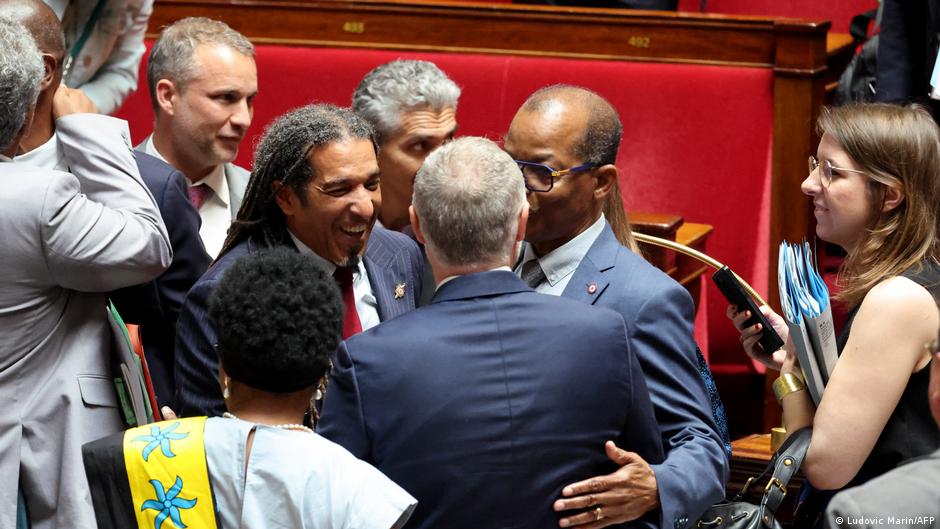
For nearly two centuries after France abolished slavery, the colonial-era law that classified humans as property remained quietly in place. On Thursday, lawmakers will finally move to eliminate it. The bill, expected to be adopted by the National Assembly, will repeal Code Noir, or Black Code, the 1685 decree King Louis XIV signed to govern slaves across France’s colonies. The law turned human beings into chattel, allowing them to be worked, beaten, sold, raped and killed – and France never formally did away with it. That realization has left many aghast. “That shocks me,” said Muriel Jean-Baptiste, a Paris-born nurse whose parents are from Martinique, a French overseas department in the Caribbean. “A law that treated Black people as property was left sitting there,” she said. The code’s reach was total. Article 44 declared the enslaved “movable property”. Other sections ordered mutilation for those who fled, and dictated that the word of an enslaved person counted for nothing. Code Noir’s 60 articles “should never have survived the abolition of slavery” in the 19th century, President Emmanuel Macron said last week. “The silence, even the indifference, that we have maintained for nearly two centuries toward this Black Code is no longer an oversight,” Macron said. “It has become a form of offense.” Like French presidents before him, Macron stopped short of an apology. Read moreMacron backs symbolic repeal of France's slavery laws, warns against 'false promises' on reparations France ran the third-largest slave trade, shipping about 1.4 million Africans to plantations whose sugar wealth built the French cities of Nantes and Bordeaux. Its empire later spanned four continents. Others see the repeal as something more telling – a symptom, they argue, of a country that has yet to reckon fully with that past, one of many slow steps along the way. In law, officially eliminating it is the easy part, observers say. Code Noir lost all authority in 1848, when France abolished slavery. France didn't relinquish its slave colonies: the four oldest – Guadeloupe, Martinique, French Guiana and Réunion – were made full French overseas departments in 1946. That means they're governed from Paris like any other. Their roughly 1.9 million people, most descended from the enslaved, are French citizens. Despite being fully part of France, the overseas departments remain among its poorest territories. Unemployment runs roughly double the mainland rate, and more than three-quarters of households in Mayotte live below the national poverty line. Before he discovered the truth, the French lawmaker who put forward the proposal to repeal the law didn't know it still existed. Max Mathiasin, from Guadeloupe, had bought copies of the text over the years and left them on his shelf. “As the great-great-grandson of people who were enslaved, I had never been able to read it in full,” he said. “This was made by human beings – against human beings.” For him, the vote is “a way of restoring our ancestors, restoring our humanity” before a France whose motto is liberty, equality, fraternity. “It means living up to the Republican promise.” That promise, he says, is still unkept at home. “In Guadeloupe,” Mathiasin said, “in the most important positions, in the structures of the state, they are White.”
France moves to repeal yet-to-be-abolished slavery law, Code Noir
French lawmakers are set to vote on Thursday to repeal the Code Noir, a law that regulated slavery in the French colonies which was never formally repealed even after the abolition of slavery in 1848.…
1,328 words~6 min read