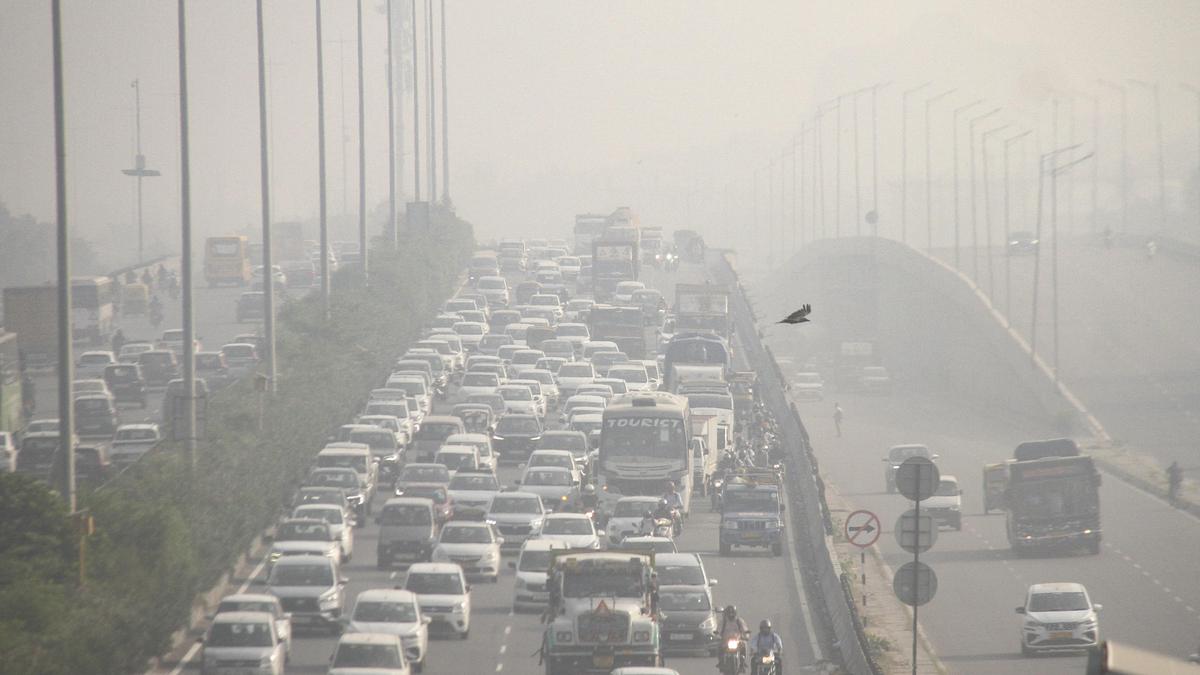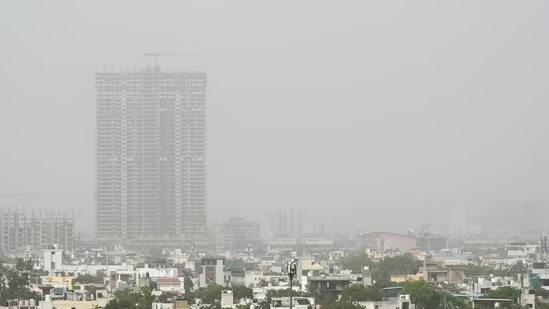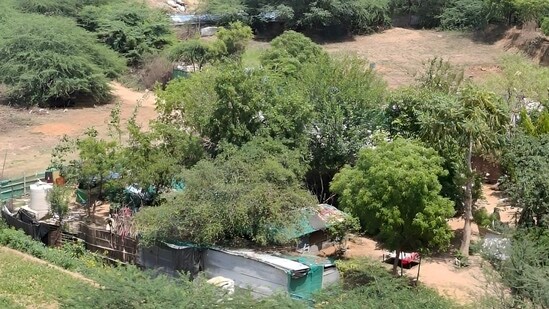
For the past week, the air quality index in Delhi has mostly hovered in the low- to mid-200s, even reaching 300 one morning -- levels the city routinely records in its smoke-choked winters but rarely in summer.Oriented almost precisely across the corridor through which northwesterly winds carry Thar dust toward the capital, the Aravalli range’s function today has been dismantled. (HT_PRINT/File)The culprit, according to meteorological experts, is dust lifted from the deserts and semi-arid regions of Rajasthan by the hot, dry winds blasting through northwest India --- a weather phenomenon that, decades ago, would not have manifested with such ecological severity.The spike in pollution brings back into focus the destruction of the Aravalli ranges, which for centuries acted as a natural barrier. Oriented almost precisely across the corridor through which northwesterly winds carry Thar dust toward the capital, the range’s function today has been dismantled.Decades of mining, quarrying and encroachment — particularly acute in Alwar and Bharatpur districts, the precise geography through which this week’s dust plume travelled — have breached the ridgeline. The dust moves through unimpeded.“The Aravalli hills – both the long continuous ranges as well as the hundreds of thousand smaller hills play a critical role in controlling the spread of sand from the western Thar deserts,” said Chetan Agarwal, a forest analyst who has studied the region in detail.“The hills typically slow down winds from the west, which shed their sandy loads on the western flanks and these sands form sandy obstacle dunes. This role is played both by the hills physically and is enhanced by the presence of dense vegetation and trees which act like a natural scrubber of sorts,” Agarwal added.Also Read: Why has the new definition of the Aravalli hills triggered a protest? What activists sayA study published in March laid out the scale of the destruction: in just seven years between 2017 and 2024, built-up areas in the region grew by 53%, or 2,644 sq km, primarily replacing croplands and rangelands.Mining, especially lead-zinc, marble, sandstone, and industrial minerals, places significant pressure on the landscape, with high number of active leases that cause geomorphic disturbance, the dean of Jindal School of Environment and Sustainability (JSES) at OP Jindal Global University said at the time. The research was carried out by JSES and Indian Institute of Technology Kharagpur researchers.The paper stated the future of the Aravalli range is an issue of national importance, noting that the Supreme Court deliberated on redefining the geographical scope of the range, which spans several states.The ruling, issued on November 20, 2025, was based on the classification of the hills primarily by altitude, limiting legal protection to locations above the 100-metre contour line. The court then suggested creating an expert board to conduct a thorough examination of the matter.“Comprehensive scientific studies are needed in the region, given recent developments, to facilitate informed policymaking. This research sought to address some of the policy gaps by developing a scientific understanding of the concerns (soil erosion, land degradation, and forest cover) surrounding the conservation of the AMS,” the paper stated.Agarwal stressed on the need to protect the Aravallis and called for maintaining “effective zoning prohibitions on real estate through the Natural Conservation Zone (NCZ), and controlling mining are key to reducing desertification and enhancing the air quality in the Delhi NCR.”More concerningly, the degraded range may no longer simply be a gap in a wall.Outside the Thar Desert itself, researchers have identified significant dust sources along the Indo-Gangetic Plain corridor — dried water bodies, abandoned agricultural lands, and disturbed terrain associated with human activity in the region.A 2021 study in the Journal of Geophysical Research: Atmospheres by researchers at the Indian Institute of Science, Bengaluru, which examined a catastrophic dust event that killed more than 100 people across Delhi, Jaipur and Agra in 2018, noted that as a convective system travelled from northwest to southeast, “it picked up dust first from the Thar Desert, followed by lifting dust from anthropogenic sources.”In urban areas alone, road dust — much of it sourced from exposed, disturbed land surfaces — can contribute more than 20 per cent of total PM10 concentrations on an ordinary day, prior research has found. The denuded slopes of the Aravallis, their binding vegetation stripped and soil left loose by quarrying, sit directly in that corridor.
Unusual summer pollution spike highlights Aravallis’ diminished role as dust barrier
The spike in pollution brings back into focus the destruction of the Aravalli ranges, which for centuries acted as a natural barrier. | India News
715 words~3 min read