FPIs have been pulling out money due to funds being allocated to AI stocks in Taiwan, South Korea, etc., the high valuation in Indian equity markets and the rupee depreciation
| Photo Credit:
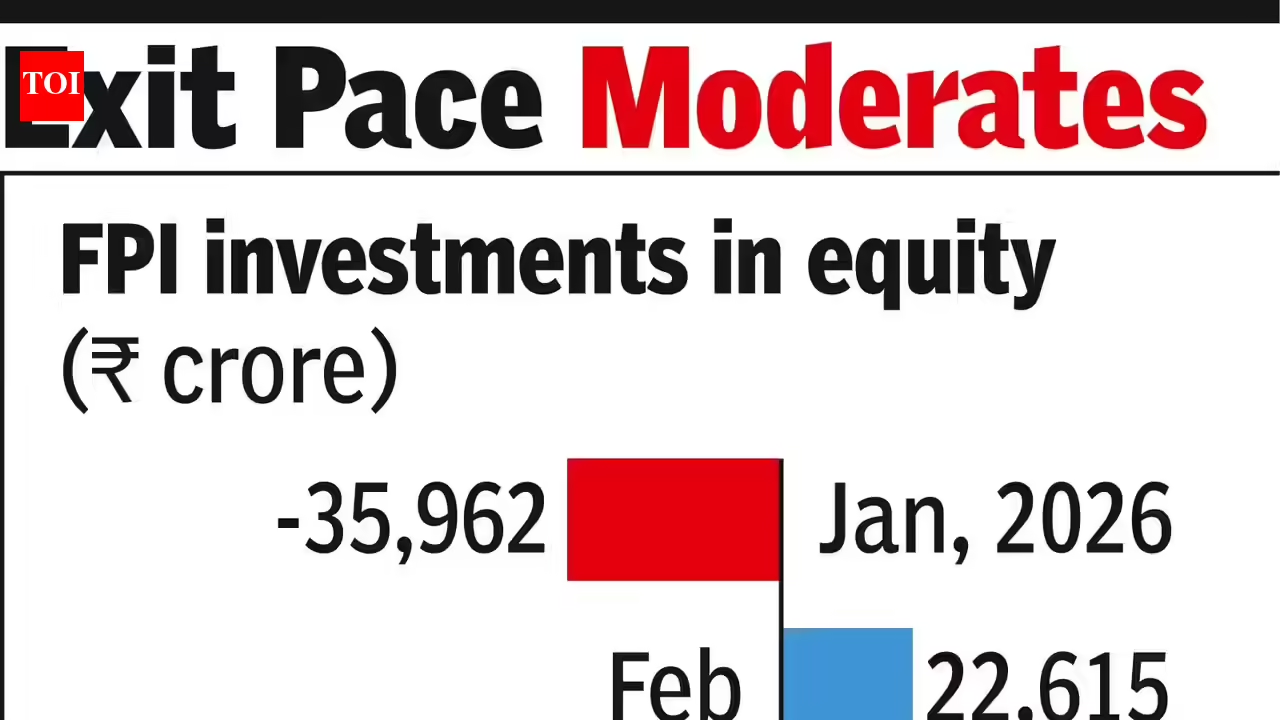
The selling spree by foreign portfolio investors is getting even the most detached market observer worried. FPIs have sold around ₹2.26 lakh crore of Indian equity in 2026, following net sales of ₹1.66 lakh crore in 2025. They have been in exit mode since September 2024, when they decided to plough more money into Chinese equity and sell Indian stocks which were trading at considerable valuation premium to most other markets.So, should you start panicking? No. Because it is wrong to paint all foreign portfolio investors with the same brush. There were 12,199 FPIs registered with SEBI towards the end of last fiscal year. These investors come from different countries and have varying investment objectives, ranging from speculative short-term trading to long-term investments. They could be foreign central banks, sovereign wealth funds, pension funds, hedge funds, portfolio management services and other alternate investment vehicles.A businessline analysis of the category-wise and country-wise assets of FPIs shows that the regulated funds from regions such as the US have sold only a small part of their holding in this spell. But unregulated FPIs from tax havens such as Luxembourg and Mauritius have seen a larger reduction in their assets.This spells good news because the speculative hot money, which comes through tax havens, is quite whimsical and can change direction quite fast.Country-wise dataThe country which originates the largest share of FPI investments into India currently is the US, accounting for 43 per cent share of FPI assets or ₹30.07 lakh crore in April 2026. With approximately half of global investable funds originating from the US, it is not surprising that this trend reflects in India too.The assets of these investors have recorded a decline of only 10 per cent since September 2024. Since the Nifty50 is down around 8 per cent between September 2024 and April 2026, the decline in FPI assets could partly be due to reduction in stock prices.If the valuation losses were excluded, these investors are likely to have pulled out only 2 per cent of their holdings. This is a good sign since investors from the US are likely to be dominated by large mutual funds, pension funds, university funds and exchange traded funds. These investors would typically have a longer-term investment horizon.The countries which follow the US are offshore financial centres or tax havens such as Singapore (7.5 per cent share of FPI assets), Luxembourg (7.4 per cent), Ireland (6 per cent) and Mauritius (4.8 per cent).These countries have seen a larger reduction in FPI assets with Singapore and Mauritius recording more than 25 per cent reduction. It is established that hedge funds and other short-term investors who prefer to switch their investments faster operate out of OFCs (offshore financial centres) for ease of operations.FPIs from Norway, dominated by Norway’s sovereign wealth fund, recorded a decline of just 4.2 per cent in their assets in this period. This would largely be accounted for by the fall in stock prices.Investors from Japan and France are at the other end of the spectrum, recording an increase in their assets, albeit marginal.Category-wise dataData disseminated by SEBI on assets held by each FPI category also reiterates the trend that FPIs with a long-term horizon are not selling too much of their holding.The largest category of FPIs, holding 57.5 per cent of total assets, are ‘appropriately regulated funds’. Large mutual funds, ETFs, insurance funds, etc., operating out of the US, Europe and other large countries would fall in this category. This category has seen assets reduce by 11 per cent between September 2024 and April 2026 to ₹39 lakh crore. As mentioned above, around 8 per cent of the decline could be due to stock price correction, implying that they have reduced their holding by only around 3 per cent in this bout of selling. Sovereign wealth funds have also witnessed only 11.7 per cent reduction in their assets.These large institutional investors are unlikely to sell in a big way since they have been investing in Indian equities since early 1990s and would be holding large profitable positions. If they sell aggressively, bringing down prices sharply, they would be harming the value of rest of their Indian equity portfolio. The second largest category of FPIs — pension funds — who hold 10 per cent of FPI assets have, in fact, recorded an increase of ₹12,718 crore in their assets, amounting to 1.9 per cent gain in this period.Categories where the decline in assets is more than 20 per cent include unregulated funds whose investment manager is category I FPI, funds not eligible to register as category I FPI, central banks and investment advisors. Central banks registered as FPIs with India include the People’s Bank of China, Monetary Authority of Singapore, Saudi Central Bank, European Central Bank and Bank of Malaysia.In sum, FPIs have been selling due to funds being allocated to AI stocks in Taiwan, South Korea, etc., the high valuation here and the rupee depreciation. But since the selling appears led by short-term speculative funds, the tide could turn soon.Published on May 28, 2026