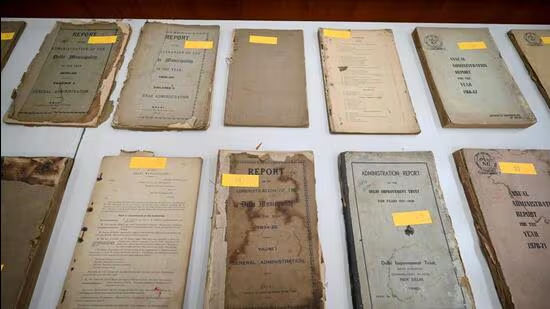
In a temperature-controlled room inside the Delhi Legislative Assembly, time settles in the fibres of paper browned by age; in ink that has faded yet refuses to disappear; and in the delicate creases of manuscripts that have outlived governments. Here, history is being remembered, handled, restored and, now, reborn.Old records and documents of the Legislative Assembly at Vidhan Sabha Civil Lines in New Delhi on Thursday. (Sanchit Khanna/HT PHOTO)Today, more than a century and a half later, the Delhi Assembly has launched a monumental exercise aimed at preserving over 5,00,000 pages — digitising records into thematic volumes that narrate Delhi’s legislative evolution.At the centre of this effort lies a fragile, handwritten record from 1861: the proceedings of one of the earliest meetings of the Delhi municipality. The document — its edges frayed and its surface mottled with time — carries within it the quiet beginnings of civic governance in the Capital.In cursive so neat it almost looks like calligraphy, it records the approval of a modest budget of ₹25,000 allocated towards a Montgomery Park, drainage systems, a general hospital, and public latrines; decisions that, though modest in scale, marked the early architecture of urban planning in Delhi.From proceedings spanning from 1863-1869 to annual administrative reports from the 1920s and 1930s, the archival inventory itself reads like a ledger of time.Some volumes are marked “fragile,” others “fragile, damaged” as a reminder of their fragility.This explains the urgency behind the Assembly’s archival initiative. The process of preserving these documents is as intricate as the histories they contain.Once scanned, each original document undergoes chemical treatment and deacidification, a method designed to halt the slow decay caused by acidic paper, after which officials mend torn folios and clean surfaces layer by layer to finally scan them.A single page may require hours of careful handling, from flattening creases, reinforcing edges and ensuring that the ink, often susceptible to fading, remains legible for generations to come.Delhi Assembly Speaker Vijender Gupta, under whose leadership the initiative has gathered pace, described the exercise as both a responsibility and a rediscovery.“This is not just an archival project. These records are the living memory of Delhi’s governance. Every page reflects how decisions were debated, contested and ultimately shaped. Preserving them ensures that future generations understand how institutions evolved over time,” Gupta tells HT.Debates that shaped a nationBeyond municipal records, the archives open a window into the larger political currents that shaped India.Among the preserved materials are records of the war conference where it was decided to send over 13,00,000 Indian soldiers to fight in World War I. The deliberations, recorded in official proceedings, reveal the scale and gravity of the moment.There are also detailed accounts of the Assembly’s opposition to the Rowlatt Act, which triggered widespread unrest across the country.A particularly evocative record notes the presence of Mahatma Gandhi in the visitors’ gallery in March 1919, the only instance of its kind. The moment is even mentioned later in his memoir, The Story of My Experiments with Truth (1926).Similarly, proceedings from 1928 record the Assembly’s firm stance declaring the Simon Commission “out of order,” echoing the larger national sentiment of resistance against colonial policies.“These are not merely records. They are fragments of a larger narrative, in which legislative spaces became arenas of political awakening. While everyone knows through the media what protests broke out on the ground during our Independence struggle, few know that most of the campaigns started from the resistance by leaders in this very assembly,” says Gupta.Voices preserved in inkPerhaps the most compelling aspect of the archival project is its preservation of speeches. From 1924 onwards, original texts of speeches delivered by prominent leaders and freedom fighters have been compiled into volumes. The first phase alone, covering speeches from 1924 to 1939, has resulted in 89 published volumes.Among these are extensive compilations of speeches by Gopal Krishna Gokhale, spanning nearly 900 pages, now being converted into three dedicated volumes. Similarly, speeches by Madan Mohan Malviya are being organised into at least six volumes, reflecting the depth and breadth of legislative discourse during that period.The documents reveal not just the content of these speeches, but their context, like the issues debated, the urgency of arguments and the ideological currents that defined the era.The architecture of powerThe archival collection also includes rare visual records — layout maps, photographs, and architectural plans.A detailed layout map of the Assembly from 1911 provides insight into the spatial design of the legislative building. Photographs from 1913 capture its interiors, including the library, chambers and corridors taken soon after the building was ready for use.Among the most striking visuals is a rare photograph of Bahadur Shah Zafar in captivity in 1858, a haunting image that bridges the transition from Mughal rule to British governance.Fragility and resilienceHandling these documents reveals their vulnerability. Pages are brittle, edges crumble at the slightest pressure and the ink that was once bold now appears faint in places.Yet, despite decades of neglect, environmental exposure and the passage of time, these records have endured. The handwriting remains legible, the structure intact and the content is remarkably complete. It is this resilience that the preservation process seeks to honour and extend.“Many of these documents were on the verge of deterioration. Through digitisation and conservation, we are ensuring that they are not lost to time. At the same time, digitisation makes them accessible to researchers, historians and the public,” said Gupta.Once scanned, the documents are being organised into thematic volumes like municipal governance, legislative debates and administrative reports, allowing for structured exploration of the Capital’s history.
Delhi Assembly launches major archival project to digitise, restore old records
Delhi Assembly launches a project to digitize over 500,000 historical documents, preserving the city's legislative evolution and civic governance. | Latest News Delhi
923 words~4 min read