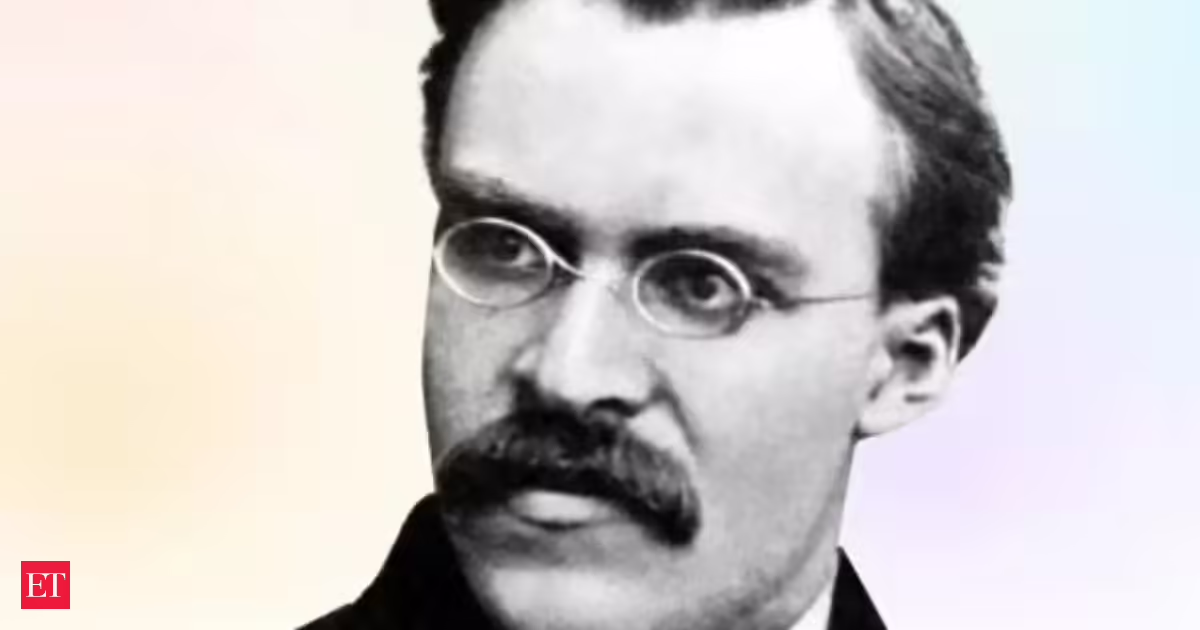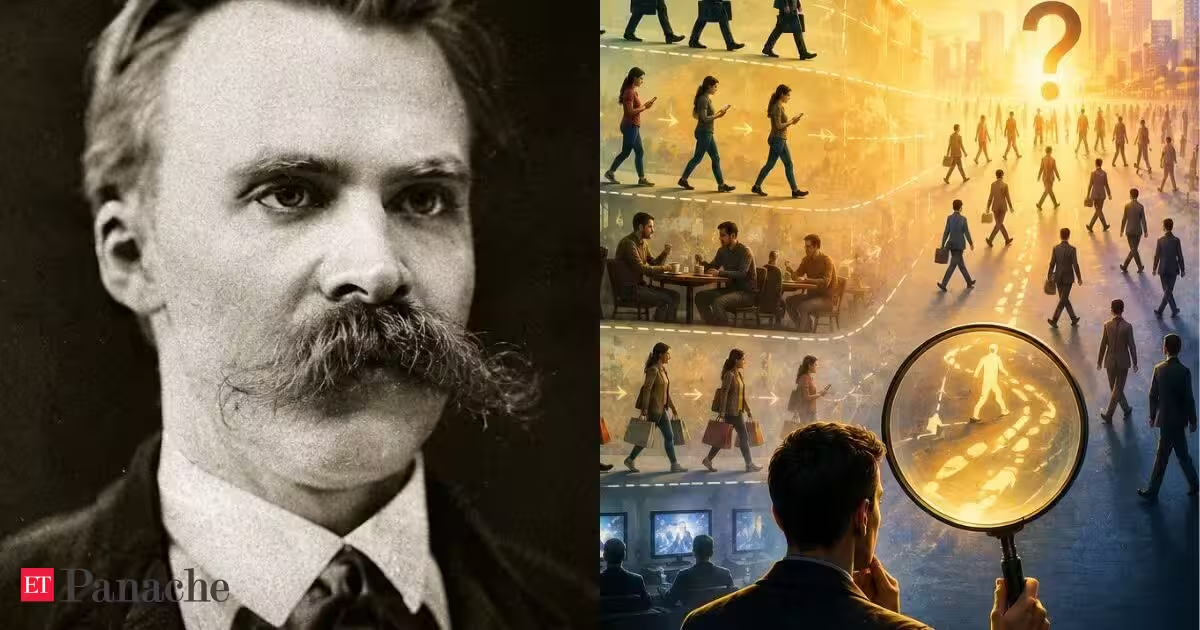
For centuries, philosophers have tried to explain the struggle between being alone and fitting into society. Some believed isolation helps a person understand himself better, while others warned that too much distance from people can slowly damage the mind. German philosopher Friedrich Nietzsche looked at this conflict in a darker and more uncomfortable way. One of the quotes often linked to his ideas seems to reflect modern life as well. The quote forces people to think about the cost of both isolation and social acceptance, and why neither path is entirely easy.Quote of the day by Friedrich Nietzsche is: “In loneliness the lonely one eats himself; in a crowd, the many eat him. Now choose.”The meaning behind this quote is harsh but direct. Nietzsche appears to suggest that human beings suffer in both conditions. A person who spends too much time alone may begin to overthink, become trapped in his own thoughts, or slowly lose emotional balance. Loneliness can turn inward and become destructive. At the same time, Nietzsche believed that crowds and society also come with danger. According to his view, people often lose their individuality when trying too hard to fit in. In groups, people may follow trends, beliefs, and expectations without questioning them deeply. So the quote of the day becomes a difficult choice between isolation that consumes a person from within and society that pressures him from outside.The line is also connected to Nietzsche’s broader philosophy about individuality and selfhood. Throughout many of his works, he repeatedly questioned whether society truly allows people to become who they really are. He criticized blind conformity and believed many social systems pushed people toward sameness instead of encouraging independent thinking. Nietzsche often wrote about solitude, suffering, self-overcoming, and the pressure created by social morality. In many ways, this quote captures the tension that existed throughout his philosophy.Who was Friedrich Nietzsche?Friedrich Nietzsche was born on October 15, 1844, in Röcken, a small village in what was then Prussia, now part of Germany. His father was a Lutheran minister, but he died when Nietzsche was still very young. After the death of his father, Nietzsche grew up mainly in a household filled with women, including his mother, grandmother, aunts, and younger sister Elisabeth. Despite personal hardships early in life, Nietzsche showed remarkable academic talent from a young age.As a teenager, he attended the respected boarding school Schulpforta on scholarship. Later, he studied at the Universities of Bonn and Leipzig, where he became deeply interested in philology, philosophy, literature, and ancient Greek culture. During this period, Nietzsche discovered the writings of philosopher Arthur Schopenhauer, whose pessimistic ideas left a major impact on him. He also formed an important friendship with composer Richard Wagner and Wagner’s wife Cosima.Nietzsche’s academic rise happened unusually fast. In 1869, at only 24 years old, he became the youngest professor of classical philology at the University of Basel in Switzerland. Many believed he had an extraordinary future ahead of him. However, even during these years, Nietzsche’s interests were moving beyond language and classical studies toward philosophy and cultural criticism.Early writings and growing controversyNietzsche’s first major book, The Birth of Tragedy (1872), explored Greek tragedy and discussed the tension between reason and instinct in culture. The book also praised Wagner’s music-drama and suggested it could help revive German culture. However, many scholars in classical studies reacted negatively to the work because it did not follow traditional academic methods. Critics considered it too speculative and philosophical.Over the following years, Nietzsche wrote essays that later became known as the Untimely Meditations. In these writings, he discussed history, culture, education, and the intellectual direction of Europe. Gradually, his relationship with Wagner began to break apart. Nietzsche became disappointed with what he saw as excessive nationalism and cultural attitudes surrounding Wagner’s circle.By the late 1870s, Nietzsche had also started developing the sharp criticism of morality and religion for which he later became famous. His book Human, All Too Human marked a major shift in style and thought. Instead of long arguments, Nietzsche increasingly used short observations and aphorisms. This style later became one of the defining features of his writing.His criticism of morality and religionNietzsche became widely known for attacking traditional European morality, especially morality rooted in Christianity. One of his most famous statements, “God is dead,” appeared in The Gay Science. The phrase was not simply a celebration of atheism. Instead, Nietzsche argued that modern society was slowly losing faith in Christianity as the foundation of moral life. He believed Europe was entering a period where old values no longer held the same authority, but new values had not fully formed yet.He questioned whether many accepted moral ideas were truly based on compassion and goodness or whether they were shaped by resentment and social control. In On the Genealogy of Morality, Nietzsche examined how moral systems developed historically. He argued that ideas of guilt, punishment, and virtue were often connected to power struggles within society rather than purely noble intentions.This approach made Nietzsche highly controversial. Some readers admired him for challenging accepted beliefs, while others viewed his ideas as dangerous or destructive. Even today, debates continue over how his writings should be interpreted.The idea of the Übermensch and individual struggleOne of Nietzsche’s most discussed concepts was the “Übermensch,” often translated as “Overman” or “Superman.” In Thus Spoke Zarathustra, Nietzsche presented this figure as someone who creates his own values rather than simply accepting society’s expectations. The idea was connected to self-overcoming and personal growth.Nietzsche also explored concepts such as eternal recurrence, perspectivism, and the will to power. He rejected the idea of one absolute truth that applied equally to everyone. Instead, he believed people experience reality through different perspectives shaped by their lives and struggles.A major theme across his work was suffering. Nietzsche did not believe suffering should always be avoided. In some cases, he thought hardship could push people toward transformation and strength. One of his best-known lines reflects this belief: “That which does not destroy me makes me stronger.”Illness, collapse, and final yearsThroughout much of his life, Nietzsche struggled with severe health problems. He suffered from headaches, eye pain, nausea, and periods of deep physical exhaustion. Eventually, his condition forced him to resign from his professorship in 1879. After leaving academic life, he spent years traveling through Switzerland, Italy, and other parts of Europe while continuing to write.Despite constant illness, these years became his most productive period. He published works such as Beyond Good and Evil, Thus Spoke Zarathustra, The Antichrist, Twilight of the Idols, and Ecce Homo.In 1889, Nietzsche suffered a mental collapse in Turin, Italy. A famous story often repeated says he broke down after witnessing a horse being beaten in the street, though historians still debate the accuracy of the account. After his collapse, Nietzsche never fully recovered mentally. He spent his remaining years under the care of his mother and later his sister Elisabeth until his death in 1900.
Quote of the day by Friedrich Nietzsche: 'In loneliness the lonely one eats himself; in a crowd, the many eat him. Now choose...' - Why people feeling alone still choose be in isolation explained by the German philosopher
Friedrich Nietzsches quote of the day reflects the difficult balance between isolation and social acceptance. The philosopher suggested that loneliness can slowly consume a person from within through overthinking and emotional struggle, while society can pressure individuals to lose their uniqueness in order to fit in. The idea connects closely with Nietzsches larger philosophy about individuality, conformity, suffering, and self-discovery.
1,153 words~5 min read