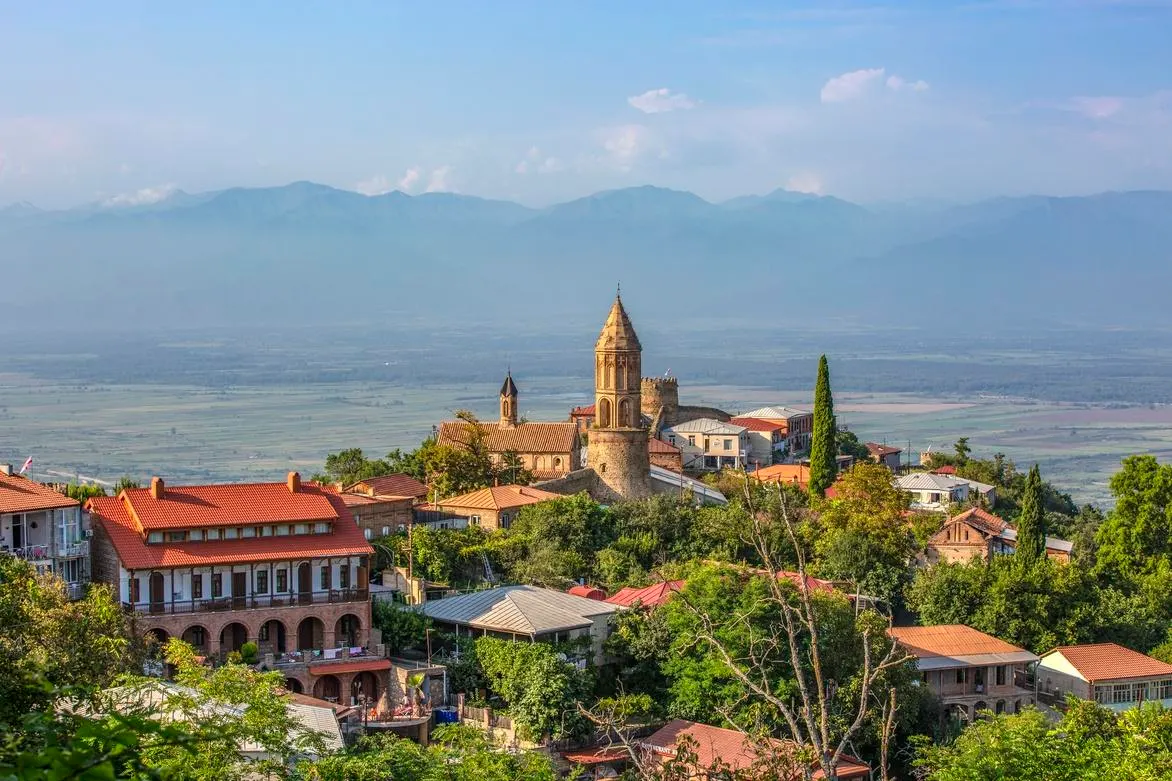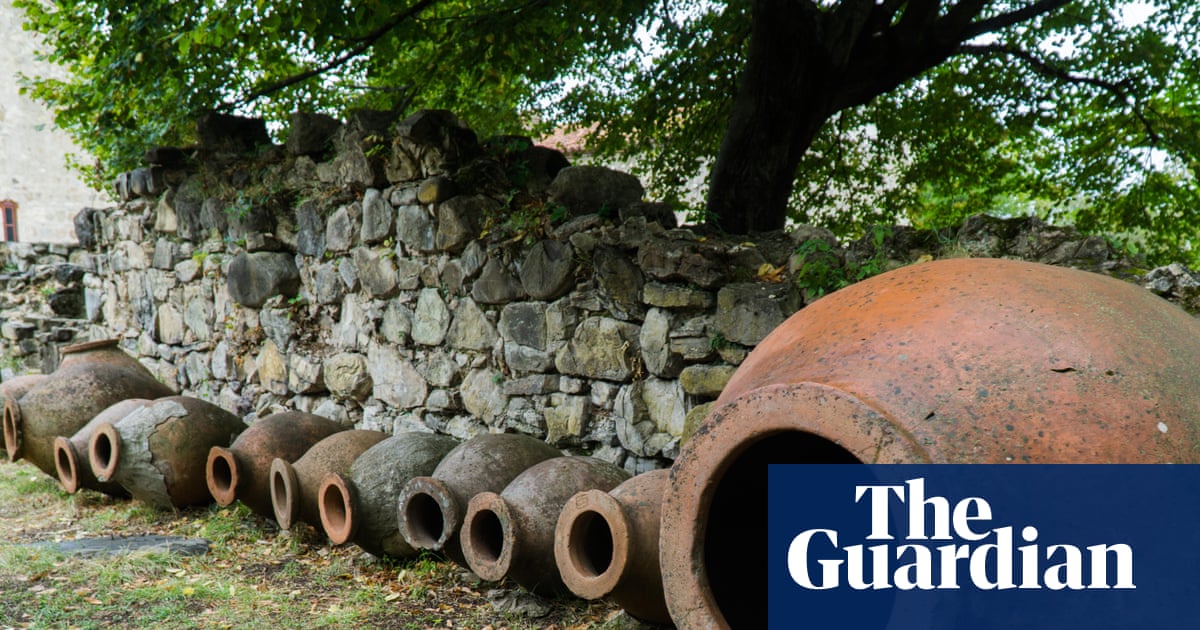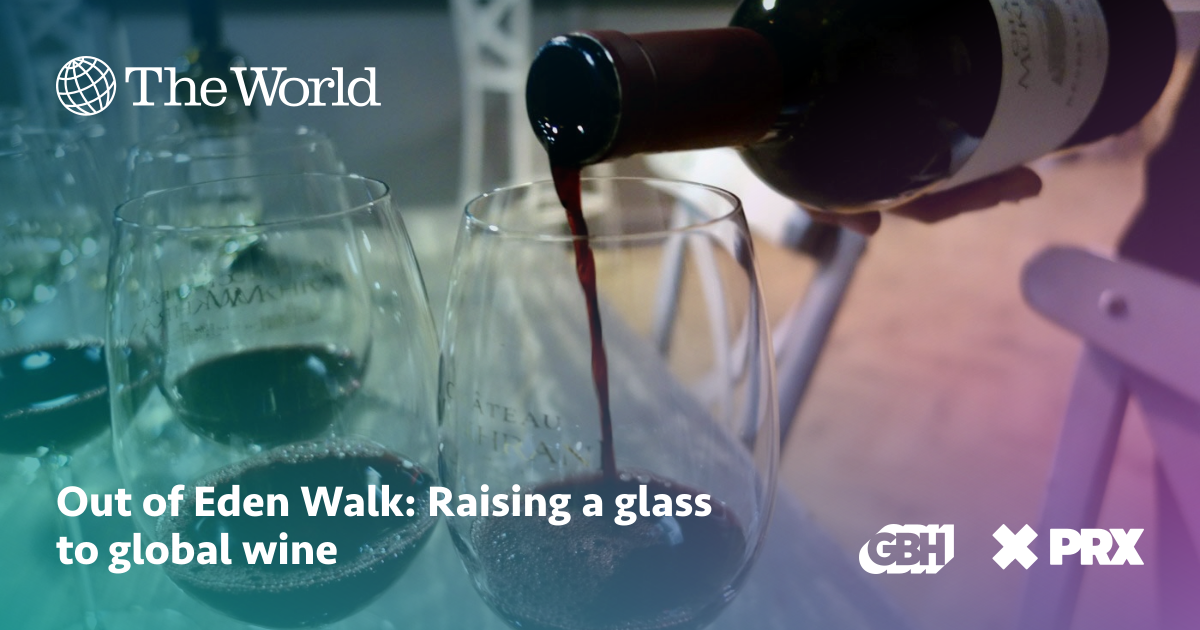
Public radio’s longest-running daily global news program.AboutContactDonateMeet the TeamPrivacyTerms of use©2026 The World from PRXPRX is a 501(c)(3) organization recognized by the IRS: #263347402.Out of Eden Walk: Raising a glass to global wineThe Republic of Georgia claims the oldest archeological evidence of grape wine-making in the world. National Geographic Explorer Paul Salopek has been traveling the world on foot for his project, Out of Eden Walk. He gives The World’s Marco Werman a tour of the ancient origins of wine-making in the Caucasus, and the folkloric properties of palm wine in East Africa.7:39Scientists think some variation on this ritual has repeated for at least 8,000 years — the Château Mukhrani winery outside Tbilisi, Georgia.Winemaking is almost as old as civilization itself.It’s a simple process: Yeast breaks down the sugar in fruit, releasing carbon dioxide and producing alcohol. The result is a rich, complex liquid that’s suitable for many occasions and usually best enjoyed in good company.As people across cultures have raised glasses for centuries, National Geographic Explorer Paul Salopek, who’s been walking from continent to continent on foot for the past 13 years, has joined in this global tradition. Along his journey so far, he’s raised many a glass, which is all documented in the Out of Eden Walk project.Salopek joined Host Marco Werman to toast experiences exploring the ancient craft of winemaking.Paul Salopek: In my research, the oldest alcoholic beverage ever discovered in residues and vessels is actually in China, on the Yellow River, and that’s about 9,000 years ago — and it was rice wine, by the way. In the Caucasus, the Georgians lay claim to a kind of primacy in grape wines, right? They have found clay vessels at archeological sites that are 8,000 years old. When archeologists scrape them and do chemical analyses, they find the residues of wine. So the cool thing about this is that archeologists also think that grape wine radiated out of the Caucasus and was carried by non-violent, non-invasive people. They actually brought goodness with them. No conquests, no burned villages, nothing like that. Kind of amity. So there you go — the social lubricant in action. It’s really fascinating. Yeah, there’s a culture out of the Caucasus that dates back to about the 3rd millennium BC, so what is that? That’s like 5 to 6,000 years ago; they had distinctive pottery, and pottery lasts forever. So archeologists find it and can use it to fingerprint cultures, right? Cultures that move, cultures that stay in place. And with this ETC culture coming out of the Caucasus, we know that they were carrying wine with them because they carried an artifact that spread wherever they went: wine goblets. It was like this explosion of wine goblets. And so they kind of migrated, radiated, or at least the technology did, down into the Middle East, where it took root and then just kind of spread like wildfire. This was really quite a surprise to me, because I’d worked in Africa, but I hadn’t been to this part of the Horn of Africa, and it’s, imagine kind of a sandy desert with big wadis, these big kind of valleys, and in the bottom of some of these valleys, there are palm trees, the dune palm, and I noticed that guys were out with machetes kind of hacking at these dune palms, then putting old plastic bottles under the wounds. They were starting to collect sap for palm wine, which I had never tasted, and the stuff was kind of frothing out. I mean, they would leave it there for a couple days and get, you know, half a little bottle, and then they’d start to ferment it. Fermented, it tasted amazing. It was like frothy lemonade. The other thing I was gonna note is that some of these guys who are harvesting are also kind of reeling around the desert. And they were carrying big knives, so, you know, you just wave from a distance. You know, it’s funny, I think every society has its favorite drink, and we attach to this whole mythology to its multiple benefits, everything from the health benefits to kind of celebrations of love. I was walking with a Djiboutian walking partner, Hussein, who said, ‘Paul would drink this stuff,’ and he bought six bottles of it. It’s heavy, and we’re on foot, and he brought these six big bottles of this stuff. At first, I was a little bit frustrated, but then I tasted this and was like, ‘Hey, you know, this is not bad,’ and Hussein was saying, ‘Paul, you just got to keep drinking it. It doesn’t keep the mosquitoes away (and there’s malaria in this area). The mosquitoes will still bite you, but it blocks malaria in your bloodstream.’ So, I don’t know if that’s true or not, but hey, I was willing to do an experiment, and I did not get malaria.You know, I’ll be confessing something here. Maybe I shouldn’t be … but I buy into the hype wherever I go. I savor it. You know, it’s not just for diplomacy’s sake. It’s always appreciated to kind of say, ‘Hey, you’ve got the best drink in the world.’ It’s the same as food: It’s sort of, the beverage is great, but … it’s who you drink with, right? And so when somebody invites you into their flat in a city or in a village hut, and they bring out a bottle, that’s the magic. It’s like you’re being led into this circle, right, of trust and hospitality. And so it sort of doesn’t even matter what you’re drinking. That’s sort of my philosophy. Parts of this interview have been lightly edited for length and clarity.Writer and National Geographic Explorer Paul Salopek has embarked on a 24,000-mile storytelling trek across the world called the “Out of Eden Walk.” The National Geographic Society, committed to illuminating and protecting the wonders of our world, has funded Salopek’s project since 2013. Explore the project here. Follow the journey on X at @PaulSalopek, @outofedenwalk.
Out of Eden Walk: Raising a glass to global wine - The World from PRX
The Republic of Georgia claims the oldest archeological evidence of grape wine-making in the world. National Geographic Explorer Paul Salopek has been traveling the world on foot for his project, Out of Eden Walk. He gives The World’s Marco Werman a tour of the ancient origins of wine-making in the Caucasus, and the folkloric properties of palm wine in East Africa.
1,006 words~5 min read