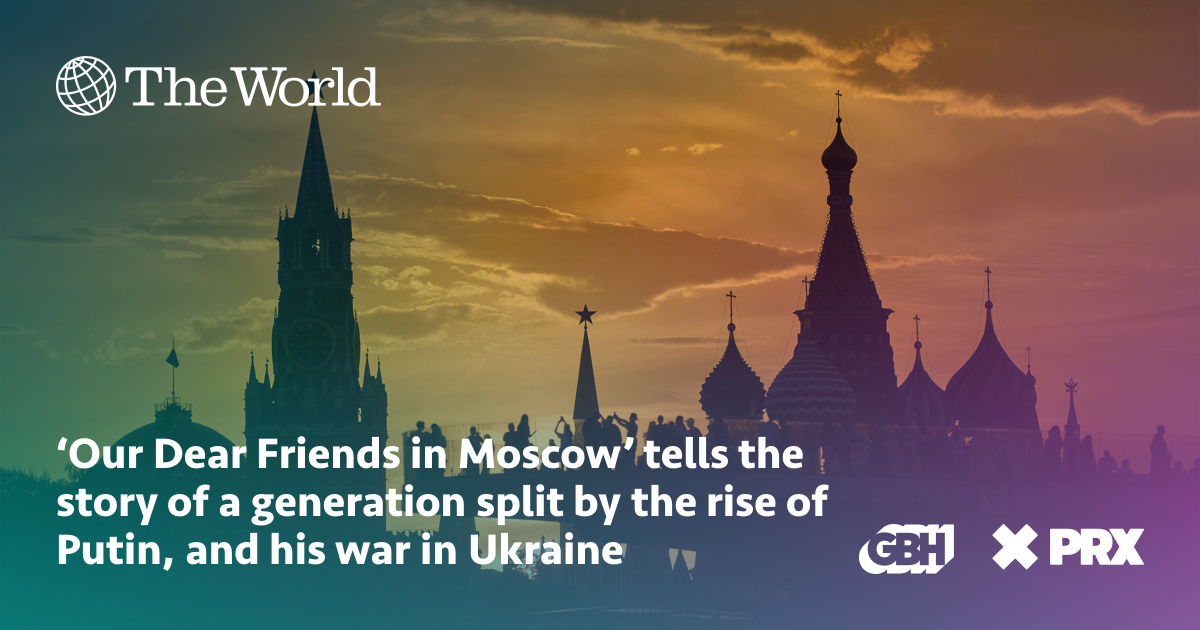
Public radio’s longest-running daily global news program.AboutContactDonateMeet the TeamPrivacyTerms of use©2026 The World from PRXPRX is a 501(c)(3) organization recognized by the IRS: #263347402.‘Our Dear Friends in Moscow’ tells the story of a generation split by the rise of Putin, and his war in UkraineThe World’s Daniel Ofman speaks with journalists Andrei Soldatov and Irina Borogan about their new book that documents their own experiences as journalists and the transformation of their friends as Russian President Vladimir Putin solidified his grasp on power over the years.13:48People watch and photograph sunset behind the Kremlin standing on the “Flying glass bridge” over the Moscow River at Zaryadye park in Moscow, Russia, May 29, 2025.Andrei Soldatov and Irina Borogan are respected Russian journalists. But as the Kremlin has clamped down on press freedom, many journalists have endured threats, arrests and even violence.That atmosphere of intimidation forced Soldatov and Borogan to relocate to London.Now, the duo has published a new book called “Our Dear Friends in Moscow.” It documents, not just their own experiences as Russian journalists, but also the transformation of their friends, who changed before their very eyes as Russian President Vladimir Putin solidified his grasp on power.The World’s Daniel Ofman recently caught up with them, to discuss their book.Andrei Soldatov: When the full-scale invasion [of Ukraine] started in 2022, it came as a shock for us, despite the fact we had been reporting about Putin’s regime for so many years. Still, the level of support this invasion got from, not only the ordinary Russians but also from the Russian elites, was absolutely astonishing, at least for us. To be honest, it was such a difficult moment for us personally, that we’ve been trying to find an answer [to] why so many people decided to support this war. And at some point, we thought that maybe the way to do that is to try to trace what happened to a group of people who used to be very close to us, our personal friends, who are still in Moscow and who became really key in the Kremlin machine of propaganda, and who, obviously, support full-heartedly this war.Irina Borogan: These people, they used to be our friends. We stopped talking to them like 10 years ago, and we reconnected with them. We focused on people who were very supportive and still supportive of the war. Intentionally, because that’s very easy to understand people who don’t support the war against Ukraine. I mean, that’s clear, you don’t need [to explain that], but why the best and brightest support the war and decided to side with Putin, that was the question. And to answer these questions we turned to our dear friends in Moscow.A view of the Grand Kremlin Palace seen behind the Kremlin Wall in Moscow, Russia, May 15, 2025.Pavel Bednyakov/AP/File photoSoldatov: Yes, when the protests started, he just attacked Navalny and he attacked us. At some point, at the height of the protests, he reposted the list of so-called enemies of the people. And we were on this list. And when we found that out, we were really surprised because that meant for us that he went really personal against us. By the end of the Moscow protests, he published a really horrible comment on Facebook. Basically saying that, “look, there is no other way to deal with Navalny but to kill him.” So, he justified an assassination of Navalny openly, which again was a really big shock for us. And after that, we haven’t spoken for many, many years. And when the full-scale invasion started in 2022, it came as a really big shock when he published his now infamous op-ed by Ria Novosti, calling for a final solution of the Ukrainian question, which, of course, reminds of the language used in Nazi Germany.Borogan: At this time, he became one of the most prominent political commentators of this Kremlin news agency called Real Novosti. I felt very, very uneasy talking to him because when I was listening to his voice, I felt like that’s the same Petya that I knew and I loved. But I decided to leave all, say, difficult questions for the last interview. And the problem is that my father, he is from Ukraine. He grew up in the Odesa Oblast and many of my relatives, they live in Odesa or in Izmail or in Odesa Oblast. And all of them, they are under bombardment constantly. And I explained to Petya what’s going on with my relatives and asked him how is he feeling about that. And he said, “Irina, I’m really very sorry for your relatives. That’s a tragedy. People are suffering a lot. I know. But, we cannot stop, we have to go further.” And that was the moment that I got speechless. I just somehow I finished the conversation and after that I could not speak for several hours. I couldn’t even move, so it was so, so terrible and shocking to me to understand that we are former friends where we are now.Soldatov: We hope that we found at least some answers. I think one of the reasons is that all of them are slightly older than us and they felt really nostalgic for the Soviet Union, unlike us. Also because many of them came from very prominent Soviet families. So, probably this thing about the social status, they felt that Russia lost the status of superpower and at the same time they, as individuals, lost a lot because of the changes in the country, and they wanted to get it back. All of them are extremely ambitious.Borogan: I mean, that’s not easy to live in the authoritarian country, in any authoritarian country. It’s very, very difficult because there are not a lot of choices, whether you’re with a dictator or you are against him. To be against a dictator, this position is very, very weak because it means that you will be always out of possibilities. You will be losing your opportunities. You will be out of a job. You will be in danger. So, to side with a dictator, it’s opposite. You can share all the power the dictator has, all the opportunities, possibilities, so it much much easier way.Soldatov: Well, to be honest, right from the beginning, already in 1999, when Putin became [Boris] Yeltsin’s choice as his Prime Minister and later on his successor, we found ourselves in a very difficult spot because many of our liberal colleagues all of a sudden started talking about a need for a dictator to fix Russia. Some of our friends, including us, felt very suspicious of Putin because of his KGB background. But many, even in Izvestia, where we worked for, they felt very enthusiastic about Putin. They felt that it was absolutely fine, that he was young, they used the word “adequate.” He was probably more adequate than Yeltsin, who was constantly drunk and was not really capable of doing anything. So, they loved him. They loved the way he dealt with the situation in Chechnya. They loved his very brutal way of dealing with terrorists and with any troublemakers. So, it was, from the very beginning, there was a huge split in Russian society.Borogan: For many people, Russian people went through terrible times in the ’90s because they were promised democracy and they believed in democracy. And their understanding of democracy was that democracy means to be wealthy, means to be happy, means to be much richer than they used to be in the Soviet times. But what happened in reality, they went through a financial crisis, like literally every three years. So, people lost everything and they lost a hope. And so, they put the blame on democracy and they put a blame on the West. That’s when Putin came with the idea that we have to blame the West because the West was always against us and they organized the crush of the Soviet Union in order to get a lot of advantages. And now, what we have, we are poor and we are not respected anymore by the West, so he promised them at least to resurrect their pride.This general view shows the Great Kremlin Palace, center, between the towers Borovitskaya, left, and Vodovvodnya, right, located within fortified walls of the Kremlin in Moscow, Russia, in this undated winter view. At far right in background is Ivan the Great Bell Tower.AP/File photoSoldatov: Yes, there were several moments. For instance, after the war with Georgia in 2008, that was really a decisive moment, a key moment, probably because it was the very first time when the Russian middle-classes felt very enthusiastic about the Russian army. His popularity was not really great before the war in Georgia in 2008, but immediately after that, it just skyrocketed. So, he made this connection that war outside the country is actually a good thing for him personally. And finally, of course, when he became really paranoid and changed everything was after the Moscow protests and the Maidan revolution in Kyiv, Ukraine. That was a moment he got really scared that the West came up with a new technology of how to topple regimes like his, and he responded with repression and the war in eastern Ukraine.Soldatov: Just terrible!Borogan: It’s terrible! It’s not great because we were taught, as journalists, not to bring yourself into the story and not to be emotional, to separate your emotions, to separate your perception from the story. That’s a very important task for the journalist. And to start writing a book which is partly memoir, it was a harsh challenge for us.Soldatov: And our editor constantly pushed us, like, “You need to add more details about you.” And I understand the reasons, because if you want to tell the story of your friends in the most honest way that people would understand and trust your judgment, you need to be equally honest about yourselves. So, if you show how people, our friends, went through all this crisis we had in Russia over the last 25 years, you also need to show how you, as a person, went through this crisis. And this is the only way to write such a book, but it was really difficult.Soldatov: Well, first of all, I need to mention that when the full-scale invasion started and we kept reporting on our topic, we wrote a really big investigation about the role the FSB played in planning the invasion of Ukraine. That pissed off a lot of people in Moscow. That is why I was put on the wanted list of Russian authorities and Irina is my criminal accomplice, which means that if we ever get back to Russia, we go to prison for up to 10 years. So, of course, we understand, with the present political regime in the country, there is no way for us to get back. But, of course, we hope that one day that could change and Russia is capable of a sudden change, as we all know. And that’s why we hope to get it back.Borogan: I’m absolutely sure we will get back. I have no doubt.This interview has been lightly edited and condensed for clarity.
'Our Dear Friends in Moscow' tells the story of a generation split by the rise of Putin, and his war in Ukraine - The World from PRX
The World’s Daniel Ofman speaks with journalists Andrei Soldatov and Irina Borogan about their new book that documents their own experiences as journalists and the transformation of their friends as Russian President Vladimir Putin solidified his grasp on power over the years.
1,867 words~8 min read