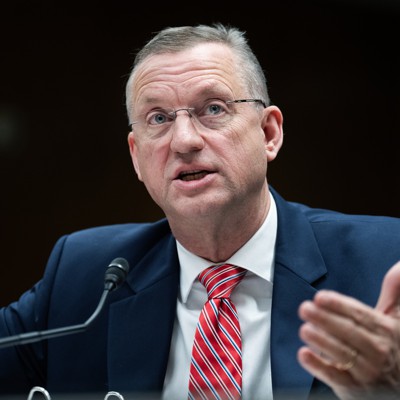
Securing a substantial new funding increase is critical for the Department of Veterans Affairs' costly Electronic Health Record Modernization Program, as is accelerating its expanded rollout across dozens of medical centers over the next two years, according to VA Secretary Doug Collins. WHY IT MATTERSCollins has requested an additional $840 million increase in the EHRM budget for Fiscal Year 2027, bringing the FY27 total to $4.2 billion. He told lawmakers last week that the funds are needed to improve interoperability.The request could bring more facilities online faster, improving their ability to communicate with other VA hospitals and community care providers and share records across them and with military care facilities."This funding level supports sustainment and operations of 19 live sites planned to be operational by the end of 2026 (13 new sites for 2026 in addition to the six sites that were live at the start of 2026), and 26 additional sites expected to go-live in 2027 (45 total live sites)," the department said in its Budget in Brief report last month."Funding will also enable VA to begin implementations at 28 VA Medical Centers with expected go-live dates in 2028."However, longtime Capitol Hill watchdogs over the EHR Modernization effort say close attention must still be paid to overcoming ongoing software glitches, and addressing burnout associated with reduced staffing at VA medical centers and congressional budget disputes. "We can’t ignore the fact that those original sites are still seeing problems, and you need to be aware of that," Sen. Patty Murray, D-Washington, told Collins.The VA Secretary also addressed the House Appropriations Subcommittee on Military Construction and Veterans Affairs the following day. "With $4.24 billion in funding, we are accelerating deployment of a modern, interoperable system that improves coordination and reduces inefficiencies," he said in his written testimony submitted May 21."My biggest problem right now is I have executive directors calling me up and saying, 'Can we move up on the list?'" Collins told the committee during the discussion that followed.While the House passed its version of the FY27 funding bill on May 15, setting EHR spending to $3.4 billion through Sept. 30, 2029, the Appropriations Subcommittee could still make changes and give the VA the 25% increase it is asking for. THE LARGER TRENDSince the restart of deployments announced in late 2024 – after years of delays, cost overruns and patient safety challenges – the VA has set an ambitious goal to deploy the new veteran patient record system at all sites by early 2031."As we move forward with these deployments, we're using the results of the Fall 2025 Electronic Health Record User Experience Survey to help us improve efficiency – using the input of VA doctors, nurses and staff who currently use the new EHR," the department said in its Budget in Brief report. Four sites in Michigan went live on the new EHR in April. When he met recently with the Senate, Collins called the recent pace of the rollout "phenomenal."Meanwhile, on May 19, the Senate Veterans Affairs Democrats held a roundtable on the department's workforce to discuss the effects of the 2025 reductions in force on veterans' access to care and benefits.Several witnesses discussed VA doctors and nurses being overloaded with patients. Jake Pannell, a business representative of the National Federation of Federal Employees, said he was concerned that the VA will continue "hemorrhaging staff" because they are burned out.As a behavioral health provider at the Mann-Grandstaff VA Medical Center in Walla Walla, Washington, Pannell noted that he has worked with the VA's new EHR since its first rollout and said that he has not seen "significant" changes.There were issues with safety alerts and suicide prevention notes "that have still yet to be fully resolved," he told lawmakers."The reports that are coming in still from the new facilities are the exact same problems that we reported in 2020, 2021 and 2022," Pannell said. "Every single problem."ON THE RECORD"Our FY 2027 budget request gives VA the tools to deliver better care, faster benefits and a more accountable department for the veterans, families, caregivers and survivors we are honored to serve every day of the year," Collins told House lawmakers.Andrea Fox is senior editor of Healthcare IT News.Email: [email protected]Healthcare IT News is a HIMSS Media publication.
VA asks lawmakers for 25% EHR budget increase for FY27
Some healthcare facilities are asking for faster rollouts of the Oracle Health EHR, Veterans Affairs Secretary Doug Collins said. Meanwhile, labor groups have cautioned lawmakers about ongoing system glitches and overburdened VA staff.
707 words~3 min read