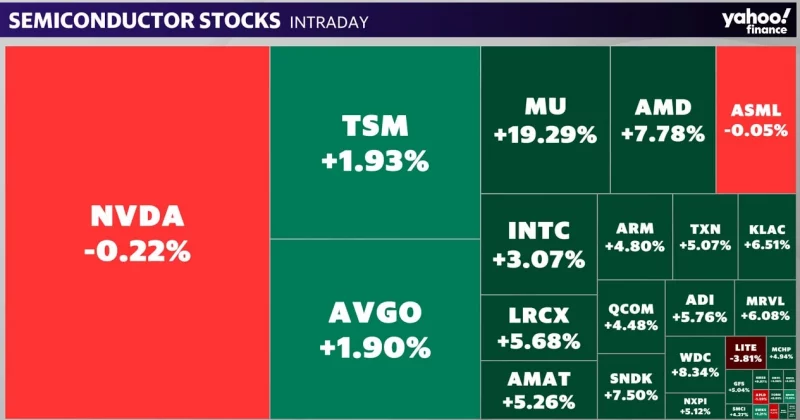
A view of a building where the facilities of US semiconductor giant Micron is located in Shanghai on May 22, 2023. US semiconductor giant Micron has failed a national security review, China's cybersecurity watchdog said on May 21, telling operators of "critical information infrastructure" to stop buying its products. (Photo by Hector RETAMAL / AFP) (Photo by HECTOR RETAMAL/AFP via Getty Images)AFP via Getty ImagesMicron’s surge past the trillion dollar mark is being powered by something far more durable than market euphoria. A global shortage of AI‑grade memory has pushed prices to record levels, tripled Micron’s revenue and locked in demand for its high bandwidth chips well into 2027 — setting up the next phase of the stock’s run.That backdrop helps explain why Boise, Idaho‑based Micron Technology crossed the $1 trillion valuation threshold on May 26 after doubling in just 48 days, according to the Wall Street Journal. The stock has risen fourteen times from a year ago, making Micron “the fastest company ever to scale the trillion‑dollar wall,” Reuters reported.I briefly owned Micron shares two decades ago after the company acquired Lexar Media — a flash memory supplier on whose advisory board I served — for $850 million, noted MarketWatch. I exited the position long before the company’s 2026 breakout, a reminder of how dramatically the memory market has been reshaped by AI demand.With Micron now trading at levels few expected even a year ago, investors are asking the same question I am asking myself: is it too late to buy the stock?Is It Too Late To Buy Micron Stock?I would say maybe not — at least for the next year. That’s because a UBS analyst tripled his price target to $1,625, implying 69% upside from here, CNBC reported. MORE FOR YOUUBS sees Micron is undervalued for two reasons. First, it could tap many long-term chip manufacturing contract opportunities with partially fixed pricing. Second, its low multiple relative to other chipmakers benefiting from AI capital spending is likely to increase, CNBC noted.What Micron Makes Micron makes commodity and AI-specialized memory chips. These include commodity products such as dynamic random-access memory and NAND flash. The company’s AI chips — called high bandwidth memory — are stacked DRAM cubes that sit beside Nvidia’s GPUs and feed them data at terabyte-per-second speeds. Micron began shipping them in February 2024. HBM is a large market opportunity that Micron is grabbing through partnerships with Nvidia and others. Specifically, the HBM market is growing at a 41% average annual rate from $35 billion in 2025 to $100 billion in 2o28. Through a partnership with Nvidia, Micron supplies its 12-high HBM3E stacks in Nvidia’s Blackwell B200 and B300 platforms as well as its Vera Rubin chips, which began in the first quarter of fiscal 2026, CNBC reported.Why Micron Stock Climbed So QuicklyStocks tend to rise after quarterly earnings reports if the company beats expectations and raises guidance.When Micron reported second-quarter fiscal 2026 results, its stock soared because the chipmaker grew much faster than analysts expected and raised its guidance. Micron’s second-quarter fiscal 2026 revenue almost tripled t0 $23.86 billion —about $3.8 billion ahead of consensus — while earnings per share of $12.20 were 39% more than analyst views, CNBC noted. Meanwhile, third-quarter guidance of $33.5 billion in revenue and EPS of $19.15 exceeded the London Stock Exchange Group consensus by 38% and 59%, respectively, CNBC reported.Underlying those results was a simple law of economics: demand exceeded supply by so much that Micron’s product prices soared. Specifically, in 2026 DRAM contract pricing could increase 355% and NAND prices could rise 510%, according to Mizuho analyst Vijay Rakesh.Memory chips are in high demand by makers of AI servers. AI servers require six times the amount of DRAM and twice the amount of solid-state drives compared with standard servers, Micron CEO Sanjay Mehrotra told investors at the company’s 2018 analyst day, The Register reported.Since late 2024, DRAM stockpiles have plummeted 79% — from 13 to 17 weeks in late 2024 to just two to four weeks in late 2025. Suppliers cut back on chip manufacturing capacity in 2023 and slashed capital expenditures just as demand from hyperscalers for AI servers ramped up.Why The Bull Case May PrevailMicron bulls are likely to outrun the bears at least until 2027 or 2028. After that, there is a risk that new memory chip manufacturing capacity could arrive just as industry demand is satisfied.For the rest of the year, Micron’s HBM production is contractually sold out at fixed prices, so investors will not need to worry about price drops for about four quarters. Meanwhile, Micron’s new manufacturing capacity in Idaho will not come online for about a year. If demand for memory chips remains strong then, Micron stock could keep rising. But if hyperscaler spending drops off in the second half of 2027 or in 2028, that new production capacity could collide with weak demand — giving Micron bears a reason to cheer. UBS thinks Micron’s valuation is too low compared with Nvidia’s. Estimates put Micron’s forward price-earnings ratio in a range between 7 and 15, while Nvidia’s is more than twice the midpoint of that range at 24.5.This is especially noteworthy since Nvidia’s latest earnings report featured 85% revenue growth while Micron’s nearly tripled.More upside may be ahead for Micron bulls at least until May 2027.
Micron Extends Its Trillion Dollar Run As AI Memory Demand Surges
Micron tops $1 trillion as AI memory shortages drive record pricing, soaring earnings and sold‑out HBM demand through 2027.
884 words~4 min read