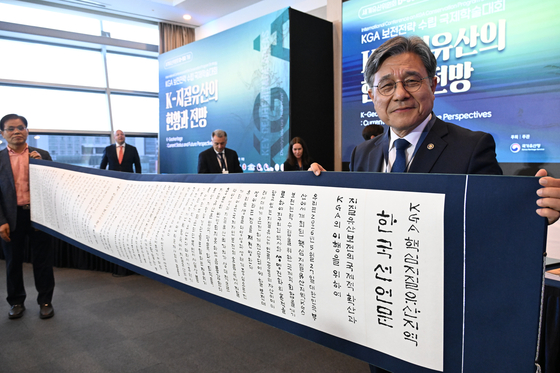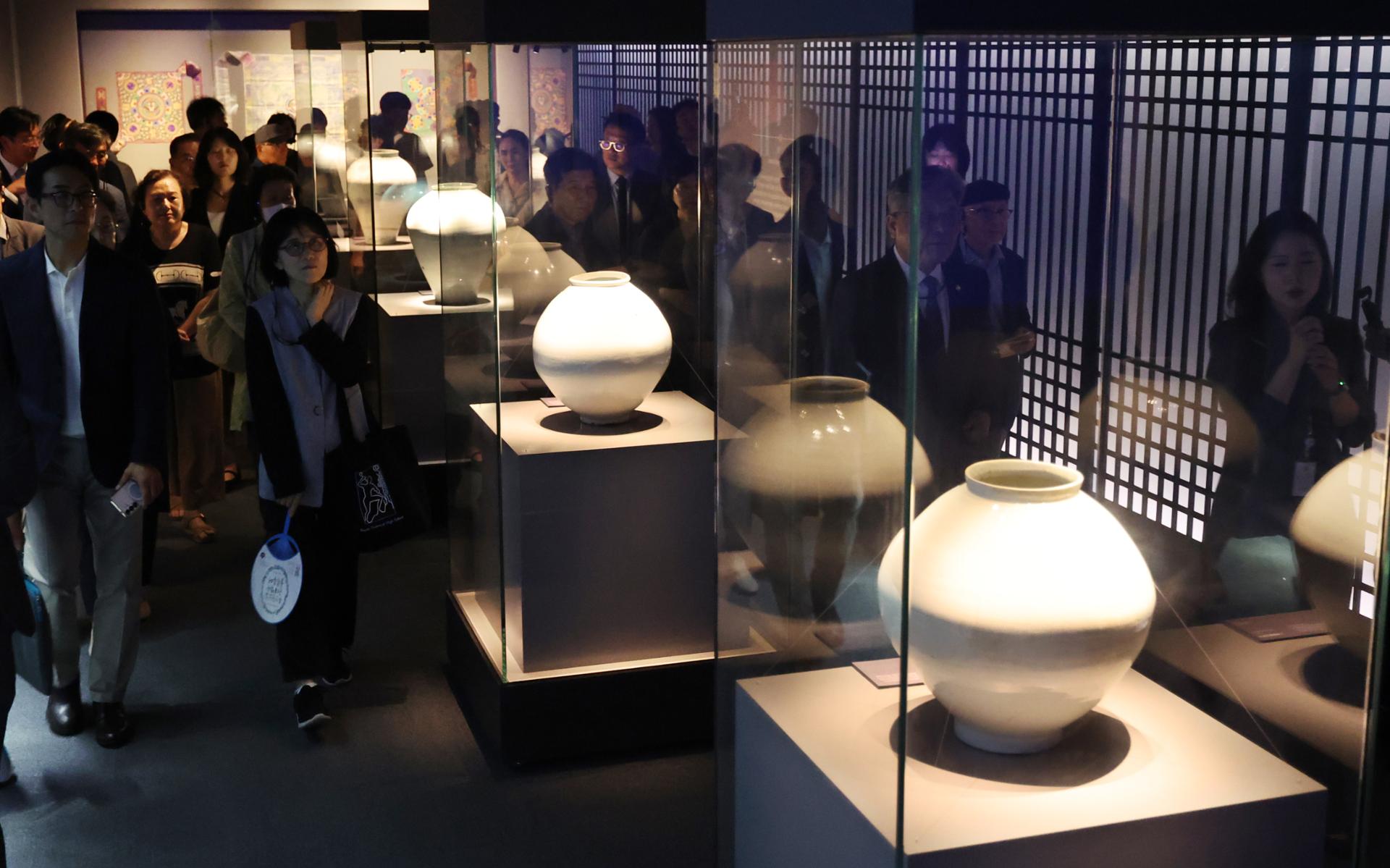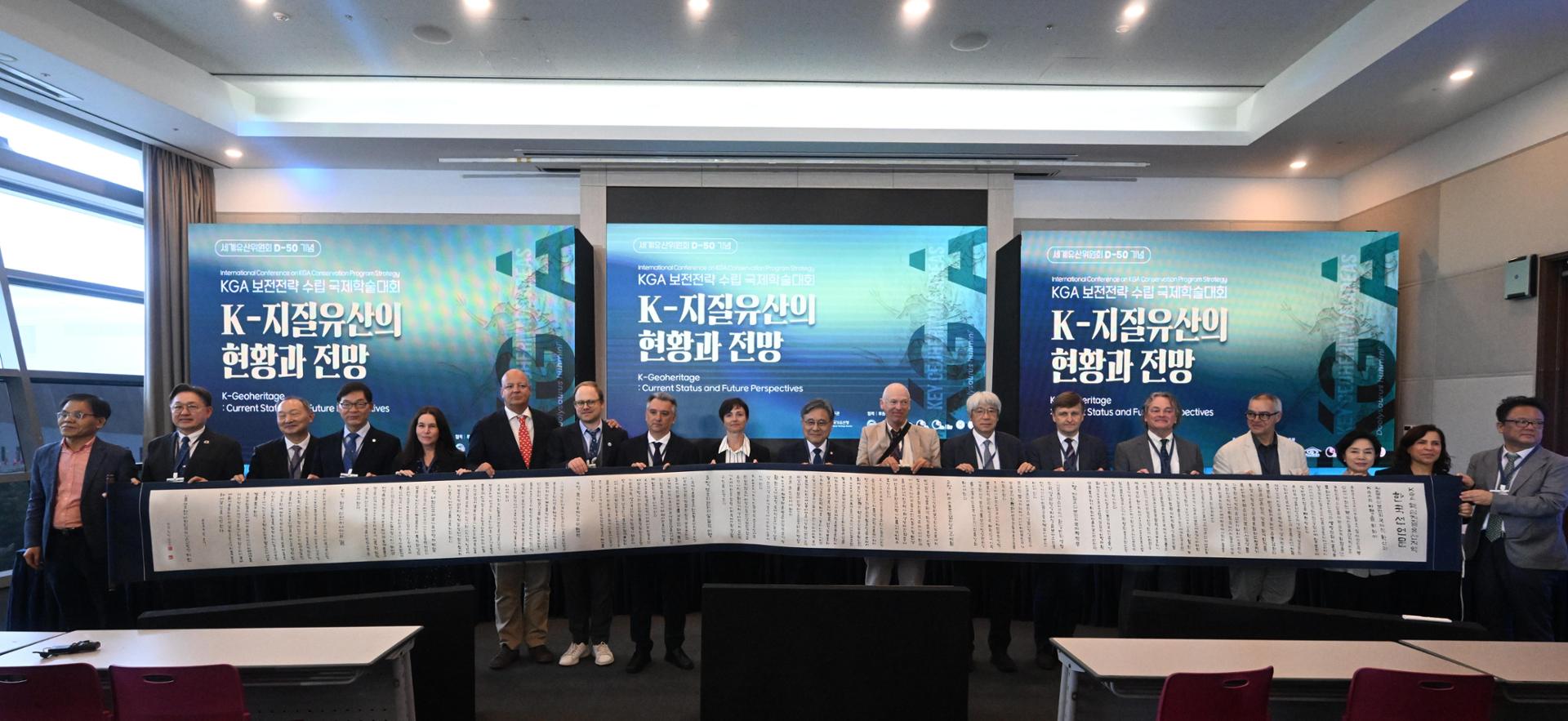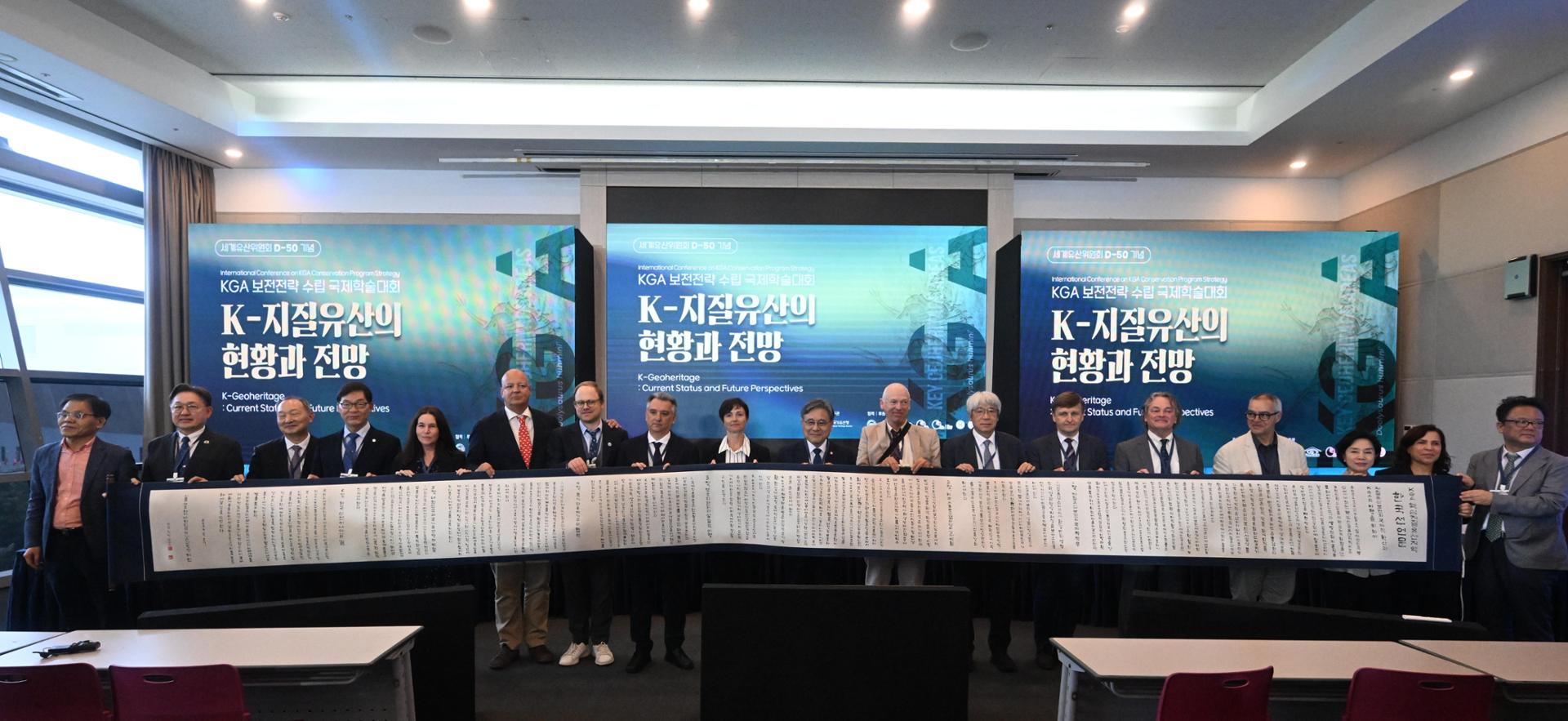
Global geological experts and Korea Heritage Service (KHS) Administrator Huh Min pose with the Key Geoheritage Areas Korea Declaration at the BEXCO convention center in Busan, Wednesday. Courtesy of KHSBUSAN — The Korea Heritage Service (KHS) announced on Wednesday plans to establish a "K-Heritage House" roughly twice the size of a soccer field at the upcoming UNESCO World Heritage Committee session in Busan in July. The initiative aims to use the committee session as a milestone event to firmly cement the global footprint of both K-heritage and K-culture."During the assembly, we will establish the K-Heritage House, covering about 13,254 square meters at BEXCO in Busan, to promote K-heritage and K-culture to the world," KHS chief Huh Min said during a briefing in Busan, Wednesday, 50 days before the session's opening."Through this World Heritage Committee session, we are anticipating three major effects: elevating our national standing, promoting the host city and boosting the local economy. The estimated economic impact is 137.2 billion won ($100 million)."President Lee Jae Myung was also briefed during his visit to Busan and echoed the importance of the event for promoting Korean culture and heritage. "No matter what anyone says, the driving force behind K-culture, which now leads global trends, is K-heritage," Lee said. "Korea must take the lead in fostering solidarity within the international community to fully protect the shared heritage of humankind amidst the climate crisis, geopolitical risks and the vortex of rapid development."The K-Heritage House will be the largest exhibition space dedicated to K-culture yet. It will feature 42 exhibition and experiential spaces, bringing together 33 entities, including six government ministries, 14 local governments and 13 private organizations.Earlier that day, KHS also held a symposium titled "K-Geoheritage: Current Status and Future Perspectives" on the systematic conservation of geological heritage sites and adopted the Key Geoheritage Areas (KGA) Korea Declaration.The academic forum featured 13 presentations from global scholars including Robbert Casier, World Heritage program development officer at the International Union for Conservation of Nature, ProGEO President Kevin Page and José Brilha, former president of ProGEO and UNESCO chair on geodiversity and geoconservation."We want to build a new framework for international cooperation so that protecting our geological heritage becomes a core focus of 21st-century nature conservation. This will help us seamlessly connect protection, management, research and education," said Huh in his welcoming remarks. "It is my sincere hope that global cooperation centered around KGAs (key geoheritage areas) will grow even stronger moving forward." KGAs refer to internationally significant geological elements, such as fossils, minerals and unique landforms, that are vital to understanding Earth’s history and life's evolution.Korea has two Natural World Heritage sites — Jeju Volcanic Island and Lava Tubes and Getbol, Korean Tidal Flats — and now aims to add dinosaur fossil sites along the country's southern coast. Driven by Korea's initiative, the conference marked the first international event dedicated to establishing global standards, conservation programs and a worldwide cooperation platform for KGAs. Robbert Casier, left, World Heritage programme development officer at the International Union for Conservation of Nature, and José Brilha, former president of ProGEO, speak during a press conference for "K-Geoheritage: Current Status and Future Perspectives” international symposium at BEXCO, Busan, Wednesday. Courtesy of Korea Heritage ServiceWhile nature conservation typically focuses on biodiversity and ecosystems, the protection of geological heritage sites is just as critical. Recognizing this, geologists worldwide are increasingly calling for active research to identify, preserve and utilize these irreplaceable global assets for their cultural and ecological worth."It is really an honor for Korea to chair this platform and this monumental global task. Only a handful of countries in Asia have chaired the World Heritage Committee so far, so I think it is incredibly special that Korea is now hosting," Casier said, highlighting Korea's role as the chair country hosting this year's UNESCO Committee session.Casier noted that the KHS has taken a definitive leading role, being the only government agency to fully back the KGA resolution during last year's World Conservation Congress. With 40 percent of countries lacking any Natural World Heritage sites, Casier emphasized that the KGA program will fill critical gaps."We're really thankful for the leadership of Korea in focusing on both the natural and cultural heritage aspects," Casier said.With the KGA Korea Declaration, the international community is moving a step closer to a standardized system to protect irreplaceable geological heritage with the same urgency and framework used to protect endangered wildlife. Through this declaration, participating governments and the KHS pledged to strengthen international standards for geological heritage conservation. "We need an international tool to recognize more sites of geological importance around the world," added Brilha, former ProGEO president. "In this event, Korea is proposing to take a leading role in this global initiative."During the 48th UNESCO World Heritage Committee session, Natural World Heritage sites are expected to be a major focus.
Korea to open massive 'K-Heritage House' at UNESCO session in Busan - The Korea Times
BUSAN — The Korea Heritage Service (KHS) announced on Wednesday plans to establish a "K-Heritage House" roughly twice the size of a soccer field at...
803 words~4 min read