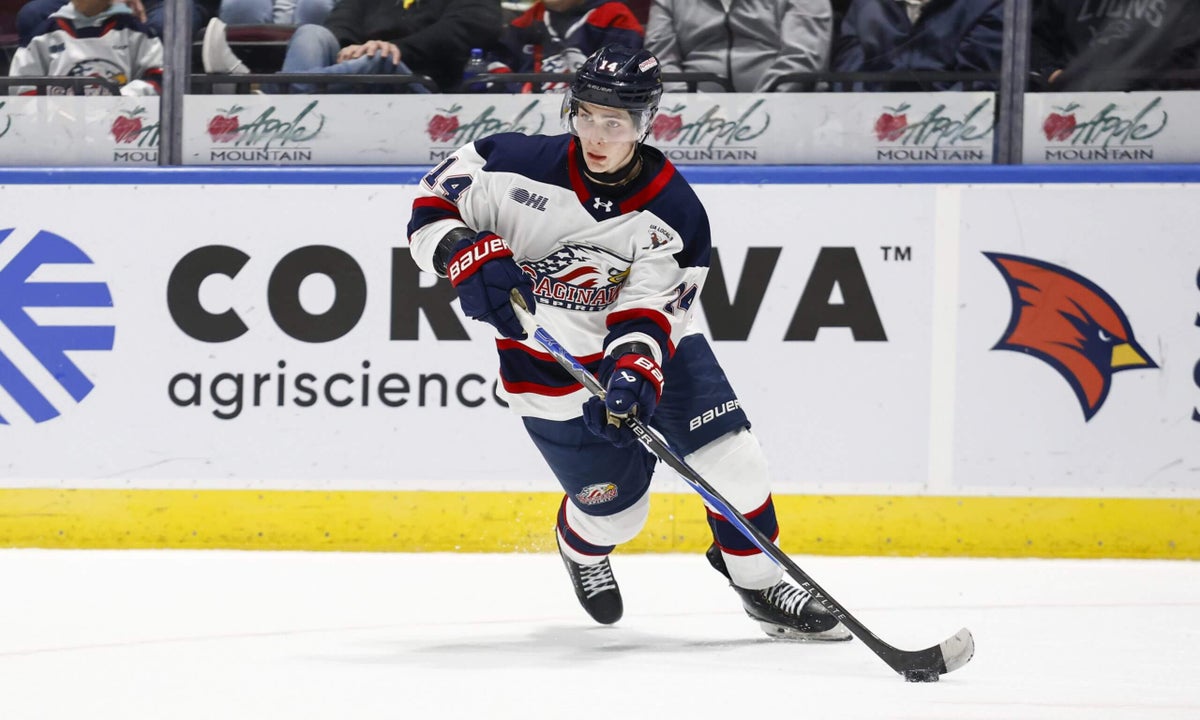
Each year, overage players — or re-entry players — account for roughly one round’s worth of picks at the NHL Draft.Here, I’ve ranked my top 20 overagers in getting a second or third crack at the draft in 2026. The list is made up of 2007- and 2006-born players. The first five names made my final 2026 NHL Draft ranking, which will be released next week. A few others were close and are worthy of strong consideration for the draft. And the rest are development camp invite types, or are players I’d at least keep a peripheral eye on.This list of overagers combines with my 30 honorable mentions (posting tomorrow) and my final top 100 to form my 2026 NHL Draft package for a total of 150 player reports this year.1. Egor Barabanov, C, 6-foot (Saginaw Spirit)Barabanov finished fourth in the OHL in scoring this year, registering 28 goals, 63 assists and 91 points in 68 games as the Spirit’s first-line center, often playing between Nikita Klepov (2026) and Dima Zhilkin (2027). He’s a heady, skilled and competitive player who was named the Western Conference’s second-smartest player and its No. 1 playmaker in the OHL Coaches Poll this year.A former Penn State commit who is now considering his options, Barabanov sees the ice at an advanced level, finding his way around the offensive zone in possession and then making plays from the outside in. He looks a bit awkward skating, and presents a little lanky, but he’s stronger than he looks and still gets around the ice quite well. And while I wouldn’t say competitiveness defines his game in the way it does Zhilkin’s, he’s willing to compete. His game is primarily about his good skill, his offensive know-how (in terms of spacing, timing, reads, anticipation) and his ability to break down coverage.2. Ethan MacKenzie, LHD, 6-foot-0.75 (Edmonton Oil Kings)Every year or two, there’s an undrafted player or two who plays their way into the mix for Canada at the World Juniors and then the draft. In Gothenburg, it was Owen Allard and starting goalie Mathis Rousseau. The year before that, it was Thomas Milic. Before them, there was famously Joe Hicketts. This year, MacKenzie’s excellent first half in the WHL (which included 10 goals, 31 points and a plus-22 rating in 30 games) played his way onto the team — his first Hockey Canada experience. He had injury troubles in his first two years in the WHL that held him back from showing what he could do, but he felt he had a good enough year last season to get drafted (32 points in 54 games). This year, his 58 points in 59 games put the question to bed. He told me he had a couple of talks with NHL teams last season, but said they never felt serious. This year has been different. And not only did he make Team Canada, but he rose from No. 7 to the top six, even playing some PP2 for them at times.A North Dakota commit for next year, his skating is high-end and will carry him. He can break up plays with his stick, seems to see the ice well, moves and carries pucks effectively and has a good shot and a strong build. He has a chance to be a two-way depth skating defenseman.3. Tomas Galvas, LHD, 5-foot-10 (Bili Tygri Liberec)Galvas, despite being a small and slight D, was one of the only players on my board all the way back in his first year of eligibility in 2024 who didn’t get picked. He skates effortlessly and played the last three seasons at Czechia’s pro level to positive two-way results and steady growth in production. He has excelled internationally at U18s and three World Juniors, playing big minutes (he also just played at men’s worlds). He was absolutely tremendous at this year’s tournament and had a very good year professionally in his third and final crack at getting picked.At his best, he can be everywhere with his skating and is often deep in the offensive zone, but rarely caught out of position back the other way because he swings back to the point so quickly. He can control play. He thinks it. He competes for his size. And the mobility is elite. He’s a natural handler who blends good touch with his four-way mobility to rotate around coverage, shape play crossing over and maneuvering across the blue line, or carry pucks past the first layer of pressure. I like the way he jumps in and out of coverage while still recognizing where his responsibilities are and when he needs to hop back out to the blue line. I like the way he jumps on pucks and gets them out of danger so that he can spend less time defending. He makes little plays under pressure to seamlessly outlet pucks from his own zone, uses his feet to annoy opposing carriers as much as a player his size can, and thinks the game at an advanced level all over the ice to limit some of his physical deficiencies. He works to help compensate for his size (alongside his superb mobility). He has good posture and looks taller on the ice than he is. He’ll try to push and involve himself when he can. He handles the puck smartly and excels in particular at skating backwards, which gives hope that he’ll continue to be able to defend up levels. There aren’t many defensemen his size in the NHL, so there’s always inherent risk there, but he has defended well at the pro level already and with some more strength and reps, there could be something there. He should be a good AHLer at minimum, and I’d strongly consider a mid-to-late-rounder on him again.4. Niko Tournas, RW, 6-foot-2 (Moncton Wildcats)Tournas, 20, is a late-blooming double overager who led the NAHL in scoring last year and then made the jump to the Q this year. He was one of Moncton’s best forwards for much of the year, too, and finished his rookie season with 49 goals and 92 points in 85 combined regular-season and playoff games, leading the Wildcats in goals. Despite his age, he’s still raw. By all accounts, he’s dedicated to getting better and has the tools, including a hard NHL shot and good size. He didn’t penalty kill for the Wildcats this year, but he played nearly four minutes per game on the power play and scored goals in a lot of different ways (off the flank, rebounds, dekes, catch-and-release, bad angles, backdoor, tips, jam plays, drives). He’s moving on to the University of New Hampshire next season and is expected to get drafted. He has to improve his pace and reads/decision-making, but there’s an interesting skill-shot-size combination there, and he clearly still has runway despite his age.5. Michal Orsulak, G, 6-foot-4.25 (Prince Albert Raiders)Orsulak is an overager in this class, but only by three weeks. He’s a big, heavy goalie who made the jump from Czechia’s junior level to the WHL this year and won the starting job for a Prince Albert Raiders team that he backstopped to the WHL final. He has also been a consistent member of Czechia’s 2007 age group internationally; he started at last year’s World Juniors and is eligible to return for the tournament in Edmonton this December.I watched him play some games, particularly early in the year, where he stole wins for the Raiders and was the best player on the ice. He has some real power to his pushes and can make difficult stretch saves. He seals his posts and the bottom third of the net effectively. He plays a confident, challenging style. But I’ve also seen him falter or give up soft goals and look smaller than he should in the net. His highs and his size/tools have made him NHL Central Scouting’s No. 2-ranked North American goalie after he started the year with a “C” rating for them (which “indicates a 4th/5th round candidate”).6. Liam Lefebvre, C, 6-foot-2.75 (Chicoutimi Saguenéens)A member of the QMJHL champs and a Vermont commit, Lefebvre made the jump from the U.S. prep circuit to the Q this year as an 18-year-old (he turned 19 on May 15) and registered 37 goals and 71 points in 79 combined regular-season and playoff games. He also finished strong at the Memorial Cup, including the overtime winner in a two-goal performance to beat the Rockets. He’s a big, heavyset center (though he split time between the middle and the wing this year) who can shoot it and finish around the net. He has some one-on-one skill and a varied NHL shot (one-timer, catch-and-release, natural wrister). Despite being an overager, his game is still quite raw and has some development to do in terms of reads, pace and playmaking. He also still has some work to do on his fitness level. He’s relevant, though, and I considered ranking him in my top 100.
Ranking 2026 NHL Draft’s top 20 overagers: Egor Barabanov leads this year’s re-entry prospects
Each year, overage players — or re-entry players — account for roughly one round's worth of picks at the NHL Draft.
4,210 words~19 min read