SynopsisThe AI industry is rapidly shifting from conversational chatbots to autonomous “Agentic AI” systems capable of independently executing complex tasks across workflows and applications. Companies including OpenAI, Microsoft, Google, and Salesforce are leading investments in AI agents designed to automate research, customer support, scheduling, and enterprise operations. The shift is expected to redefine productivity, workplace automation, and how businesses interact with software globally.ET OnlineFor a long time, using AI felt like talking to a very smart, very literal librarian. You’d ask a question, and it would give you an answer. If you wanted the AI to actually do something like book a trip, organise a project, or fix a technical error, you had to guide it through every single step.Unlike earlier AI tools that relied on constant human prompts, AI agents are designed to plan, coordinate, and complete multi-step actions with minimal supervision. The shift is now driving aggressive investments across the global technology industry, with companies including OpenAI, Microsoft, Google, Salesforce, and Amazon positioning AI agents as the next major computing layer.The transition signals a broader evolution in how AI is being deployed across enterprises and consumer platforms. While the first wave of generative AI focused on answering queries and generating content, the next phase is increasingly centred around execution.OpenAI has accelerated industry attention through tools such as Operator and Deep Research. Operator is designed to independently browse websites, complete online forms, make reservations, and execute browser-based tasks on behalf of users, while Deep Research automates large-scale information gathering and structured analysis.Enterprise adoption is also gaining momentum. Salesforce recently expanded its AI strategy through Agentforce, a platform enabling businesses to deploy autonomous customer service agents capable of handling billing disputes, updating records, processing requests, and escalating only high-complexity cases to human teams.Microsoft is embedding similar capabilities into its Copilot ecosystem across Teams, Outlook, Word, and Excel. The company’s AI systems can now generate meeting summaries, manage workflows, analyse spreadsheets, and automate repetitive workplace tasks.Google, through Gemini and Project Mariner, is also developing AI systems capable of interacting directly with browsers and digital tools to complete multi-step actions autonomously.Industry analysts view the emergence of Agentic AI as a significant operational shift, particularly for sectors dependent on repetitive digital workflows, including customer service, IT operations, business process management, and enterprise administration.For India, the development could carry significant implications. With large-scale exposure to IT services, outsourcing, and workflow-driven enterprise operations, Indian startups and technology firms are increasingly building AI agents for finance, healthcare administration, recruitment, legal documentation, and vernacular customer support.The broader industry consensus suggests the AI race is no longer limited to building smarter chatbots. It is increasingly focused on building autonomous systems capable of functioning as digital co-workers across enterprise and consumer ecosystems.Nominate for ET Most Innovative AI Product 2026Disclaimer Statement: This content is authored by a 3rd party. The views expressed here are that of the respective authors/ entities and do not represent the views of Economic Times (ET). ET does not guarantee, vouch for or endorse any of its contents nor is responsible for them in any manner whatsoever. Please take all steps necessary to ascertain that any information and content provided is correct, updated, and verified. ET hereby disclaims any and all warranties, express or implied, relating to the report and any content therein.Read More News onRead More News on
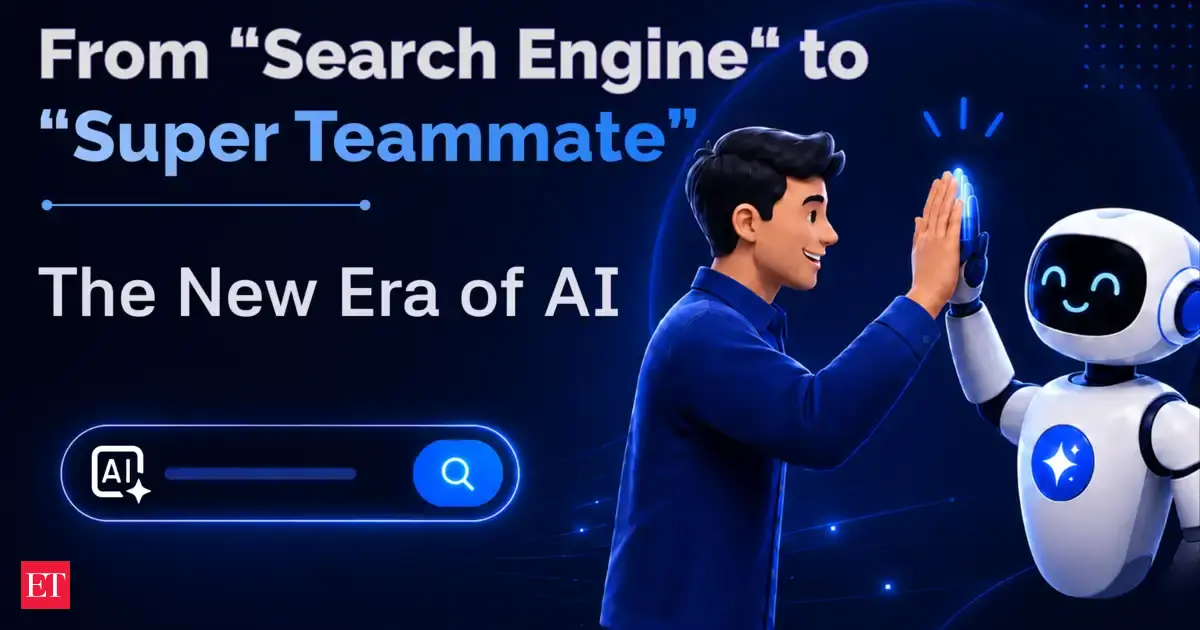
From Search Engines to Autonomous Agents: AI industry enters its next phase
The AI industry is rapidly shifting from conversational chatbots to autonomous “Agentic AI” systems capable of independently executing complex tasks across workflows and applications. Companies including OpenAI, Microsoft, Google, and Salesforce are leading investments in AI agents designed to automate research, customer support, scheduling, and enterprise operations. The shift is expected to redefine productivity, workplace automation, and how businesses interact with software globally.
553 words~3 min read