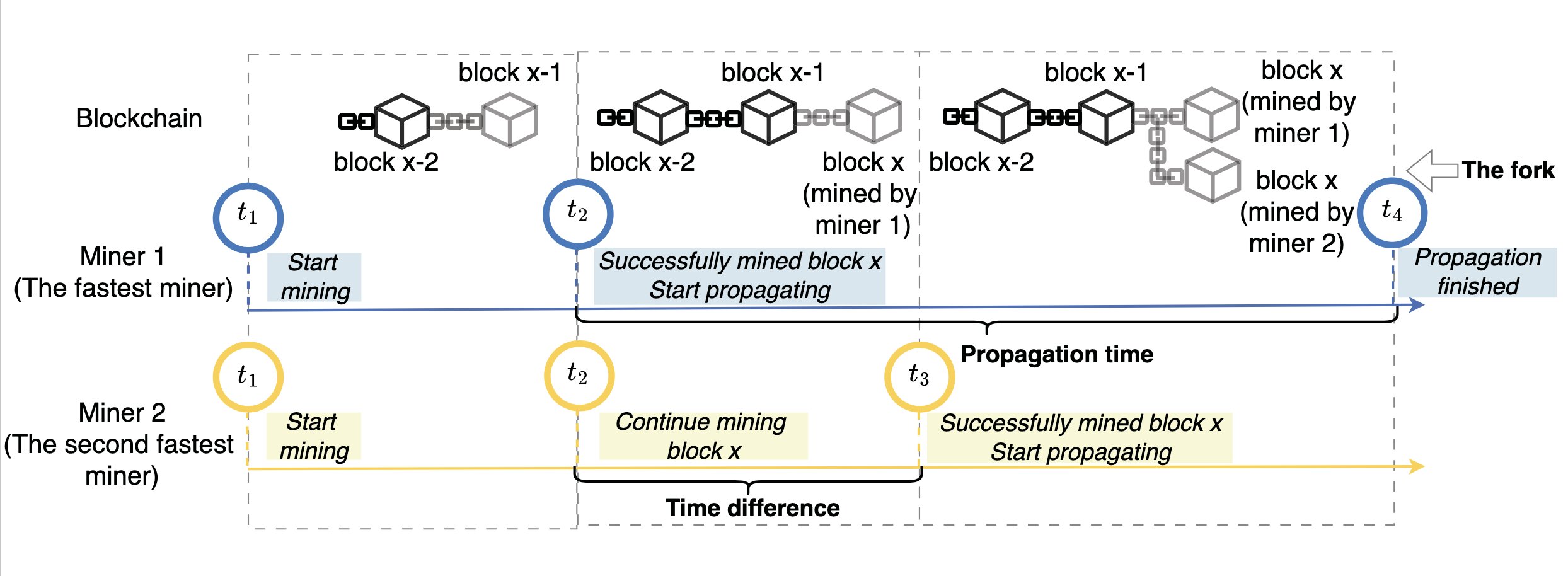
Fork generation. To simplify the dynamics for the models, the authors assume that all miners start mining at t1. At t2, Miner 1 solves the proof-of-work puzzle for block x and starts broadcasting it to the network. By t4, the message has spread to most of the nodes and a new block x + 1 is likely to be appended to block x. However, Miner 2 successfully mines the block at t3, which is later than t2 and earlier than t4. Therefore, based on the definition above, the propagation time is t4 − t2, and the fork is present between time t3 and t4. Credit: Barucca et al.
Creating new cryptocurrency requires large amounts of computing power, which is used to solve cryptographic puzzles in what is known as proof-of-work mining. When two computers attempt to solve the same puzzle, the first to find the solution creates a new block and claims the right to create a predetermined amount of new coins, while the losers get nothing.
Publishing in PNAS Nexus, Paolo Barucca and colleagues show that this system favors miners who have expensive specialized hardware which can outperform off-the-shelf computers, leading to a consolidation of power in the industry. Today, just three mining pools produce over 50% of new Bitcoin blocks.