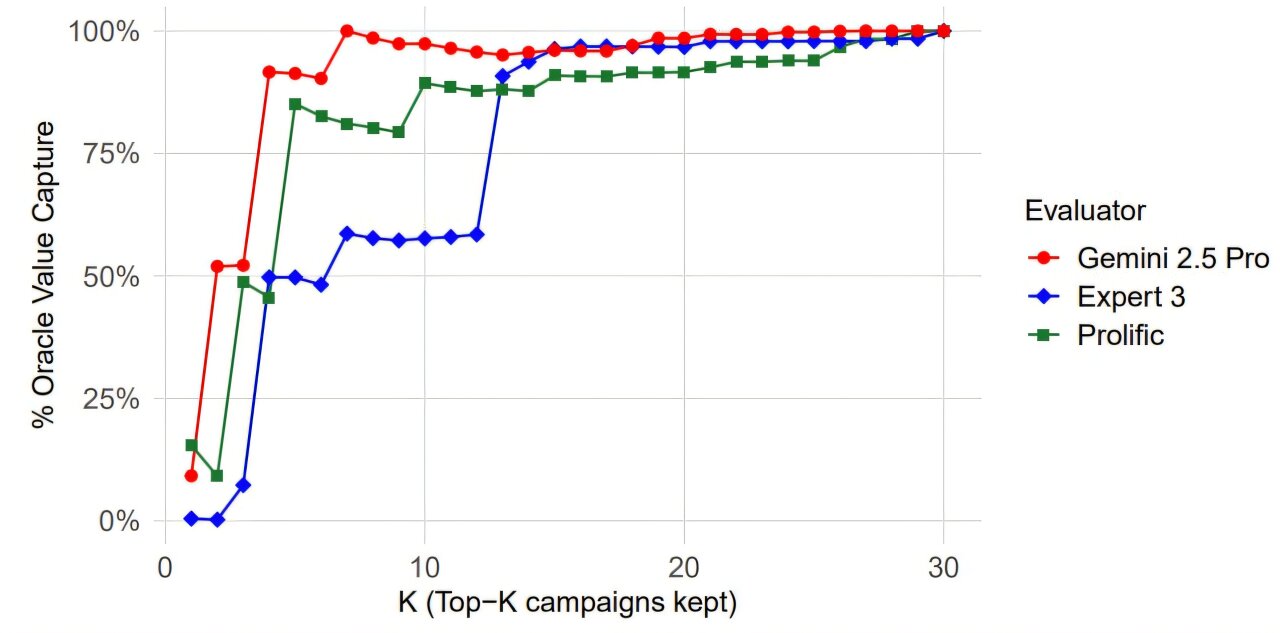
Cumulative percentage of total funds captured as portfolio size (K) increases from 1 to 30. Credit: arXiv (2026). DOI: 10.48550/arxiv.2602.01684
For decades, the idea that artificial intelligence can beat humans at number-crunching tasks like high-frequency trading has been widely accepted. But strategic foresight—the ability to predict the success of high-stakes, uncertain business ventures—has long been held as a uniquely human superpower.
A study co-authored by a University of Michigan business expert suggests artificial intelligence is beginning to surpass human prediction capabilities in the context of predicting the success of new ventures.
"Strategy felt so different from algorithmic trading," said Felipe Csaszar, a professor of strategy at U-M's Ross School of Business. "It was, in a sense, obvious that algorithmic trading was doable, because it was all about numbers. But strategy is all about words."
The findings, posted to the arXiv preprint server, could mean businesses no longer need to compete on once rare, specialized strategic forecasting skills, but how they integrate AI-generated predictions.